Saturday, December 2, 2023

Best friend, office assistant, warm encourager's death blackens 72nd birthday ... Even though our chair feels empty, Champ's forever there for me

 “You are my best friend,” I said, fighting to keep my voice from shattering as my writing partner looked at me, a moment before his heart stopped.

It was about 12:30 a.m. on November 18, 2023 … a half-hour into my 72nd birthday, one that will never be remembered for candles and cake but rather always carry heartache and hints of hurt … until my own journey into the blackness into which my best friend would embark.


“You’ve always been a good boy,” I said, stroking Champ’s head. “Beautiful boy. You’ve been my best friend for a long time now.”

Even though blindness had accompanied his downward spiral in recent months, accelerating as autumn chill had settled in outside the French door where he would let slanting sun warm his frail body, the light disappeared from his eyes quickly as his heart stopped on what will forever be my most somber birthday.


My wife -- who never minded that I referred to my office assistant as “my best friend” every night before he settled down on my chest … or simply when he vaulted into my lap here in my office, as I began my daily quest for words to string together -- stroked his back and told him “We love you, Champ. You’re a good boy.’’ If she was trying to hold it together for my sake, she failed. “You’re such a good boy, Champ.”

Champ had always sought out Suzanne when he needed comforting, whether in a thunderstorm, when neighborhood scalawags celebrated July 4 or the New Year with bottle rockets or when workmen cursed and slung hammers against nails during various renovation projects.  Champ had lived through many of those in our home, a 1956-model brick rancher in Nashville’s Crieve Hall neighborhood.  Other than his annual physical or the occasional visit to the heart specialist to monitor an eventually mortal defect, he’d never been anywhere else.

In the hours before his death, he laid, gasping, on Suzanne’s outstretched legs and lap. He would try to purr. But then he’d cry, a soft, cat whimper. It was time, we knew. All three of us. We wanted that journey to begin and end at home. But that bad heart, his long-ago forecast fatal flaw, struggled to keep him going, faintly, in fits and stops, as fluids filled his lungs. He was struggling, even as he spread his love.  

Champ had been with us almost 12 years, after I picked him out of a Nashville Humane Society cage.

Everyone else in the cat room that winter’s day was playing with and adopting kittens.  It was the full-grown fellow, at least 2 years old, that I pulled from his cage.  He was happy about that. Me, too. I had called the Humane Society to see if any of their population already had been declawed. I didn’t want to do that to a cat, but if the deed had been done, I wanted him in my house rather than with someone else, who might let him wander, defenseless, as so many cats do. Too many coyotes and vermin around the woods behind my home.

“We’ve got one older cat here who’s been declawed,” I was told. “His name’s Mike.”

I asked for them to put a “hold” sign on his cage while we trekked the 20 minutes from what was to become Champ’s lifelong domain.

On that long-ago December 29, my daughter Emily, and my son, Joe, sat with Suzanne in the glass room where you “try out” cats. They’d all been looking at kittens, while they waited for me. Their eyes sparkled when I entered the room with the tabby in my arms’ crotches.

“This is the one I was telling you about. His name’s Mike, but that’s no name for a cat,” I said, handing the handsome eight-pounder to Suzanne.

The beautiful cat began campaigning for adoption, wandering around the little room, spreading purrs and rubbing against legs. He didn’t know the decision had been made as soon as I made that phone call, less than a half-hour before I lifted him from the cage and he purred, contentedly.

It was the birthday of my late mother, a cat-and-dog lover named Dorothy Champ Ghianni. Suzanne suggested we call him “Champ.”

It fit. I didn’t know at the time that he would become my office assistant as I wrote my yarns, mostly melancholy ones. My name’s Timothy Champ Ghianni. Jocko, or maybe it was Nardholm or Carpy… maybe even Uncle Moose … dubbed me “Champo” in college. Those from Hanson House who survive continue to call me Champo.  It’s been a life full of nicknames. There remain a few who call me “Flapjacks,” a name I earned during caffeine and nicotine-fueled newspaper deadlines, back in my favorite professional days. That’s another story. There’s a book about those days if you are interested.

When we got the former Mike to our house almost 12 years ago, Champ immediately strutted, calmly through his home, the place where he’d reign. He found the litterbox in the utility room and his food and water dishes at the kitchen’s edge.  

He was sweet and happy, immediately.  Suzanne took him to the vet in the next day or so, and the doc was concerned. He sent Suzanne and Champ to the specialist who detected the major flaw in the cat’s heart. “He’ll only live six more years, at the most. If he’s lucky.”

We were the lucky ones, as he spread love and devotion in our house for 12 more years.   

Quickly, Champ learned how to chase the melancholy from my soul – admittedly it sometimes ends up in my dispatches as I continue a life of chasing away the black dogs of depression – just by his presence.

My newspaper life ended in 2007.  That’s another story, and it can also be found in that book I referenced earlier.  It’s a story about personal ethics versus corporate tyranny. And it doesn’t have a happy ending. The scars exist still, and Champ, when he joined us, helped me cope with that still, long-lingering pain.

That’s all beside the point of this little tale, other than to note that on December 29, 2011, when Champ first moved into what became his house, the beautiful cat learned that a great place to spend the days was in my lap as I sat before my computer. Soothing any sourness in my soul as I composed news and feature pieces, class lessons, blogs and authored five books.

His calming attitude worked well, as I typed my way through a jumbled career that included freelance work (sometimes for free if I thought it might help my friends in music or the arts…. My heart and personal loyalty long has outpaced any push for riches, which is fortunate.)

 I also wrote for a major news service for a decade, a job I lost in the heart of COVID and when Reuters began trimming its part-time freelance staffers.  An every-other-week, slice-of-life-and-news, people-focused column I had written for a decade for Nashville Ledger similarly died of COVID cutbacks. Champ also sat on my lap as I worked hard to prepare writing and stylebook lessons and quizzes for my journalism labs at a local university.  When all those long-running jobs died at about the same time, ending consistent income, Champ sat in my lap and purred. Sudden loss of even minimal income wasn’t important to him. Or to me, thanks to Champ. 

Life cannot be bad when you’ve got a cat who loves you unconditionally in your lap and a great family around you.

Champ was with me from about 8 a.m. to 5 p.m. daily, seven-days-a-week while I wrote my latest book, Pilgrims, Pickers and Honky-Tonk Heroes.   He was there when I called friends like Duane Eddy, Kris Kristofferson or my dear pal Bobby Bare to talk about what I was writing.

He was with me when my best human Nashville friend, Peter Cooper, who was editing the book for me and who wrote the foreword, spoke to me about what I’d written during that year of typing and remembering. “Change nothing,” he’d say as he concluded each chapter, suggesting only minor grammatical or punctuation changes. “It’s beautiful. It’s written only as you could write it, Timmay.” (That was another nickname I earned, one used only by Peter. I also had been dubbed “The Dirt Man” or simply “Dirt” by my friend, my long-ago Tennessean entertainment staff gossip columnist Brad Schmitt, who continues at the paper, where he provides good-news and tasty filet/buttered biscuits tales…. Back in high school a bloodthirsty football coach dubbed me “Brahma Bull,” but that tale is long, painful and is in another of my books. My head still hurts, though.)

In 2019, when my Dad succumbed to his World War II-age and corresponding maladies, I would spend quiet time, mourning, with Champ on my lap. Dad used to watch Champ when we went on our seldom vacations, and I think Champ likely knew his “Grandpa” was gone.

Champ climbed in my lap each day last December when I’d get back from the hospital where Peter Cooper lay dying after damaging his brain in a hard fall a year ago Friday, December 1. He died five days later, and I miss him and our almost-daily phone conversations. 

My office assistant’s soft purring helped me survive those blackest days.  I cried, while Champ nudged his face against my own, calming if not fully chasing away the tears of heartbreak over a beloved friend’s too-young exit. Champ’s purr and his gentle head nudges were his way of saying “I love you. Everything’s OK.”

 I wish Champ’d been able to calm me the other night, early on my 72nd birthday, as I wiped the tears and petted his still body.

“He’s still beautiful,” Suzanne said, as she battled her own heartache. Her lap of solace for Champ would forever be empty now.

A major reason for our own love story, dating back into the 1980s, was Suzanne’s love of animals matched my own. To many, pets are for entertainment, accompanists to neighborhood struts. And that’s fine. As long as they are loved.

To others of us, they really are family members. There is incredible weight in this attitude, as we know they will only be with us an abbreviated amount of time.

Of course, Suzanne really is my best-best friend, she is a former lifelong journalist who loves animals. Fact is, our only real difference is that she turns to Matthew, Mark, Luke and John; while I find my solace in John, Paul, George and Ringo.

My mother -- or maybe it was James Thurber, James Herriot or cat-lovers Ernest Hemingway or John Lennon -- said long ago that the greatest gift pets give us is they prepare us for death. If we can say goodbye and not totally break when a pet dies, then perhaps we’ll be able to handle the deaths of parents, grandparents, best friends, work colleagues and Beatles.

True enough. But then, what prepares us for the death of our pets? One who is a best friend? I know the writing rules call for pets to be “its” and “thats” and only humans dubbed “whos,” but that’s heartless and complete bull shit.

Every year, near but never on my birthday, I write a column or a blog. I write it for me, soothing or cleansing my brain... It’s sort of a State of the Union, or a State of Old Timothy Address, a rundown of my thoughts. Generally melancholy, as I am, I run through what I’m thinking, what I’ve accomplished and how I’ve failed in the previous year … and then reflect back on the now 72 years since I was born in Saint Joseph Hospital, a dandy Catholic joint, in Pontiac, Michigan.

I often don’t publish it. It’s just for me, a way of busting through the cobwebs of death, disappointment and defeat that have been spun during the previous year/years. Oh, I do celebrate the triumphs, too, like the success of getting a major book publisher to take on my recent book about the Pilgrims, Pickers and Honky-Tonk Heroes I had befriended.

I never published last year’s for example. It began with a litany of bad things that had accompanied my year and the good things, like my grandson (I now have a granddaughter, as well), my children’s successes and my spiritual bond with Peter. Before I could post it, Peter fell, hit his head and died. I rewrote that year-in-the-rearview meanderings to reflect that loss – but I never published that 2022 State of Timothy Address. Too damn sad. I did write and post a separate piece about Peter, as I thought it might help the many others who mourned him.  And writing always has been my own salvation.

Last I looked, the 2022 State of Timothy Address was about 15,000 words, as long as a novella. Perhaps if I ever do a collected works, weird scenes inside the goldmine that is Champo/Flapjacks/Timmay/the Dirt Man and Brahma Bull, I’ll include it. I’ll give you a hint: Nobody wins.

I read through that unpublished 71st birthday declaration again as I was thinking about Champ’s death on my 72nd birthday. There are several mentions in that one of that wonderful cat and how he helped me cope.

For example, near the end, I say:

Now, I am fortunate. I have a nice, little house in a prime Nashville neighborhood. I have been married 30-plus years to my best friend. And I have two kids and a grandson.  

And a cat, who helps me write this stuff. 

Again, that was just over a year ago, on my 71st birthday.

That cat isn’t around to help me on this one. He died and there was no cake. Just tears.

One thing Champ had to endure over the years was my love of music. For years now, I’ve been pedaling my recumbent stationary bike daily for miles to nowhere in my basement. That bike sits right next to my office door.

Sometime, usually in the mid-afternoon, I put on my favorite music – The Beatles, Rolling Stones, Tom Petty, The Traveling Wilburys, Bare, Kristofferson, Dylan, Cooper, Brace, Jutz, Byrd and death-era Cash.

At least 60 percent of the time, it’s The Beatles, as a group or separately.

And I begin the daily toil designed to keep my own heart healthy. I pump ‘til I sweat, climb off to arrive where I began.

Champ, who always claimed my office chair as his own as soon as I ducked out from beneath him, would just sit in the chair – he frequently spent his nights there in recent weeks, I guess because it was comfortable, smelled like me and he could find it in the darkness that had become his worldview.

He’d watch through the office door as I pedaled. Or at least look toward the sound.

Last week, in the days toward his decline, Champ heard an awful lot of Beatles. For some reason, I’ve been exploring the outtakes from John Lennon’s Imagine album package of a few years back, seeking answers or just smiles. Champ always seemed to like John’s voice.  I’m sure he was particularly fond of John’s description of life’s peasants in “Working Class Hero.”

 If I was playing The Stones, for example, he might get down and wander upstairs and jump in Suzanne’s lap to avoid the Crossfire Hurricane.  Jumpin’ Jack Flash may be a gas, gas, gas; but it’s difficult on feline ears.

Lennon, whose voice soothes me as well as provides heartache because of the fact he died more than 40 years ago when he could still be making music, seemed to be a favorite of Champ’s.

Course I don’t know that. I just know Champ sat quietly in my office chair as John sang by himself or with his Scouse cronies on my old stereo.

I’m not sure what was the last song my beloved office assistant heard. It could have been “Imagine,” “Crippled Inside” or a long piano solo from those Imagine outtakes, that to me are better than the finished album.

Thinking back to that day, as I write this, though, I’ll wager it likely was a “new” song – The Beatles’ hit record “Now and Then” – that I’ve been playing several times a day that Champ last heard.     

It’s John Lennon’s voice from the grave, an old cassette demo that was brought back to life by Paul McCartney, Ringo and Giles Martin.  A dead George Harrison plays guitar and harmonizes.

Some say, and I am among them, that the cassette left behind by John was a sort of love letter to his life’s best friend, his truest companion on the road through life, Paul. The two boys from middle-class Liverpool changed the world, with the help of a couple other Scousers. Some are dead and some are living.

Truly, the last music my beloved Champ likely heard included John’s purified voice singing: “Now and then, I miss you.”

It’s very true that Champ helped me write stuff all of these years.  Often, I wrote through too many disappointments, deaths and betrayals. Champ calmed me with his purr or head nudge, triggering emotional rescue. Then, and I’m thankful, my words would smile.

Accomplishments, like having a book published that was praised by Kris, Peter, Bare and more, also were put into perspective by his steady support and encouragement. Keith Richards got a copy of the book in trade for loaning me a couple of photos published inside, and I hope, even though it’s not only rock ‘n’ roll, that he liked it.

Sitting here in Champ’s office chair, thinking of the huge hole in my heart and the shock-induced nausea and diarrhea as his death exacted a physical toll on Champ’s favorite writer and best friend, he’s still here with me in spirit.

My lap is empty, and it’s colder down in the basement without Champ.

I keep looking at the chair when I come down to the office.

Champ: Now and then, I want you to be there for me.

Only in memories and warmth in my soul.


Saturday, June 24, 2023

The death of a newspaperman; Jim Monday was a big man with a big heart who leaves massive void as he promises he's leading the way to heaven


Then Big Jim Monday died. Quietly and with little notice for a man who touched so many lives. Including mine. In a very large and spiritual fashion.

Since cutting back on my blogs to focus on my book that was published recently, I haven't written many "They Call Me Flapjacks" pieces for awhile. Unless it involved the death of a newspaperman. In the last few months, I've written tear-drenched salutes to dead guys who happened to work with me during the half-century I've worked as a journalist.

Peter Cooper (who left journalism for guitars and museum display) died in December. Since he didn't spend his life in newspapers (though I hired him), perhaps I shouldn't refer to him as a newspaperman. He did a damn good job as my entertainment staff chief music writer, though. Better job, still, as my friend and biggest fan.

But Charlie Appleton sure was a newspaperman, throughout his life, and he died in February. He was kind of like a big brother to me, my shotgun passenger in the daily news wars. A kind and profoundly talented newspaperman, Mike McGehee died in January. He and I worked together and smoked cigarettes every predawn that we served as Nashville Banner editors. And I still miss Max Moss, my newspaper mentor, who died in 2021. He'll be with me every day, especially when I smile at the pica pole in my desk drawer.


Max Moss, left, and Jim Monday discuss front-page philosophy. This picture would have been taken sometime in the early 1980s. Max was managing editor, Jim copy desk chief, at The Leaf-Chronicle newspaper in Clarksville. I would guess this photo was taken by W.J. Souza, if he still was alive during that period.

All were men I loved, and I still miss them and especially their voices, as I sit alone here in my basement office with the four clocks counting down life -- in Nashville, Bucharest, New York and Los Angeles time -- on one wall, a portrait of John Lennon on another and the wooden hand-carved angel that Tom T. Hall gave me, from him and his late-wife, Dixie, looking up at me. She wears Mardi Gras beads and a Beatles COVID mask I've given her.

"Dixie sure loved you," said Tom T, as he autographed it for both of them. I didn't realize it until months later that Tom T. was giving away stuff to people he thought might like it, who might collect memories, because he planned to end his life. Peter got a bunch of stuff from Tom T. He didn't live long enough to use most of it. I think guitar virtuoso Thomm Jutz and great harmonizer Eric Brace, two of Tom T's friends, do have stuff they have lived long enough to use.

A hand-carved wooden Chet Atkins nameplate -- he carved it and his widow gave it to me to remember him -- is on the shelf next to a copy of my book, Pilgrims, Pickers and Honky-Tonk Heroes. Chet's kindness to me fills up a chapter about him in this book that you should buy, and he reappears in other spots. There's a John Lennon "Give Peace A Chance" beer glass on the same shelf. Peter gave it to me at least 20 years ago after he emptied out the contents during December 8 Lennon death day celebration at a now deceased bar near Union Station.

I've spent the last couple months trying to help my book publisher sell copies of my book, filled with lively and often quite personal anecdotes from the mouths of those featured. And I've been fiddling about on a couple of potential follow-ups. Hadn't planned to do anything particular on this "Flapjacks" blog, though. I was sure something would come up I'd want to opine on or make fun of, but I had no topics that were urgent.

Until Jim Monday died....They say 87-year-old James Morris Monday had suffered a pair of falls and the second one on June 18 was fatal, injuring his God-loving brain. Peter pretty much died that same way, by the way, for those of you who keep asking.

I wasn't sure what I could write about Jim Monday, though. Because, even though he was old, I didn't expect him to die. No one ever called me an optimist, but I just figured he'd stick around long enough to sing at my funeral in 27 years. He had a helluva voice.

Sure, during our regular phone conversations -- I ALWAYS called him, as he was one of those who didn't realize phones worked in both directions -- he obviously was suffering the maladies of age. Dementia, hardening of the arteries, confusion, whatever. He still was a joy to have as a friend.

Old-guy confusion, perhaps, but he remembered me and our times together in the newsroom of the oldest newspaper in Tennessee. He remembered my wife, Suzanne, who also worked at that old newspaper for a couple of years.

I put in 14 years there, part of the time mainly because I loved the city of Clarksville, which The Leaf-Chronicle newspaper, founded in 1808, used to serve so well. Call 931-552-1808. No one answers in the newsroom. I called twice last week.

Corporate greed came much later than 1808. That newspaper -- where I worked 12 hour days, seven-day weeks as associate editor and with Jim as one of the stalwarts on the copy desk -- is now, like most newspapers published outside of New York and D.C. just a soulless receptacle and purveyor of press releases and shallow reporting. And the ones in the big cities are only alive because of costly life support.

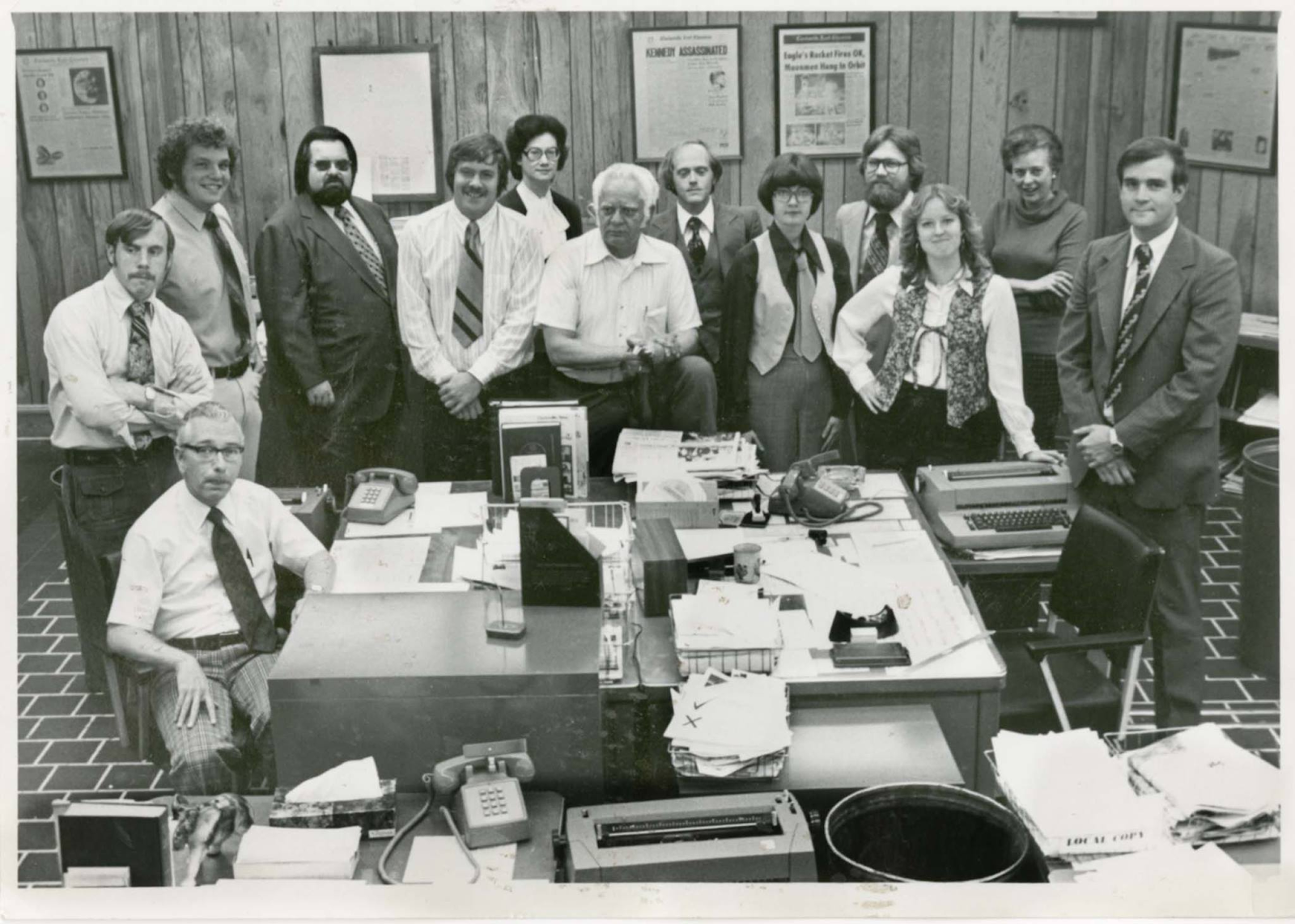
Jim Monday is third from left, between me and Larry Schmidt, in this 1970s Leaf-Chronicle newsroom photo. I'd name them all, but it would take up too much space (and I'm old). My mentor, Max Moss, is the guy sitting down. And photographer W.J. Souza, a WWII tank driver, is the old man in the middle.


I'm old and in the way, some say. Perhaps they are right. But 30-40-50 years ago, every Little League and society function and civic club speech was reported in The Leaf-Chronicle. All police reports were printed. Court agate was always there. (You don't know what agate is, and that's just sad to me. )The TV schedule was printed daily. The County Commission and the City Council were reported on, in detail, both in day-of previews and day-after coverage. With art (photos, you'd say). And everyone who died in Montgomery County received an obituary ... for free. If it meant killing a house ad or wire story, well so be it.

About 10 p.m. each night, as a last-gasp task, one of the staff, sometimes me, sometimes Jerry Manley -- my best friend, who himself has some health woes -- Jim, Suzanne, Larry Schmidt, Rob Dollar, Ricky Moore, Jim "Flash" Lindgren, whoever was available, would go downstairs for one last swing by the mail slot where the funeral directors would drop off the obit forms.

"Got George Smith's death notice," or something like that, the director would say in the one-way phone that was by that mail slot.

Sometimes, Mr. Foston, or another funeral director, would call one in from the embalming room. Right on deadline. One of us, an editor, a reporter, a sports writer, a copy desk honcho like Jim or Jerry, hell, even that asshole city editor (I won't name him here, but he knows, as do we all) would take the dictation.

Everyone who died before the newspaper's final plates were shot by Camera Room Foreman Ronnie Kendrick got in the newspaper the next morning.

Ronnie would be glad to reshoot a page if necessary to get the obits in. Last time I saw Ronnie, he was running a Waffle House, off I-65, not far from my house. That was his fate after a half-century at the newspaper. I'm sure it was him, though I didn't recognize it at the time. At least he appeared well-fed. I loved his mom, who would make me occasional caramel pies. I'd share them with the newsroom, much to Big Jim's delight.
Dropping everything to get the obits in may seem like a small thing, but it really was the most important service by local newspapers, or even big-city newspapers, back until the corporate snakes and money-sucking, bloodthirsty slugs took over and figured, "hell, we've been giving away this space for free. Why don't we charge people hundreds of dollars for their mom's obituaries? Most families will pay it. They're still in shock."

It's only in recent years that people have figured out that the internet, the tool that allowed the pigs to kill newspapers, was also the best tool for obits. Funeral homes put them on their sites for free. Or at least for a bit of overhead on the gluttonous casket costs. Only the frivolous pay to put their family obits in the newspaper.

All of which is kind of a collection of my loose thoughts while pondering that Jim Monday -- a caring, loving, peaceful big man -- died Sunday.

Not a word in The Leaf-Chronicle, where he spent his life, or its website by afternoon the day after. Heck, I may be wrong (I may be crazy), but following the internet trail, it appears that the first time Big Jim's final bow was noted in his newspaper for life was in the regular obits on Wednesday. One of the most-beloved people in that city had been dead three days by then. I am no internet wizard, and I certainly hope I'm mistaken.

I found out after a Facebook message from an old-timer, Gary Green, who I haven't seen in 40 years, said he had heard a rumor that Big Jim had died. But he wanted me to check it out for sure. He knew I'd want to find out if that was true.

First thing I did was call Jim's phone. No answer. "I hope you're OK. I love you, Jim," I said to the recording device. I was thinking "Jim is dead." I used a harsh expletive, one that doesn't belong in a story about Big Jim, even though he used to get red-faced and laugh when I'd pepper the newsroom air with it while exhaling clouds of smoke while waiting for Harold "The Stranger'' Lynch to get back from a meeting at City Hall. I have never been shy nor proper nor politically correct. Just principled and hard-working. And I always love my newspaper staff and colleagues more than just about anything.

Nothing on the Clarksville news websites about Jim right then, so I looked up the site of the most-likely funeral home. It had one line, just a name. "James Morris Monday" it said. Services were to be announced later, it noted. I figured it had to be my Jim Monday, but you never take that sort of thing for granted, and I called Neal-Tarpley and Etc. funeral home and asked. "Is the Jim Monday you have the old newspaperman? The Big guy who used to write the religion column?"

The nice lady told me the family had just finished making arrangements, but yes, indeed it was the old newspaperman. I am obsessive compulsive, so I asked two more times.
Of course, it was Big Jim. Damn it.

The Leaf-Chronicle, where he spent a half-century, had nothing on its website other than assorted filler and pictures from Bonnaroo, the music festival IN MANCHESTER. That's a long ways from local news in Clarksville, the type of news the son of Corbin, Kentucky, shepherded as a reporter, as a copy editor, as copy desk chief, as religion editor and columnist.

A competing site, ClarksvilleNow, got the obituary up later that day, with a huge portrait of Big Jim, and the full-blown obituary taken directly from the funeral home and reprinted. Chris Smith, editor at that site, had worked at The L-C, so he knew this death -- while likely not of import to the quarter-million or so folks who live in the area now -- mattered a lot to the 60 or 70 thousand who grew from childhood reading Mr. Monday's column. Perhaps even seeing his mammoth frame outside, in the city he loved.

"He was a great man," or some such, Chris said when I called to thank him for thinking about the old-timers, the ones who built Clarksville.

Big Jim spent 51 years or so editing and writing for the L-C, including post-retirement years continuing with his folksy "Open Line" religion-based, family-values based weekly column. Sometimes he'd write about his favorite vacation spot, Pigeon Forge. Or his visits around the country and the world to keep up with his daughter, who married a military man named Mike, I believe.

Jim stopped writing a few years ago. They had a big party to celebrate the half-century at his work. Then he quietly exited. Anyone who has "retired" from a newspaper in the last 16 years knows what that really means.

"I don't hear from anyone up there at The Chronicle, but there aren't many left these days," Jim would lament during our phone conversations from his home in Sango, the bustling suburb of Montgomery County where quickly rising homes fill the formerly pastoral community that used to be tobacco barns, ponies and Brown's Store, where old-timers gathered for dollar pool and canned Pabst most nights. Maybe open a can of Vienna (pronounced "Vi-en-nee") wieners and spit tobacco juice in the empty can.

Hank Jr. wrote a song, "Stoned at the Jukebox," after a stop at a roadhouse near where I lived for awhile. He was halfway between his Nashville and Paris homes/offices and he decided this dank Sango country bar was a good place to stop.

Getting a little off-topic, but, hell, a friend of mine is dead. Another newspaperman is dead. A newspaperman is someone who lives and breathes newspapers and as a result is poorly equipped to do anything else with their lives. Newspapermen don't willingly leave the lifestyle to become public relations guys or run a bank or become professors or water heater execs. They can't function properly on the "outside." Nothing wrong with any of those fields, but newspapermen simply cannot do that. Too cynical, too ethical beyond reason or health. No 9-5 and forget about it. There's always that headline you worry about or the cutline beneath the picture on the agate page. I suppose we should write a "newspaperperson'' sted "newspaperman" nowadays? ("Sted" is editor's bizarre lingo.)

And that is fine. My wife was a newspaperwoman/newspaperperson. My friend and former boss, Dee Boaz, was a newspaperwoman. Sara Foley, who I've lost track of, was a newspaperwoman (I put her in here just in case she sees her name). Jane Srygley was a newspaperwoman. Frances Meeker, too. Charlie Appleton and Joe Caldwell were newspapermen. Harold Lynch was almost unmatched. Richard Worden, too. Bob Battle. Joe Biddle. John Bibb. Mr. Russell .... C.B. Fletcher. The Old Lefthander. Vince Troia is still alive, but he can't stop trying to figuring out ways to be a newspaperman again. Ken Beck, same thing, although he keeps his hands in by writing. Same with Larry Woody.

Some newspapermen, like Rob Dollar, noted above, try other things, but can't be happy as anything but a newspaperman. Jerry Manley, too. I used to drink with those two newspapermen after the presses rolled. "You know we're society's misfits. All newspapermen are," I'd say. They'd laugh. But nod. "Nothing else will make us happy."
Publishers can even be newspaper people. Luther Thigpen was one. So was John Seigenthaler. Irby Simpkins and John Jay Hooker, well, not so much. You get the picture.

Gender regardless, they all were of the impression that what they did daily, from obits to cutlines to making sure the right crossword puzzle answers were in the paper, mattered.

We didn't find out otherwise, until Korporate America chimed in that it really didn't matter, nor did we. What matters are dollars.

I first met Big Jim on September 12, 1974. That was the day I began my first newspaper job as a high school sports writer.

Sports Editor Gene Washer had hired me a week earlier, but I hadn't had a chance to meet the staff. They all were chain-smoking, pounding on typewriters, tearing copy off the UPI and AP machines, sending page layouts and copy to the second floor typesetters via pneumatic tube. Pica poles cut like switchblades through the thick, blue smoke.

It was a glorious, near-cinematic sight. Editor didn't like the story? It was violently impaled on a spike for consultation with the reporter later. Everyone who edited copy had a spike, a chunk of square lead with an eighth-of-an-inch-thick, 6-inches high piece of steel with a deadly point on the top. Eventually, OSHA came through and demanded the spikes be emasculated by bending the tip down, the formerly fierce jutting metal turned into a limp "U." I still have my spike, with the extra pica poles, in a box in the garage. Got a scale wheel, too.

The day I finally met Big Jim and the rest of the staff was short on introductions. My direct supervisor, Max Moss, handed me some local football stats to type up. Jim sat a few feet from me at the head of the copy desk. He was a mammoth man, who slimmed down considerably as he aged. He had a flattop haircut. A typical good old boy appearance. With the sweet soft voice colored by welcoming warmth in his greeting. That assured me I truly was in the right place.

I bummed a smoke from Max and went to work. I smoked in college, but I had quit. It took one hour in the blue-smoke cloud that hovered over the L-C newsroom to break me of that no-smoking habit. Hell, if you gotta breathe the stuff, might as well enjoy it. I finally quit smoking a quarter-century later, after firing them up with Eddie Jones, McGehee and other dead guys during my second newspaper job at the Nashville Banner.

I quit smoking four years into my work as entertainment editor at The Tennessean, something Bibb lamented, because he bummed at least one a day from me. A small price for being able to share time with one of the most legendary of sports editors.

Big Jim quit long before, as far as I know. He eventually let his beard and hair grow out, giving him a sort of extra-large Jerry Garcia appearance.

And, like I said, he began losing weight.

But he really didn't change. Big Jim was a local journalist, in the best sense. He encouraged his copy desk staff and led by example. He later was switched to No. 2, behind Jerry Manley, when we turned to an ayem product.

Jim oversaw the desk during the daytimes, Jerry at night when deadlines loomed.

Jim also was worshiped in Clarksville for his Sunday column.

During our phone conversations in recent years, I'd encourage him to put together a collection of those columns for a book. "Old Clarksville will love it," I'd say.

I don't think he ever did.

I have done my best to keep up with Big Jim over the years, 5-1/2 years ago even attending his late-in-life wedding (his first wife died long ago). We spoke frequently, but he was forgetful, even in the same conversation. Still I loved the Big Man.

"We sure used to put out one helluva local newspaper," I'd say.

"It's not like the old days now," he'd say. "But we really did a good job."

I should mention he also was a gospel singer of some renown. I have a CD of him singing old-time religious numbers and some he wrote. Jim also was my key into the gospel and pork barbecue worlds when I was in Clarksville. One day, The Pettus Family Singers -- cousins of local running sensation Wilma Rudolph -- came into the office to sing a few spirituals for Jim.

I introduced myself, and within days I was spending my free evenings at a barbecue stand across the river from the city, where Ole Steve Pettus taught me how to smoke whole hog and shoulders. Steve had been one of the singers, of course. His brother, Euless, often helped with the smoking. And I ended up being a fairly white face at the family's annual picnic. Wilma was there, too. And wherever they were, they sang harmonies of God and heaven.

That's all another story.

Heaven is a concept, of course, debated by many people. Regardless of that debate, Big Jim is up there now, his lilting tenor making Gabriel smile.

A few other things. Because of his desire to live a full life -- and he did -- he probably lost 150 pounds since I first met him. There was some of that weird "he looks so good" stuff from those who stood by the open casket Saturday. I'm glad some find comfort in that almost-lifelike appearance.

He loved pie and ice cream. And cornbread. And barbecue. And Red's Bakery's double-stuffed potatoes. And life.

He hated it when Red's Bakery closed, by the way. We all did.
He loved the family that surrounded him when he died and who gathered Saturday, June 24, in the funeral parlor.

I was fortunate in that after Suzanne and I made our seat selection we were joined by Dee and by Carolyn Lynch, Harold's widow, and their son, Chris. "This is an L-C row," said Dee. I only saw one other Chronicle person there. Suzanne reminded me that probably most of the people I worked with 36 years ago -- when I left L-C -- are dead. She was only half-joking.

Jim Monday absolutely hated what had happened to the newspaper where he spent his adult life.

"I'm just glad we came along when we did," he'd say, and I'd agree. "Glad we're not young. They'll never know what a great place a newspaper was. Being a newspaperman."

Even though he was 87 and had obvious health difficulties, I always hung up figuring there'd be another conversation.

I guess that will have to wait, I hope a few years. I may be a cynic, hardly the man of Christ like my friend. He had no doubts there was a heaven. That we'd all see each other again.

I'm hoping Jim Monday was right about that.


Sunday, February 26, 2023

Charlie Appleton, the classic, old-fashioned newspaperman's life reaches "30" mark ("the end" in newspaper lingo). But, in a not-so-bizarre twist: Love lives on, though my rewrite magic fails

 "Timothy, I am looking forward to it, getting back there on the back porch of our cabin, smoking my pipe. Going home Sunday. If not before."

Charlie Appleton told me that, again, just a couple of days ago, Ash Wednesday, when my wife, Suzanne, and I visited him at the NHC rehab center in the southern end of Gallatin. My wife also had been a lifelong journalist, and she just wanted to let Charlie know she loved him, too.

Charlie never made it to that porch or that beloved pipe -- "You only can smoke it outside," semi-chided his wonderful wife, Eben.

Charlie's eyes just sparkled and shifted to me and to my wife. Then he shrugged. And laughed. "Wives," I'm sure he was thinking.

But we all knew the pipe would only be lighted outside. And that was fine with Charlie.
He'd been dreaming of sitting on that porch, in the bright spring sun, for the weeks he'd been hospitalized and then more weeks in rehab.

"They got me so I can get to the bathroom on my own and get to the refrigerator," Charlie bragged.
He was like Charlie always was, full of life.

Three days later he was dead. I'd been trying to call him most days, especially on ones when I couldn't make it to see him, ever since he'd been hospitalized.

Friday, the day or perhaps two after my last visit, he didn't answer his phone. I left a message saying I'd talk to him later.

We never did.


He responded to my call by sending a FaceBook message. Most of it is too personal to repeat here, without crying. He simply said he'd been tied up with doctors etc. and church people and added "Thank you pal. I love you for all your concern .... It's just been incredible. Thank you. Thank you. Thank you."
No such thanks are needed when it's someone you love, a fellow you know had been given a death sentence of 3-6 months tops by his doctors. I spent time talking with and visiting with Charlie because I loved him.

Later in the afternoon Friday, as he and Eben planned their escape from "captivity," the potential of great pie, coffee, a pipe outside and a beer, he sent me a more worrisome message: "Have heart trouble. Waiting EKG."

That was it. I sent him a little note of reassurance after my calls again went to voice mail.

Saturday, I tried again. Then I got a message from Eben that he was dying. The last rites had been delivered. The clergy and church and family was gathering.

I told her I loved her. And Charlie. And the family. And I thought of Charlie's Siamese cat, Taboo, who had been pining for her best friend for weeks, had been sleeping in Charlie's spot at home. Had been anxiously awaiting the return of her "father" and best friend.

Now that cat will need to try to console Eben. I'm sure she won't mind if the cat continues its recently developed habit of sleeping on Charlie's pillow. She used to sleep on Charlie. And he loved her.

I had tried to give Charlie "some flowers while he lived" in a little FaceBook post a few weeks ago. I'd gone to see him at his house and then again after Eben called to say he was in the hospital and my visit might cheer him up.

In an earlier visit and on the phone, he delivered the docs' verdict: "It's OK. I'm ready for it. I've lived a good life."

Yeah he did.

Some of it I tried to capture in that post that I wanted him to read a few weeks ago, recounting our time together in the Banner newsroom and in life, and my love for the guy. Remember he is past tense now. All hope is in the hands of the Lord that was so important to him that last time I saw him he was rubbing the charcoal cross, installed by his priest, from his forehead. A large Anglican cross hanged from a chain around his neck.

Here's that post from just a few weeks ago, when I thought we both would gather on his back porch pretty soon. I'd smell the tobacco and we'd talk about the kid who married his mother over in Dickson County and other bizarre but fabulous stories Charlie discovered:

.........."In another bizarre twist," ... well, only Banner folks will get that ... but I decided there was no better way to spend a chunk of my Friday than hauling it on up to Gallatin and visiting my good friend, Charlie Appleton, who is recuperating in the hospital.
 
This great reporter .. who I purposely kept in the cubicle next to me when I became state editor at the Nashville Banner in the late 1980s -- is enduring some health woes, but he looked great today. Course, Charlie brings nothing but joy to my heart.

In the Banner days Charlie became my chief state writer, and he trolled his law enforcement and radio news pals throughout the state to find the best stories for me to pitch at the 6 a.m. news meeting.
 
I would delight the group -- managing editor Tony Kessler, opinion editor Dan Coleman, business honcho Bob Battle, wire editor Max Moss, deputy editor Mike McGehee and the rest -- when I detailed the stories Charlie had working.
 
We talked about some of those stories today. So many mornings were spent listening to Charlie work the phones, magically unwrapping the layers of a tragedy or calamity before forwarding his raw and compelling copy to me: "Timothy: Here it is: Work your magic." I loved the editing process when it came to a Charlie Appleton story.
 
I love the guy and his wife, Eben, who has taken such great care of this treasure.

Charlie is a great man, another of us silly bastards who only wanted to be a newspaperman (or newspaperwoman), only to see that profession die (or be obliterated in corporate haze) and nobody really care.
 
Still, we rage on.

I thank Charlie for being my friend for all of these decades, and I look forward to seeing him at his home soon.

"I can't wait until it warms up and I can sit on my porch," he told me. I'll relish sitting next to him, talking about life's bizarre twists........"

In many conversations since I published that, he told me he liked that little tribute and talked about his pipe, Eben and reminded me that I was his hero -- that my work as state editor in encouraging this greatest of reporters and editing his work, making sure the bizarre twist was evident enough to the editors' meeting attendants -- made him look good. He knew I worked hard to make sure his stories were the first-edition leads.

But it was Charlie who was the hero. I kept him sitting next to me in the newsroom because I loved old-fashioned journalism.

I loved letting my reporters work and then doing my best to make the stories shine. I had a great staff in Leon Alligood, Gina Fann, Alisa LaPolt, Toni Dew, Patrick Willard, Donna Davis, Beth Fortune and my assistant Andy Telli and others. And we had about 80 correspondents around the state calling in their daily tips.

The Nashville Banner State Desk was a wonderful place to be, and I, as longtime state editor, loved every one of them.

Charlie was special, remains special. I liked having him next to me, because I could listen to his end of bizarre tales told and, if necessary, take that new information, the latest bizarre twist, to Managing Editor Tony Kessler.

Perhaps, well, more often than not, a good Charlie story would kick the Metro Council tale of inaction and flatulence down the page.

There was an uncommon grace in Charlie. The Banner had created a position to hire me from The Leaf-Chronicle in Clarksville at the beginning of 1988.  The purpose, though no one said it, was to eventually take my decade-plus newsroom editing and managing chops to the State Desk.

Basically, I was hired to replace State Editor Charlie Appleton. He and I sat together in the meeting in which Eddie Jones and Tony Kessler and Shaun Carrigan (then city editor, since deceased), discussed this change. That assshole Irby may have been there, too.

Charlie wasn't upset: "You can have the headaches, Timothy. I'll have more fun." We hugged.

My first move as state editor back in 1988 was to change Charlie's title to Chief State Writer and let everyone know that he was the guy who was our chief lieutenant in oft-bloody deadline battle for stories and story placement. Everyone wanted the lead story or they didn't belong in a newsroom.

I had to take the slightly larger state editor's desk, but I moved Charlie down, one cubicle, so he'd be next to me. Leon was on the other side of Charlie.

Freed of management responsibilities and sometimes ridiculous meetings that come with a job, Charlie let his telephone fingers roam the state, cheerily spending his time making that old paper have even more personality than ever.

The State Desk was a team that provided me and that other ink-stained wretch next to me much joy. Stories would come in before 8:20 A-1 deadline, by a minute or two. He and I daily pushed the deadline to get the best and bizarre out to the folks who got the state edition. Sometimes I'd take a quick look over his shoulder, but I didn't disturb him as he worked.  Then, Charlie would push his desk chair away from the antique computer and tell me to "work your magic."

Yes, I did work to make the stories sing, but strove always to keep in mind that it was Charlie's story. It was his magic I was using a bit of fairy dust to, at his urging and cheerleading, make it better. He was my biggest fan, so it was mutual for sure. 

Oh, I know between us we produced some fantastic tales of murder, mayhem, burned bodies, perhaps even cannibalism.  But Charlie also told the good stories, about people who had rescued others, acts of God (he was devout), but was better known for the 400-pound Giles County twins or whatever, who killed folks for the hell of it and burned the bodies. I think they may have roasted marshmallows or hot dogs on the fires. 

 If that was the case, Charlie would have found out where they bought the marshmallows and talked to the grocer about the fat twins.  Then he'd call the parents to ask if they ever knew their monster-sized redneck twins were sociopaths who enjoyed dismembering and burning strangers.

As Suzanne reminded Charlie the other day at the rehab center: "You and Tim were something. You had great adventures. Two great newspapermen, having fun and doing their jobs. He sure loves you, and the most fun he ever had in a newsroom was working with you." 

Charlie was in the rehab center a week ago, when the Banner refugees celebrated the 25th anniversary of the slaughter of a truly great newspaper, butchered by owners and corporate greed combined. We FaceTimed him during that celebration. Afterward, I called and told him how much he obviously was loved.

Who couldn't love such a guy, the sort who, like me, knew that being a newspaperman (or newspaperwoman) was the best and only career where guys like us fit in and could advance as leaders and mentors. And tell dandy stories along the way. And, damn, it was fun before corporate power-hungry jerks stole the joy from newspapers across the nation. 

Charlie and I talked about that change and that perhaps he was really lucky, because the Banner folded before demographics and brokers sucked the life from the world of a true newspaperman.  

Charlie's final story will be told Friday, at his funeral and burial.  I'll be there  -- as he asked me a few months ago, when he first talked about his fatal liver failure diagnosis -- as a pallbearer. So will our pal and cohort, Leon Alligood, the other newsroom pallbearer of choice.

"It's an honor, of course." I told Charlie that. I have to admit to muted tears when he asked me to assume that role.

I've been losing friends to time and neglect lately, and my heart is breaking as I listen to the clock tick  in my empty office, where I think about all the great people who have departed my life. Fortunately, for me and my fragile mind, the last words I said to Charlie on Ash Wednesday were simple: "I love you Charlie."

Also joked him that he'd rubbed the ash cross  -- installed by the Anglican priest who visited moments before I arrived -- off his beautiful and beaming face where serenity overcame the certainty of his future. He shot his thumb up into the air. "I love you."

I wish this was one of those Charlie Appleton stories, and he could push his chair back and tell me "Timothy ... Work your magic."

Because I'd changed the ending.  We'd be sitting on the porch of his log cabin. He'd be smoking his pipe and stroking the back of Taboo, the Siamese cat.

And we'd laugh.

Saturday, January 28, 2023

Test Post for Internal Migration

 Test Post for internal Migration 

Wednesday, January 25, 2023

The life and death of a real newspaperman

 Nothing better than that first pre-dawn cigarette break of the day, then watching as the embers exploded down in the 11th Avenue North Gulch 50 feet or more below. Ink-stained fireworks.

Sorry, this was in a time when it was considered OK to smoke -- especially if you were a newspaperperson -- and to toss the flaming butt to the ground.  Unfortunately, environmental concerns sometimes aren't first in mind at 5 or so in the morning, when the workday is just getting underway. Especially a generation ago.

Such events took place daily more than 25 years ago when I spent my workdays, that began at dark and generally continued well into the afternoon, with Mike McGehee. Mike died January 4. And it was something of a gut punch. 

Time really isn't on our side, after all. I hadn't really kept in touch much with him since the Nashville Banner closed a quarter-century ago. I'd been to some of the McGehee Christmas gatherings and had a couple of long talks about his post-newspaper discovery of Civil War history while he worked with his wife in the real estate business.

Waiting for potential customers in an empty house-for-sale became a good time for him to read about the bloody war.  

It's just that I figured he'd always be around, a guy who would care when I died more than the other way around.

I figured today I'd share my thoughts that I posted on the Neptune Society website shortly after members of the Nashville Banner family -- of which I'm a survivor, so far -- were alerted after his death.

Bad sinuses kept me away from a veterans cemetery service for my old friend on Monday, but I made sure to be at Tuesday evening's celebration of life at the Crow's Nest in Green Hills. For his was a life to be celebrated.

And Judy and the girls, the whole family, are people to be cherished. 

Mike was a real newspaperman, one of those who knew and experienced what truly was the best profession ever (if you had the stamina and the coffee.) Oh, and don't forget the beer at day's end.

He had a variety of editor's and other roles at the old Nashville Banner, which truly was a great local newspaper (when such things were seen as important and the world wasn't reported in Tweets and Toks.)

I am proud that I spent 10 years as a colleague of Mike's. He was perhaps the kindest fellow in the newsroom. He surely was a rock. And he loved that profession.  When the Banner closed, he laid low for awhile, as he wasn't one to seek out employment at The Tennessean, the other newspaper that was upstairs.

About two years into that forced retirement, he called me at The Tennessean --where I had found an uneasy and eventually temporary landing spot -- and said "Tim, I'm ready to come in from the cold if there's anything there."

If it had been up to me, he'd have been there that same day, but there were no openings for older fellows at The Tennessean.  I found out myself later how true that was.

Here is an expanded version of a little note I wrote on the obituary site after he died. Figured I'd share it and my love for Mike and for this great, dying breed that I'm a part of:

Mike was my "booster" and friend at the old Nashville Banner. Of course, he was my boss, too. 

But due to changes brought on over the years, he and I became newsroom brothers, relying on each other, Tony Kessler and Eddie Jones for help weathering all the changes. He also was my smoking partner. Most mornings we'd get in around 4:30 or 5 at the latest.

We would prepare whatever we needed to present or discuss in the morning news meeting at 6, and then Mike and I ... and often Eddie if he was there yet and any other old-fashioned newspapermen who still smoked, would take a break and smoke, overlooking the Gulch. 

When we had Irby-inspired setbacks and other such shit to deal with, we relied on each other. Mike was a steady, sure hand, a proud and brave comrade and, on occasion, when the old Saab was broken down, my ride to and from work. Usually, beer was with us on those afternoon rides. I loved Mike like a brother and Judy was his perfect companion.

I guess his strongest trait was his support of those who he knew were trying their best. He knew mistakes happened, as he'd made them himself in his career.

I'll add here a note of one of our "adventures." One day, Irby (and if you know who that is, well, good for you, and if not, well, better for you) wanted a huge notebook full of documents about, I believe it was Lamar Alexander, photocopied. And he ordered me and Tony and Mike to do it. Hundreds of pages of stuff that never amounted to a story. We did as told. And we bit our tongues as hard as possible.  Well, Mike and I may have discussed how we really felt during our smoke breaks from the busy work.

Workdays that began at 5 a.m. extended until past 6 or even 7 p.m. on  that silly and fruitless day. And Mike and I shared the same opinion about the value of the work and the fellow who ordered it because he could.

Mike was of the breed that still held hard to a pica pole and a scale wheel, long after they went out of fashion.

I know that when there was a big newsroom shakeup, not the infamous massacre, but much later, Michael (as I called him), Tony and I spent hours commiserating while also encouraging each other.

Also, I appreciated his "generosity" when he opened up an unlimited tab for Irby to pay when newsroom management made its two trips to the Don Cesar in St. Pete for Poynter nonsense. 

Michael, Pat Embry and I (then a without-limits drinker) and a few others tried to make sure Irby got more than his money's worth at the poolside bar.  I don't think any of us ever made it into the pool on that long Saturday afternoon. Probably would have drowned.

Heck, we all managed to make it to an evening meal with Poynter folks and, if I remember correctly, we spoke soberly about our boss and the newspaper business with that gang of think-tank "journalists."

 I spent most of my life in newsrooms, and there really are only a few who I label as newspapermen (or newspaperwomen). 

These are people who never lost their love of what was the greatest profession ever. Michael was a brother on that list. Love you, old friend.

Thursday, December 15, 2022

'Timmay' says goodbye to 'Mr. Cooper': Loyal friend also a father, musician, journalist, historian, brother, beloved ex-husband, damn nice guy

                                                 
Somehow, Peter Cooper is dead.

I already wrote a blog of sorts on Facebook after his death December 6.  But I haven't really been able to process it.

                                           Photo by Peter's friend John Partipilo

I stuttered through possible remembrance thoughts at all hours, day and night. And I ran through some of the things I liked best about Peter, who I hired as my chief music writer after old Jay Orr left The Tennessean for ventures that ended up with him in the deserved and honored position of Grand Old Man at the Country Music Hall of Fame and Museum.

This isn't about Jay, though I really love that guy, and he served well as a journalist on my staff at the old Nashville Banner and then The Tennessean.  He took his glorious knowledge and kindness with him to the CMHOF and M. He is a great man who has made a huge impact on me, personally, and on his colleagues, the music world and his family. 

About eight years ago, Peter packed up his desk at The Tennessean and joined Jay at the Hall of Fame. It was his dream job. He wasn't writing much any more, but he was hanging out with visiting dignitaries like Bill Anderson and Tom T. Hall and Joe Walsh and Albert Pujols and working with nice guys like Jay Orr.  

My favorite quote from a Jay Orr story came early on in Garth Brooks' meteoric rise, Garth, who I actually like, talked about some big honor he'd won, and how he went home with then-wife Sandy to their Goodlettsville home to celebrate. "Sandy and I balled all night," Jay quoted Garth. Of course, Garth and his wife actually "bawled all night," meaning they wept tears of joy. Either that or Garth spent the entire night singing "I'm Back in the Saddle Again."  It's a night he probably doesn't like to talk about with Trisha, though perhaps they ball all night, too, when she's not making cookies on TV.

The bawl/ball incident -- and no one complained, by the way -- was actually my fault. Jay, who was as diligent as anyone about making sure his stories were excellent and scholarly, turned this one in -- as was his nature -- right on deadline, if not later. I had to spin through 55 inches of copy about Garth in about 10 minutes. I read right through the bawled/balled miscue without a thought of its sexual content. 

Jay was a great journalist and museum executive and I still love him more than most people I've ever known. In my mind, I saw Peter, who succeeded Jay at The Tennessean, similarly maturing, perhaps growing a scholarly beard, and becoming the next Grand Old Man at the Hall of Fame and Museum. After all, Jay is almost my age, and surely he has plans to step down and spend his time writing cowboy songs and polkas in his golden years.

Seriously, they loved Peter at the museum, although life began catching him by surprise in the last three years or so.  It became obvious that he wasn't going to be the next Grand Old Man at the Hall of Fame when director or whatever Kyle Young and a half-dozen of his frat-style-dressed minions formed something of a receiving line outside Room 5 of the Surgical Intensive Care Unit. They were all taking turns telling the fallen and frail friend, Peter, "goodbye."

I'd already said "goodbye" to my friend, several times over, by the time the receiving line got there.  

Peter was forecast to die that day, or really the night before, according to the SICU doctors and assorted medical experts. But he fooled us. He'd fooled us a lot over the years. He didn't die on schedule. Sadly, the when is not as important as the what ... and he did die, after a few days of giving us false hope by fighting to stay alive. His fight came too late, when he was too weak.

Now, I'm not in the family, but I was there a lot during the four days he was alive in the hospital. Hell, on the Saturday and Sunday of his mortal stay in the SICU, he was even "recognizing" people, a little.

As my friend, I had asked him long ago to write the foreword to my book, Pilgrims, Pickers and Honky-Tonk Heroes, that comes out in March.

He wrote that foreword. He read much of the book, chapter-by-chapter, via my email dispatches. Then he stopped responding. I thought perhaps his interest had tailed off. I didn't realize that life was the problem.

 Still, once I had it assembled, I had a full manuscript printed out that he wanted to edit. But he had excuses. And he didn't. I was not critical of him. Bobby Bare wanted to edit it, too, and he had a copy, but it's a tough job.  Hell, John Sebastian, Lovin' Spoonful honcho and a friend of sorts, volunteered to read it, too. He stopped, though, blaming dyslexia.

As for Peter's participation, it was clear, in sort of a muddied way, that he just couldn't do it. His mother died. He got sick and spent a couple of weeks in the hospital. And he had two or three bouts with COVID that required isolation, not hospitalization. He got divorced from the woman who loved him the most of anyone ever and who held his hands while he died. For some reason or reasons, he was runnin' like he was runnin' out of time, to lift a snippet from my good friend, Kris Kristofferson. Take it all, take it easy, til it's over. And now, it is.


                                                                     Peter Cooper: Photo by John Partipilo

On Sunday, December 4, I held Peter's hand, stroked his forearm, and told him how much I loved him. I talked about the book -- he loved my writing -- and about his foreword and how much I appreciated it. I told him that I was planning on having him play the guitar and sing, if he wanted to, during at least one of my book-signings. He squeezed my index finger and moved his legs and his left arm. There even was the semblance of a nod. Of course, it all was, or perhaps it just fueled, wishful thinking. 

Doctors had said that when he recovered from the brain injury from what turned out to be his mortal fall, he'd be in good shape mentally, but perhaps his motor skills might be diminished. He may not be able to work the frets on the guitar seemed to be a major worry. So, I figured maybe I could get my friend, Thomm Jutz, to join on guitar while Peter sang at a book-signing. 

I was sure he was going to make it, so I was planning for the future. 

I think he was, too, until the next day. Monday, December 5, he was still and struggling. He was not responsive to conversation. He was running a fever. Jason Ringenberg (yes, the Scorchers' front man aka Farmer Jason) stood at his bed and talked to him. Jason recited a long passage from Ezekiel. I rubbed Peter's hand and cried in my heart. I pretty much lost hope that night. He lost life the next day. 

I had to call our mutual friend, Bobby Bare, to inform him. I'd been calling him all weekend. Bare wrote the preface for my book, by the way. I love that guy and it pained me to have to tell him that the fellow I regarded as my best friend in Nashville had not survived. I spoke briefly, tearfully, with our mutual friend, Nicole Keiper Childrey, who spent her share of time at the hospital, with so many others who loved Peter. I messaged our beloved photographer pal, John Partipilo. They already knew.

I dashed off a quick note to Kris and Lisa Kristofferson, as well. They also knew Peter, and they had told me back when their friend, Vince Matthews, died in 2003, to make sure to let them know when folks in the music community had died. It is a solemn honor, though tears drove my fingers as I typed the news about Peter Cooper to those wonderful people.

You may remember that Kris and Lisa delivered Jerry Lee Lewis his Hall of Fame medallion in his Memphis hospital bed, about a week before "The Killer" died October 28.  It had to be a hard task, as Jerry Lee's friend Kris has endured his own medical struggles.  But, at 86, he is proud and determined to live.

Peter's body couldn't measure up to any such determination.

I've been fiddling with this blogpost for more than a week now. I did post one, a mournful and angry lamentation, on December 7, the day his kind baby brother, Professor Chris Cooper, sent out this message: "There's no good way to say this, but I wanted you to know that Peter passed away in his sleep last night."  

Chris wrote the note, and the gentlest guitar genius I know, Thomm Jutz -- Peter's dear, dear friend, who pretty much stayed at the hospital through the ordeal -- forwarded it to those of us who had been keeping what we had hoped was a life watch. It turned out the opposite.

An early effort at this farewell began with me somehow thinking the phrase "Thank you for being my friend."  I think that's kind of a trivial way to say it, reminiscent, I guess, of the geezette sitcom "The Golden Girls," that ran from the mid-1980s into the 1990s. That comparison really doesn't work, given the fact that my friend was not able to reach the golden years. Frozen in time at 52 years old.   

I've had a few days to think about it since Peter Cooper died December 6 in Nashville.

He had fallen and injured his head and his brain. And there was hospital-developed pneumonia. Nothing much else needs to be said about how he died.

It's just that he is dead. The day he fell on his spiral to death, he called me. He'd been MIA for quite awhile, a couple of months really. He hadn't answered calls or texts in which I expressed my worry and my love. My encouragement. He sounded tired, but he was "the same old Peter," and he told me he knew what he needed to do for his health, that he was fine.  He praised his ex-wife Charlotte and talked about his love for his son, Baker.  "It's all going to be OK, Timmay. I love you." "I love you, Mr. Cooper," I said. 

(I've been calling him "Mr. Cooper" pretty much since I've known him, after an old sitcom, "Hangin' with Mr. Cooper," that was about a teacher, which was the world Peter came from, perhaps even where he made his biggest mark. He called me "Timmay," because of the "South Park" character. I'm not sure who really understood why we so-addressed each other. Course, it didn't matter.)

In that phone call, though, Peter said he was going to the Waffle House for flapjacks and hash browns. A pescatarian, he didn't think he'd try the fish there, if there was any. He did that, as far as I know. He was hungry. 

But shortly after, some friends found him, mortally wounded from a fall.

Of all the friends I've made in Nashville since beginning the second phase of my newspaper career here -- I began with a 14-year stint at The Leaf-Chronicle in Clarksville -- Peter was at the top of my list. I told him often he was my best friend in Nashville, "and I hope you don't fucking mind it."   

After I lost my job to corporate change -- I was "bought out" at The Tennessean 15 years ago -- Peter was one of the only members of the newspaper staff to keep up with me.  The rest of them, for the most part, were very kind.  But they had, it turned out in most cases, good reason to want to separate themselves from the outcasts.  The less they knew about the folks who were kicked to the curb, the better.

Most would find out for themselves soon enough how it indeed does feel to be cast out on your own.

Peter and I spoke regularly, from the very first day I was out.  For years, we'd meet every other Wednesday or so at Athens in Melrose (now gone, victim of Nashville-brand progress and greed) for lunch. He seldom let me pay, though I was able to rip the check away from him on occasion.

It had become the place where I'd meet interview subjects for freelance pieces, potential freelance clients and/or simply to grab a cup of coffee and chicken souvlaki or spanikopita (spelling?) while watching the wheels go round and round. I'd tell Peter to meet me at my office. Those were lunches filled with laughter, lullabyes, legends and lies. 

I'd tell him the latest I'd heard from Kris or Bare. He'd talk about his adventures with Whisperin' Bill or maybe even Joe Walsh, the "life's been good to me so far," singer who is the best thing about the  Eagles. Joe really does have that Maserati and gold records on the wall, Peter told me. And I don't want to be hard on The Eagles, especially since they took on young guitarist Vince Gill to take over for the lamented Glenn Frey.  George Jones called Vince "Sweet Pea," I think for his wonderful voice that actually is at its best when he sings "Go Rest High On That Mountain," Nashville's funeral song. I'm going to settle for a recording of John Lennon's "Working Class Hero."

If a country music or roots artist came into Athens who I didn't know, Peter would introduce me, tell them I was the guy who brought him to Nashville from Spartanburg, South Carolina, in 2000, and that I was the nicest man in Nashville, a great writer.

Mostly, the thing that he said though was that "this is my good friend."

I pretty much stole the lead of this post with the "Somehow, Peter Cooper is dead" from the obituary my friend wrote for Johnny Cash.  He had taken three weeks or so to craft the obituary, working full-time from his home. 

You see we all knew Johnny Cash was ill and that things were not likely to get better, so our chief music writer was assigned the role of producing what became a full-section tribute when the inevitable day arrived.

"Somehow, Johnny Cash is dead," the lead of that obit, was also the best part of what was a sprawling, multi-faceted tribute to a great man.

Johnny Cash was 71, had a hard life, some of it self-inflicted, and he was older than his years.

Peter Cooper was different. He was only 52.

Somehow, Peter Cooper is dead.


Tuesday, November 22, 2022

November 22 doesn't seem to mean much any more. Is that because most of us who were stunned to tears are dead? And Thanksgiving wishes

 I shouted out "Who killed the Kennedys?" When after all, it was you and me.

Mick Jagger and Keith Richards wrote that line for their masterful "Sympathy for the Devil," on the album I consider the band's best, Beggars Banquet, released December 6, 1968.

This short blog tale isn't about that album -- the last one with their troubled and soon dead founder Brian Jones on it fully (some post-mortem work appears on Let It Bleed) -- though it and The Beatles Revolver super deluxe remastered package have been my main music in recent days while pedaling my bike.

It is a solitary ritual: An hour spent on the road to nowhere, the same figurative path I've traveled all too often. But this is literal, in that every day, seven days a week, I climb on my stationary recumbent bicycle and pedal as fast as I can, until my heart begins pounding and perspiration soaks my body.

I love it. I've been doing it for several years now, going from three or four days a week at a gym to the last couple of years when I've been riding in my basement, next to my office and the nearest music source, seven days a week.

I'm purging my tensions and disappointments during those rides. I'm thinking. Mostly, though, I'm just singing sometimes in my horrible voice that's perhaps a notch below Johnny Cash's in all of his waiting-to-die splendid albums, produced by Rick Rubin.  The pain in that faded American Recordings voice,  is part of what makes those albums must-haves for anyone who ever liked music.

I do sing better than that arrogant little squirt, Barney Fife, though, if you need some sort of comparison. Anyway, sometimes I just listen, sometimes I sing along with this music turned as loud as I can stand it, while pedaling.  Perhaps the odd thing is that out of all of the thousands of recordings I possess, I return to the same 20 or 30 as my menu.

Most-often, it's Beatles and Stones, though I do a lot of Traveling Wilburys (a relative of The Beatles, of course), Petty (a Wilbury as well), Kristofferson, Dylan (also a Wilbury), Cash and Bobby Bare.  Speaking of Bare, well, he's one of my best friends and I am fortunate to be able to pick up the phone and call him and wish him a Happy Thanksgiving. I love that young man and his family.

I'll wish you all that as well. Happy Thanksgiving.

But, for a moment, I guess, I'll return to the opening lines of this little blogpost. I'm not going to write long, I don't think, as I have real work to do. And a long bike ride to make before the network news comes on and I see the results of the latest mad-man's killing or perhaps asshole Putin's rain of death on Ukraine. Do you remember back when you were young and we always called Ukraine "The Ukraine." The Beatles didn't use "The" when they sang of that country's treasures: "Those Ukraine girls really knock me out, they leave the West behind."

I also use "The" when discussing the other-than-Putin modern scourge. To me it's "The COVID." 

It strikes me that most people alive right now have no reason to regard November 22 as anything other than two days before Thanksgiving this year as well as an ad-whacked predecessor to Black Friday. If they hear "Sympathy for the Devil," they don't place it at a bleak period in their lives. It's just a song by those old, naughty Rolling Stones who Pops likes so much, younger people might say.

I am no Santa or Hallmark movie, so to me Black Friday really is Bleak Friday, signaling the black dogs and the ghosts of Christmases past it's time to begin their monthlong residency in my house and in my brain.

To those of us in my generation and older and to a whole lot of dead people, November 22, which is today, marked the beginning of the darkest holiday period in our history.

It was 59 years ago today that some miserable weasel-faced dick in a book depository and other assorted conspirators, Castro lovers, mobsters and famous Texas politicians -- take your choice in a mix-and-match -- gunned down America's hope.

Whether it was Oswald in the Texas Book Depository or the mafia on the grassy knoll or perhaps jealous politicos and other friends of Jack Ruby, someone blew John F. Kennedy's mind out in a car as it cruised through Dallas. He didn't notice that the lights had changed.

My memories are strong. Mr. Schultz, the social studies teacher at Alan B. Shepard Jr. Junior High School in the Chicago-area town of Deerfield, was summoned to the principal's office. All teachers were. By intercom.

Tears ran down his cheeks when Mr. Schultz came back into the classroom, kicked a trashcan as far as he could, and he left.  It was explained to us that Mr. Schultz had been a JFK campaign worker, a young Democrat who believed in Camelot.

He left the school and never came back. He left teaching, and he went into the milkman business. That was back in the era when the milkman came predawn daily, filling up the little metal-insulated box by the back door with the daily order of milk. If mom wanted eggs, chocolate milk etc., she'd just leave a note in the box and the milkman would add those. Eggnog was big during the holidays. Cider in the fall. 

That really was a more peaceful era, even though it was the Cold War. Today if a milkman left jugs of milk by the door, some asshole would steal it or poison it.  The dry cleaning man used to open up the backdoor and holler "Dry Cleaning!" and hang dad's suits and shirts on a hook in the hallway. The electric, gas and water meter men would let themselves into the house and go to the basement to read that month's usage for billing. 

In the summers, Jimmy Haan and I would meet the milkman in the dawn hours and he'd let us ride in back of the truck. All the ice we could eat and laughter.  Such would be idiocy, of course, in this time of murderous perversion and society's deadliest beasts.

So, thinking back today, I wonder if Mr. Schultz really did spend his life as a milkman. Probably the last generation of that species, because of the nation's loss of innocence trailing back to November 22, 1963.

In some writings I've referred to the people who have ruined it for us all as "the darkest underside of the human spirit." 

I first used that phrase to describe the men who abducted and murdered a pair of teenagers, in separate cases but at the same time, decades ago when I was in charge of news coverage for The Clarksville Leaf-Chronicle.

Now that underside is represented everywhere.

How many times a day do you check your locks? Do you park your car near the lights in a parking lot? How many security lights do you turn on every night?

These are all things we have come to accept as daily precautions, because of that darkest underside, as personified for the first time on a mass scale by Lee Harvey Oswald.

And his friends from Cuba, the New Orleans mafia or Austin, Texas. Hey, hey, LBJ, how many kids did you kill today, we used to chant at anti-war rallies. That's a different topic. Or is it, really?

There really was a time, before that day, when we trusted each other. People didn't lock their doors and we could put a bill payment in the mailbox and know it was going to be delivered to the recipient.

I know I'm old, and I know most people this is directed at have no idea what happened 59 years ago today. They likely have stopped reading by now so they can check on their latest tattoo or nipple ring.

It wasn't the day the music died: that came in Clear Lake, Iowa, on February 3, 1959, or December 8, 1980, in front of the Dakota, or perhaps when a fat guy clutched a commode on August 16, 1977, down at the end of lonely street in Memphis.

But looking back from a 71-year-old relic's perspective, that November 22 really was the end of innocence, the beginning of fear, perhaps just the realization that evil lurked in every shadow.

JFK was a symbol to us all, I had just turned 12, of hope. We didn't worry too much about politicians bedroom adventures back then. Because of JFK we thought about what we could do for our country.

I remember that the only good thing that happened that day is that when I got home, I had a belated birthday present from Grandma and Grandpa Champ.  It was a teenager's version of writer Lowell Thomas' "Lawrence of Arabia."

I still have that book, but I don't keep it within eyeshot of my desk, because, as heartening as it is, the jacket reminds me of the day Mr. Schultz kicked the trashcan of hope down the road.

The changing society perhaps was perfectly described by Msrs. Jagger and Richards back then when they added "Every cop is a criminal and all the sinners saints." 

Hope you have a wonderful holiday. But please be careful. Have some sympathy and some taste and use all your well-earned politeness.