For acclaimed Southern writer Robert Penn Warren, Guthrie, Ky., truly was A Place to Come To, his hometown, which he would visit to reconnect with his roots.
For me, it has not been a place to reconnect with roots, but rather a place to go to escape stress, where a girl named “Sparkplug” strains against her tight T-shirt while peddling burgers and fries at the American Café, where Mennonites mingle with their more modern agrarian brethren of multiple races and colors.
In my early escapes to this village, on the Tennessee-Kentucky state line, I was running from murder. No they weren’t murders I committed, but murders I covered as an editor and columnist for the newspaper 15 or 20 miles south in Clarksville, Tenn.
I wasn’t really running away from my job as a newspaperman telling tales of life and death of young people cut down by vile punks.
Rather I was running to Guthrie.
To a place that for more than 30 years now has become at least in my mind, a Mayberry.
Oh, there have been acts of violence here, too. I once wrote about a merchant whose life’s blood ran out on the steps of his store on U.S. 41.
Here I could find an uncommon peace, though. Decades ago, it was found in the warm embrace of a fellow who was a stranger just once, Louis Buckley, a native son himself, who was battling colon cancer.
He too had run to this town. He’d been a record peddler in Nashville, but decided to close up shop after one of his clerks was murdered.
He hauled his records into a series of deserted storefronts, welcomed collectors.
Gave away more records than he sold, I’d reckon.
At least to me. On my first visit he not only loaded me down with albums, he also opened the doors and the heart of the city to me.
He introduced me to Reuben Toliver, the king of the whole hog barbecue. This peculiarly southern traditional food still can be purchased in Guthrie. But it truly isn’t what the Rev. Reuben cooked in the pits outside his church in nearby Sadlersville as much as it was the spirit of the man himself. Reuben Toliver’s annual Labor Day picnic, a family dinner on the grounds, was a sight, and experience, to savor, as I spent the night out there in Sadlersville, helping as the old preacher maintained the coals, sizzling with the aroma of pork.
The first time I tasted this barbecue was when Mr. Buckley took me into Longhurst's General Store. At the time it was the rare thriving business on Ewing Street, U.S. 41, as it rolls beneath the blue Kentucky sky.
It was in that store that I first met William Longhurst Sr., the proprietor whose mantra was “If We Ain’t Got It, You Don’t Need It.”
His son, Bill Jr., inherited not only the business, but the smile of an attitude, the warm welcoming character of his dad.
It was also in this store that I first met Thomas Warren, Robert Penn’s brother.
Sometimes the visits would extend to the skyline’s most-imposing structure: the grain elevator that Thomas ran. “I love my brother, but I don’t understand what he’s writing about” (or words to that effect) the gentle soul confided one long-ago afternoon when his office was my refuge from the cold.
Oh, it’s a hard-scrabble town in the middle of the “prairie.” Mennonite carriages and tobacco farmers’ tractors rattle slowly through.
Some people escape the storms of life by visiting spas. Others play golf or, if they are fortunate, visit exotic ports of call.
For me, the moment I step from my car and onto Ewing Street, the moment I go into Longhurst’s to see how things are going, it is as if a weight is lifted.
Many people I’ve known here have died.
The old poet and great novelist Robert Penn Warren never made it back to town after the home of his birth, a block from downtown, was turned into a museum 20 years ago. He'd planned to. But he became ill.
Through his relatives he passed on word that he was a fan of my writing, that he was glad I loved his town, his people.
Among the items inside that museum are baseball trousers from the poet’s best friend, Kent Greenfield, whose first pitch for the New York Giants was a fastball knocked out of the park by the Philadelphia Athletics’ Cy Williams. In later years, Greenfield raised bird dogs and occasionally welcomed young reporters.
Most of the men I first met here are buried in the cemetery at the edge of town.
When Mr. Buckley died, Song of the Islands, a scratchy old 78 rpm recording by Louis Armstrong, was played at his funeral. It was by his instruction. A note requesting that song was found tucked into the album sleeve in his home. A column I’d written about Guthrie, about Buckley was also tucked in the sleeve with the record. It was one of many I wrote about the town, about Robert Penn and Jesse James, about Reuben Toliver and the befuddled bicycle rider who lived in an open shed on Ewing Street. About the murdered hardware merchant. And tattooed redneck women. All parts of this wonderful town.
Yet I still come to Guthrie.
No time hasn’t stood still. Yet it is a place where for almost half a year the high-noon siren pierces the peace at 11 o’clock. Why bother changing it? It’ll only have to be changed back when the time changes is the logic. Sounds reasonable to me.
Today, yesterday, rough struggles continue for us all, not just for this old man still making his way, searching for answers. Asking "Why?" So I stopped for a few minutes to think about, to write about Guthrie. I'd written a part of this tale long ago and, every so often, I either read it or add to it or both. Today, a bit gloomy perhaps on a Good Friday, 2011, seemed a good time to post it.
And it also is posted as a way of promising myself that soon I will return to watch the red-tail hawks sail over the cemetery, the Buckley and Warren plots, to wander in and continue a conversation with Bill Longhurst Jr., as it we'd never stopped talking.
Maybe meet my old pal, Rob Dollar, and go to the American Café to see Sparkplug and have a burger.
Walk down Ewing Street. And take a deep breath of a place to come to for freedom.
Friday, April 22, 2011

Thursday, March 24, 2011
Treasuring Magic moments at 1979 NCAA basketball tournament when Al McGuire & I defined the proper urinal-interview etiquette and I befriended Earvin
Standing elbow-to-elbow with Al McGuire, I figured I’d strike up a conversation. Obviously, neither of us was going anywhere soon, as we were using adjoining urinals.
Besides that, we both were raised in the North, loved basketball and had just relished watching a young and lean Earvin “Magic” Johnson offer proof that he was the best basketball player in the universe.
I was looking for some happy banter, anyway, as I had just been talking to Bobby Knight and was feeling the need to escape that egotistical throw-a-chair-across-the-court hangover funk that resulted.
And Al, well, he was such a contrast to the perhaps brilliant, but erratic, Knight, who these 32 years later has said “Jimmy Tressel represents all that’s good about college athletics” or some such. That’s another story, of course. If that’s true, then Bruce Pearl also is a similarly stellar representation. Wonder if Pearl took that orange sport coat with him when escorted to the door at UT? Great for grilling out.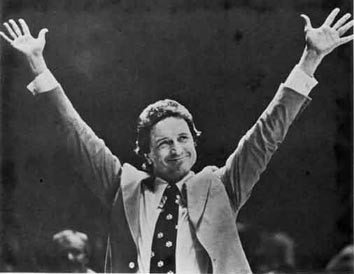
Normally I don’t conduct interviews at urinals. First of all, at least in my case, it’s difficult to take notes. But urinal etiquette usually calls for a couple of guys to brag about the number of Buds passing through or complain that the Cubs haven’t been the same since Ernie Banks last played two.
It’s generally a guy thing as well. And in most cases, I prefer it that way.
“So, Flap, what’s this have to do with going to the bathroom at a local university the other day?” you might ask if you were reading my mind or had been with me.
As “journalist-in-residence” at one of our fine universities in Nashville, I teach young people about writing, ethics, AP style and also advise the student news web site.
And when I’m not talking with these bright young people or drinking Pepsi Maxx, I’ll occasionally – like many of my friends across the U.S., including in Libya and our other recent acquisitions – take a bathroom break.
Other than the every third or fourth decade occurrence, like when I’m chatting with Al McGuire about Magic Johnson and personal hair styles – Al was of the slicked-back persuasion and I am, well something altogether different – I try to pay attention to my own business when in the john.
I’m sure women do the same, but I’ve never been one (although I remain an avid fan), so am not sure what goes on in the women’s restrooms. I have seen couches in there, which does give me pause to wonder just what kind of lurid things are happening in there. But it’s none of my business.
Speaking of minding my business, that’s what I was doing the other day at the university when a when a young man – wearing a T-shirt proclaiming allegiance to God and country – stepped up two urinals away and turned on the speaker function on his iPhone, so he could have a loud conversation with his girlfriend while he was going to the bathroom.
Between the “I’m sorrys” and “I love yous” and “I can’t wait to see yous” and “what did your parents say when they found out” conversation bouncing off the tile walls, well I have to tell you I felt violated. The girl’s voice was so loud that it was as if she was in there too.
And I personally couldn’t believe this young man – a smart and rich young college lad I’m sure – would continue his elimination process while love-cooing his girlfriend. I mean, I’m all for multi-tasking….
Few call me a prude … with good reason and reputation, I’m afraid … but this whole thing turned me against iPhones. If I’d been at Greer Stadium, where they have those big troughs, I’d probably have knocked the phone in there. The girl’s voice would have faded into the sea of recycled Buds.
Which brings me back to Al McGruire in the restroom at the Murphy Center in Murfreesboro back in 1979.
It was my favorite time to be a sportswriter, as generally the first round of the NCAA tournament would be played within a couple hour’s drive. It would be in Murfreesboro, Tenn., or Bowling Green, Ky., and once we even went over to Lexington to watch the first weekend’s games and then the following week’s Regionals.
What was special about these tournaments was that, to a young sportswriter/editor, I got to spend time with the best young athletes and broadcasters, watch remarkable basketball and, if necessary, eat for free in the media lounge.
On that particular weekend in 1979 I was in Mufreesboro primarily because I wanted to see Earvin “Magic” Johnson and his pal, Greg Kelser (the only Spartan to ever score 2,000 points and 1,000 rebounds ) tear into Lamar (Not ALEXANDER … the University … although I’d have gladly watched them tear into the governor as well.)
I’d also been a huge fan of Al McGuire, especially liking it when he reamed out Billy Packer. Hey, Al’s dead. Don’t be silly: Whatever happened to Billy?
Al didn’t hold himself as better than anyone. He and I had just ended up in the same bathroom because back then, the NCAA tournament was not owned by General Electric, Disney World, Gannett, CBS, the oil cartels and the law enforcement Taliban. Even small-time newspaper sports editors and their pals were afforded press credentials without fingerprinting, genital fondling, DNA analysis and blowing into a blood-alcohol machine (a fortunate thing in many cases).
It was in the era of “jump balls.” Remember them? If so, I’m sorry for you. You are pretty damned old.
Anyway, I wanted to talk to Al for one of my slices of life columns I was providing from this tournament. I was covering the games, but I also was writing color stories.
Which would be the only reason I’d ever go into a press conference held by Bobby Knight and ask what he’d tell me was a stupid question. You know, all I did was ask him why he was such a turd. The answer was obvious to us all, and I don’t think he took particular objection. But every question was stupid then for Bobby, long before they tarred and feathered him and ran him out of Bloomington, Ind., in a straitjacket with a bottle rocket up his butt.
But then there was Al McGuire, who coached his Marquette team – a gang of very skilled pseudo-Catholic outlaws – to an NCAA championship in 1977 and retired to the broadcast booth.
He was a likable coach, who proved even more likable behind the microphone. And since I’d won $136 on the Marquette victory (office pools were illegal back then .. .much as they are today), I really liked the guy. After all, he and “Bo” Ellis and the gang had defeated Dean Smith’s Tarballs for the championship.
Anyway, let’s get right to the point, as my pal, Tom Petty, likes to say, I found myself standing at the urinal next to Al McGuire in between games.
Since this was one time when I was alone with one of the great characters in basketball history, I decided to conduct an interview. I mean, I already at that point in my life had spent days with Muhammad Ali (clothed and unclothed – him not me), John Wooden (generally well-clothed), Henry Aaron (in a nice suit), Joe Montana (wearing a dozen Super Bowl rings) and O.J. Simpson (who kept sharpening his knife on his shoe soles while we spoke).
So, with Al, well, I just started chatting. We had bladders filled and so there was time to talk about basketball, about Magic and about his championship season. It was obvious to me that we’d both had our share of “Tab” back in the media lounge. Remember “Tab”? Tasted like Diet Coke.
After we zipped up that conversation, we converged on the single sink. I always wash my hands. Not just after I use the facilities, but always. In fact there are times when my hands turn raw from the repeated washing. Yes, I am the lunatic you’re looking for.
There was just the one sink, so Al and I washed our hands together. Soap brothers. Then he smiled and looked at my shock of hair. My hair, although somewhat shorter back then and almost black, always has exceeded societal-norm standards.
“I guess you don‘t use one of these, do you?” he said, as he pulled a comb from behind the hanky in his breast pocket. “See, you go like this….”
At which point one of the great basketball coaches in NCAA history gave me lessons on combing hair while I finally retrieved my notebook from my back pocket and began scribbling down notes.
“Well, Tim, I gotta get back to work. See what happens in the next game,” he said, as we shook clean hands and walked back toward press row.
Probably nowadays, sports announcers have security clear the rest rooms so long-haired smalltown journalists won’t bother them in their hour of darkness. For all I know Billy Packer left broadcasting not just because he insulted Duke students and alienated almost everyone but because he was afraid I’d catch up to him one day in the john.
I loved Al McGuire and Marquette, and his street-guy-gentlemanly ease with a young reporter proved his image was just him being him. And the urinal interview would have been the capper on a great weekend.
But then, as Al walked away, I looked up, and there was Magic Johnson, standing in front of me, in the hallway.
He’d already done his dog-and-pony press conference, his NCAA duties, smiling and capturing hearts, just as he did the remainder of his ball-playing years.
He had no reason to stop when I asked him if he had time. Course he was standing in front of me, but much lesser athletes and musicians and politicians have ignored me and wandered off, haven’t you Senator Sasser, Mickey Mantle (course you were drunk), Toby Keith and Al Gore.
I looked up at the guy blocking the hallway, who was, to my way of thinking, the best, most-complete basketball player on the planet. And he was there with Kelser, his support man.
This was long before Magic became famous for contracting HIV. Long before he took over the helm of the Los Angeles Lakers after Jabbar went down and guided them – from the center spot – to a world championship.
He was just a big kid, a sophomore in college, and that day he and Kelser had put on a Globe Trotter-worthy exhibition, crushing Lamar, 95-64, in the second-round of the Mideast Regionals.
During my life, I’ve covered a lot of basketball games and met a lot of ballplayers. But, other than James “Fly” Williams, who was a gunslinger for then-outlaw school Austin Peay State University, none of them had a bigger smile than Magic.
And, to be fair, Fly’s smile was enhanced by the fact he was snaggle-toothed. His Peay pals apparently didn’t take care of his dental work. He became a friend of mine and sometime I’ll go up to see if he’s still alive in New York City.
That’s another long story and I may get to it today or it may be next time. Or later on to be sure.
Because this one really is about Magic. Well, about Al McGuire and Magic.
I’ve been thinking a lot about both men as this NCAA tournament – as Al called it “The Big Effin’ Dance” -- progresses.
I love basketball, but there never has been another player who could not only dominate a game but capture hearts like Magic Johnson.
I saw Michael Jordan in the rafters up in the Charlotte Mausoleum the other day and it made me think two things.
No. 1, Michael Jordan was a great basketball player and I loved to watch him play. But I don’t think I’d like to know him, as I’m a Fruit of the Looms guy.
No. 2, Magic Johnson was better. And I am glad I got to know him a little bit back during his playing days.
For me that 1979 season, which ended up with the storied Bird-Magic showdown – won by Magic – may have been college basketball at its best. I later met Bird, and he too seemed like a nice guy, even when I laughed at him for growing up in French Lick.
Anyway, after our conversation, Magic told me he wanted to watch some basketball. So I let him go.
A few minutes later I walked back into the arena, and was looking for a place to sit in the stands. Magic and Greg Kelser waved me up to sit with them.
So I did. Just a scruffy-haired sports editor, wearing Acme cowboy boots, sitting up in the stands watching basketball games with Magic Johnson.
And, a few rows below, Al McGuire was sipping on a Tab.
Besides that, we both were raised in the North, loved basketball and had just relished watching a young and lean Earvin “Magic” Johnson offer proof that he was the best basketball player in the universe.
I was looking for some happy banter, anyway, as I had just been talking to Bobby Knight and was feeling the need to escape that egotistical throw-a-chair-across-the-court hangover funk that resulted.
And Al, well, he was such a contrast to the perhaps brilliant, but erratic, Knight, who these 32 years later has said “Jimmy Tressel represents all that’s good about college athletics” or some such. That’s another story, of course. If that’s true, then Bruce Pearl also is a similarly stellar representation. Wonder if Pearl took that orange sport coat with him when escorted to the door at UT? Great for grilling out.
Normally I don’t conduct interviews at urinals. First of all, at least in my case, it’s difficult to take notes. But urinal etiquette usually calls for a couple of guys to brag about the number of Buds passing through or complain that the Cubs haven’t been the same since Ernie Banks last played two.
It’s generally a guy thing as well. And in most cases, I prefer it that way.
“So, Flap, what’s this have to do with going to the bathroom at a local university the other day?” you might ask if you were reading my mind or had been with me.
As “journalist-in-residence” at one of our fine universities in Nashville, I teach young people about writing, ethics, AP style and also advise the student news web site.
And when I’m not talking with these bright young people or drinking Pepsi Maxx, I’ll occasionally – like many of my friends across the U.S., including in Libya and our other recent acquisitions – take a bathroom break.
Other than the every third or fourth decade occurrence, like when I’m chatting with Al McGuire about Magic Johnson and personal hair styles – Al was of the slicked-back persuasion and I am, well something altogether different – I try to pay attention to my own business when in the john.
I’m sure women do the same, but I’ve never been one (although I remain an avid fan), so am not sure what goes on in the women’s restrooms. I have seen couches in there, which does give me pause to wonder just what kind of lurid things are happening in there. But it’s none of my business.
Speaking of minding my business, that’s what I was doing the other day at the university when a when a young man – wearing a T-shirt proclaiming allegiance to God and country – stepped up two urinals away and turned on the speaker function on his iPhone, so he could have a loud conversation with his girlfriend while he was going to the bathroom.
Between the “I’m sorrys” and “I love yous” and “I can’t wait to see yous” and “what did your parents say when they found out” conversation bouncing off the tile walls, well I have to tell you I felt violated. The girl’s voice was so loud that it was as if she was in there too.
And I personally couldn’t believe this young man – a smart and rich young college lad I’m sure – would continue his elimination process while love-cooing his girlfriend. I mean, I’m all for multi-tasking….
Few call me a prude … with good reason and reputation, I’m afraid … but this whole thing turned me against iPhones. If I’d been at Greer Stadium, where they have those big troughs, I’d probably have knocked the phone in there. The girl’s voice would have faded into the sea of recycled Buds.
Which brings me back to Al McGruire in the restroom at the Murphy Center in Murfreesboro back in 1979.
It was my favorite time to be a sportswriter, as generally the first round of the NCAA tournament would be played within a couple hour’s drive. It would be in Murfreesboro, Tenn., or Bowling Green, Ky., and once we even went over to Lexington to watch the first weekend’s games and then the following week’s Regionals.
What was special about these tournaments was that, to a young sportswriter/editor, I got to spend time with the best young athletes and broadcasters, watch remarkable basketball and, if necessary, eat for free in the media lounge.
On that particular weekend in 1979 I was in Mufreesboro primarily because I wanted to see Earvin “Magic” Johnson and his pal, Greg Kelser (the only Spartan to ever score 2,000 points and 1,000 rebounds ) tear into Lamar (Not ALEXANDER … the University … although I’d have gladly watched them tear into the governor as well.)
I’d also been a huge fan of Al McGuire, especially liking it when he reamed out Billy Packer. Hey, Al’s dead. Don’t be silly: Whatever happened to Billy?
Al didn’t hold himself as better than anyone. He and I had just ended up in the same bathroom because back then, the NCAA tournament was not owned by General Electric, Disney World, Gannett, CBS, the oil cartels and the law enforcement Taliban. Even small-time newspaper sports editors and their pals were afforded press credentials without fingerprinting, genital fondling, DNA analysis and blowing into a blood-alcohol machine (a fortunate thing in many cases).
It was in the era of “jump balls.” Remember them? If so, I’m sorry for you. You are pretty damned old.
Anyway, I wanted to talk to Al for one of my slices of life columns I was providing from this tournament. I was covering the games, but I also was writing color stories.
Which would be the only reason I’d ever go into a press conference held by Bobby Knight and ask what he’d tell me was a stupid question. You know, all I did was ask him why he was such a turd. The answer was obvious to us all, and I don’t think he took particular objection. But every question was stupid then for Bobby, long before they tarred and feathered him and ran him out of Bloomington, Ind., in a straitjacket with a bottle rocket up his butt.
But then there was Al McGuire, who coached his Marquette team – a gang of very skilled pseudo-Catholic outlaws – to an NCAA championship in 1977 and retired to the broadcast booth.
He was a likable coach, who proved even more likable behind the microphone. And since I’d won $136 on the Marquette victory (office pools were illegal back then .. .much as they are today), I really liked the guy. After all, he and “Bo” Ellis and the gang had defeated Dean Smith’s Tarballs for the championship.
Anyway, let’s get right to the point, as my pal, Tom Petty, likes to say, I found myself standing at the urinal next to Al McGuire in between games.
Since this was one time when I was alone with one of the great characters in basketball history, I decided to conduct an interview. I mean, I already at that point in my life had spent days with Muhammad Ali (clothed and unclothed – him not me), John Wooden (generally well-clothed), Henry Aaron (in a nice suit), Joe Montana (wearing a dozen Super Bowl rings) and O.J. Simpson (who kept sharpening his knife on his shoe soles while we spoke).
So, with Al, well, I just started chatting. We had bladders filled and so there was time to talk about basketball, about Magic and about his championship season. It was obvious to me that we’d both had our share of “Tab” back in the media lounge. Remember “Tab”? Tasted like Diet Coke.
After we zipped up that conversation, we converged on the single sink. I always wash my hands. Not just after I use the facilities, but always. In fact there are times when my hands turn raw from the repeated washing. Yes, I am the lunatic you’re looking for.
There was just the one sink, so Al and I washed our hands together. Soap brothers. Then he smiled and looked at my shock of hair. My hair, although somewhat shorter back then and almost black, always has exceeded societal-norm standards.
“I guess you don‘t use one of these, do you?” he said, as he pulled a comb from behind the hanky in his breast pocket. “See, you go like this….”
At which point one of the great basketball coaches in NCAA history gave me lessons on combing hair while I finally retrieved my notebook from my back pocket and began scribbling down notes.
“Well, Tim, I gotta get back to work. See what happens in the next game,” he said, as we shook clean hands and walked back toward press row.
Probably nowadays, sports announcers have security clear the rest rooms so long-haired smalltown journalists won’t bother them in their hour of darkness. For all I know Billy Packer left broadcasting not just because he insulted Duke students and alienated almost everyone but because he was afraid I’d catch up to him one day in the john.
I loved Al McGuire and Marquette, and his street-guy-gentlemanly ease with a young reporter proved his image was just him being him. And the urinal interview would have been the capper on a great weekend.
But then, as Al walked away, I looked up, and there was Magic Johnson, standing in front of me, in the hallway.
He’d already done his dog-and-pony press conference, his NCAA duties, smiling and capturing hearts, just as he did the remainder of his ball-playing years.
He had no reason to stop when I asked him if he had time. Course he was standing in front of me, but much lesser athletes and musicians and politicians have ignored me and wandered off, haven’t you Senator Sasser, Mickey Mantle (course you were drunk), Toby Keith and Al Gore.
I looked up at the guy blocking the hallway, who was, to my way of thinking, the best, most-complete basketball player on the planet. And he was there with Kelser, his support man.
This was long before Magic became famous for contracting HIV. Long before he took over the helm of the Los Angeles Lakers after Jabbar went down and guided them – from the center spot – to a world championship.
He was just a big kid, a sophomore in college, and that day he and Kelser had put on a Globe Trotter-worthy exhibition, crushing Lamar, 95-64, in the second-round of the Mideast Regionals.
During my life, I’ve covered a lot of basketball games and met a lot of ballplayers. But, other than James “Fly” Williams, who was a gunslinger for then-outlaw school Austin Peay State University, none of them had a bigger smile than Magic.
And, to be fair, Fly’s smile was enhanced by the fact he was snaggle-toothed. His Peay pals apparently didn’t take care of his dental work. He became a friend of mine and sometime I’ll go up to see if he’s still alive in New York City.
That’s another long story and I may get to it today or it may be next time. Or later on to be sure.
Because this one really is about Magic. Well, about Al McGuire and Magic.
I’ve been thinking a lot about both men as this NCAA tournament – as Al called it “The Big Effin’ Dance” -- progresses.
I love basketball, but there never has been another player who could not only dominate a game but capture hearts like Magic Johnson.
I saw Michael Jordan in the rafters up in the Charlotte Mausoleum the other day and it made me think two things.
No. 1, Michael Jordan was a great basketball player and I loved to watch him play. But I don’t think I’d like to know him, as I’m a Fruit of the Looms guy.
No. 2, Magic Johnson was better. And I am glad I got to know him a little bit back during his playing days.
For me that 1979 season, which ended up with the storied Bird-Magic showdown – won by Magic – may have been college basketball at its best. I later met Bird, and he too seemed like a nice guy, even when I laughed at him for growing up in French Lick.
Anyway, after our conversation, Magic told me he wanted to watch some basketball. So I let him go.
A few minutes later I walked back into the arena, and was looking for a place to sit in the stands. Magic and Greg Kelser waved me up to sit with them.
So I did. Just a scruffy-haired sports editor, wearing Acme cowboy boots, sitting up in the stands watching basketball games with Magic Johnson.
And, a few rows below, Al McGuire was sipping on a Tab.
Tuesday, March 8, 2011
On Mardi Gras, Fats Domino offers hope, pounding piano and friendship from a city I fell in love with when I killed Jesus in Lower 9th
The first time I was in New Orleans I killed Jesus.
That’s a long story.
Now whenever I think of that city, I think of Fats Domino.
Of course, the two incidents and the two main stars in my New Orleans dramas aren’t the same.
Fats helped invent rock ‘n’ roll.
Jesus, of course had plenty of other accomplishments, what with the water into wine and the other miracles of faith.
But I think the ignorant white trash who burned Beatles albums back in the 1960s call rock ‘n’ roll “the Devil’s music.”
Course it’s not the Devil’s music that came from my friend Fats down in New Orleans. It was equal parts tabernacle and temptation, boogie and bordello stomp, sung by a man with the voice only an angel could emulate. Or was he a devil in disguise?
Many have laid claim to “inventing” rock ‘n’ roll. Little Richard. Chuck Berry. Ike Turner. Sam Philips. Elvis never claimed he invented it, even after he was crowned king.
Carl Perkins’ role in the “invention” of the music is under-appreciated, at least in part because he was seriously injured early in his career, allowing Elvis to leap frog. And in another part because Carl was humble.
Well, Carl said that Fats was the one who kept the rock flame burning while all others extinguished. His flamboyant showmanship didn’t become a self-indulgent caricature. Instead, the Fat Man just kept on making music.
And, as for the Devil’s music, well in one of the interviews I’ve been fortunate enough to do over the years, Fats said he was “lucky” that songs like “I’m Walkin’” and “Blueberry Hill” and “Walkin’ to New Orleans” allowed him to make a good living while still allowing him to stay true to his gospel and family roots. Not just in spirit but by living in one section of town, he hoped, for his whole life.
“Nobody lives forever,” he told me once. “Stay as close as you can (to the teachings in the Bible). That’s the main thing.”
A bit of Fats on the CD player (for I still listen to music that way) I was thinking about the day I killed Jesus and about the great and humble rock pioneer Tuesday, Mardi Gras, so I picked up the phone to call Fats to wish him a happy Fat Tuesday. After all, if anyone should enjoy Fat Tuesday, it should be Fats Domino.
Fats lives not too far from the Lower Ninth Ward, where he lived with his family in a colorful compound virtually forever, until Katrina. In fact he never would have left if it hadn’t been for that disaster.
It was his home, his part of town.
People who had all but forgotten about him were reminded first when authorities said they thought Fats and his family were among those washed away, and then later when Coast Guard boats rescued the whole clan from the second floor of the house.
While cultural historians have helped to restore the old office of the man who took New Orleans funk to the people, it is still in a desolate and unfortunate part of the city. The surroundings show the disgrace of abandonment, of ignorance and neglect of those who have been in power since and before the Hurricane.
Now, back to the first part of this New Orleans love story. How did the guy who loves and has befriended Fats kill Jesus in New Orleans?
Well, first of all I was still a juvenile, so it can be forgiven this “sin” that took place in between a couple of hours of jump jiving gospel music, chicken and sweet potato pie at a church in the Lower Ninth.
I was there again as something of a rebel. While I was good about attending church, I was (and remain) a “non-joiner.” So, I didn’t participate in the youth group activities, other than the night The Byrds played in the teen nightclub in the church basement. Our own cellar full of noise, I suppose.
Oh sure, I was a good student. And I was a good usher in the early service, primarily because the offertory came pre-sermon. We could collect, go downstairs and count, put it in the safe and head to the kitchen for donuts and coffee.
Yes, sweet caffeine. So while they were upstairs singing the praises, I was double dunking and enjoying the fruits and bounty. My Sweet Lord indeed.
The problem was that, despite my misgivings, the youth minister wanted me involved. There was a choir trip coming up around Easter time and she wanted me to try out for a play that was going to be the centerpiece. I looked at the script for “Christ in the Concrete City.” I still have it around here someplace.
Basically, the stark play put Jesus in a modern environment. The four –person cast had multiple roles.
I was typecast from the outset: “Tim, I want you to play Judas, Pilate and the Roman soldier who nails Christ on the cross,” said the preacher.
OK. Other people got to play Peter, Paul and Mary or whatever. I get to be the combination of history’s greatest villains. Appealed to the side of me who enjoyed breaking noses in soccer games in p.e.
Course, if you see me, you’ll notice I had my share of busted noses as well. Two in football and probably two or three playing soccer. Pleased to meet you, I suppose. And we all shine on.
Anyway, I won’t bore you with details, as this really is about New Orleans, but the play was presented throughout the South, in urban, black churches. We stayed in those churches and enjoyed the best food they had to offer.
My favorite performance was in New Orleans, as a matter of fact. For when I came to the line where I actually nailed Christ to the cross (he wasn’t played by anyone… merely a holy air space we played around), my line was “Down goes the hammer!” and I was supposed to drive my right arm down, invisible hammer driving invisible spike into invisible savior’s hands and ankles.
Well, the church kneeling rail was right up next to where I was killing Jesus, and as my arm went down, I caught the underside of my forearm on the rail. It cut my shirt and arm. Blood came rolling down my arm. Peter, Paul and Mary came over to look at me and see if I was all right. It had been an awful sound after all. I don’t think I cursed.
“Just got some of Jesus’ blood on me. It splashed,” I adlibbed, quietly.
Play was almost over.
Anyway, that was in New Orleans. I’ve been back plenty of times, though seldom have killed the savior again.
I’ve been there when I slept in my car next to the Mississippi and spent another night sleeping in an all-night showing of “Live and Let Die” in one of those old theaters on Canal.
Been down there to cover sporting events, like Muhammad Ali and Leon Spinks’ prizefight in 1978.
Taken other business trips there and even have taken to enjoying family vacations there….. The last one, though, came about two weeks before Katrina.
I have no great claims on the city, other than that it is probably my favorite city in North America.
Of course it has had its problems, with violence and corruption. And it has been ignored. Many thousands who fled in the days after George W. Bush and the Corps of Engineers exercised due diligence in saving the city, have not returned.
Many more people died.
And now, much of the city remains in ruins.
So it cheers me to see that it is Mardi Gras and that the people down there are celebrating again. Of course the skin tone of celebrants is increasingly white, since large black sections of town were obliterated by the storm. Never to return.
Still it is Mardi Gras. The big blast before Lent.
So, I called Fats and asked what he’s been doing lately.
“Been playing a lot, you know, keeping fingers loose,” he said, with a laugh.
He also likes to watch TV, sleep and visit with his family and friends.
He’s got new songs he’d like to record, but, since he just turned 83, he may or may not have a chance.
Still he was glad to hear from me. “You call any old time,” he said.
“You going to party today, since it’s Mardi Gras?” I asked.
“Believe I’m just gonna lay down on my bed,” he said, again his soft laughter rising. “You call again, Tim. Anytime.”
On Mardi Gras, the great rock pioneer set down the phone in the city where I killed Jesus. And he went to bed.
That’s a long story.
Now whenever I think of that city, I think of Fats Domino.
Of course, the two incidents and the two main stars in my New Orleans dramas aren’t the same.
Fats helped invent rock ‘n’ roll.
Jesus, of course had plenty of other accomplishments, what with the water into wine and the other miracles of faith.
But I think the ignorant white trash who burned Beatles albums back in the 1960s call rock ‘n’ roll “the Devil’s music.”
Course it’s not the Devil’s music that came from my friend Fats down in New Orleans. It was equal parts tabernacle and temptation, boogie and bordello stomp, sung by a man with the voice only an angel could emulate. Or was he a devil in disguise?
Many have laid claim to “inventing” rock ‘n’ roll. Little Richard. Chuck Berry. Ike Turner. Sam Philips. Elvis never claimed he invented it, even after he was crowned king.
Carl Perkins’ role in the “invention” of the music is under-appreciated, at least in part because he was seriously injured early in his career, allowing Elvis to leap frog. And in another part because Carl was humble.
Well, Carl said that Fats was the one who kept the rock flame burning while all others extinguished. His flamboyant showmanship didn’t become a self-indulgent caricature. Instead, the Fat Man just kept on making music.
And, as for the Devil’s music, well in one of the interviews I’ve been fortunate enough to do over the years, Fats said he was “lucky” that songs like “I’m Walkin’” and “Blueberry Hill” and “Walkin’ to New Orleans” allowed him to make a good living while still allowing him to stay true to his gospel and family roots. Not just in spirit but by living in one section of town, he hoped, for his whole life.
“Nobody lives forever,” he told me once. “Stay as close as you can (to the teachings in the Bible). That’s the main thing.”
A bit of Fats on the CD player (for I still listen to music that way) I was thinking about the day I killed Jesus and about the great and humble rock pioneer Tuesday, Mardi Gras, so I picked up the phone to call Fats to wish him a happy Fat Tuesday. After all, if anyone should enjoy Fat Tuesday, it should be Fats Domino.
Fats lives not too far from the Lower Ninth Ward, where he lived with his family in a colorful compound virtually forever, until Katrina. In fact he never would have left if it hadn’t been for that disaster.
It was his home, his part of town.
People who had all but forgotten about him were reminded first when authorities said they thought Fats and his family were among those washed away, and then later when Coast Guard boats rescued the whole clan from the second floor of the house.
While cultural historians have helped to restore the old office of the man who took New Orleans funk to the people, it is still in a desolate and unfortunate part of the city. The surroundings show the disgrace of abandonment, of ignorance and neglect of those who have been in power since and before the Hurricane.
Now, back to the first part of this New Orleans love story. How did the guy who loves and has befriended Fats kill Jesus in New Orleans?
Well, first of all I was still a juvenile, so it can be forgiven this “sin” that took place in between a couple of hours of jump jiving gospel music, chicken and sweet potato pie at a church in the Lower Ninth.
I was there again as something of a rebel. While I was good about attending church, I was (and remain) a “non-joiner.” So, I didn’t participate in the youth group activities, other than the night The Byrds played in the teen nightclub in the church basement. Our own cellar full of noise, I suppose.
Oh sure, I was a good student. And I was a good usher in the early service, primarily because the offertory came pre-sermon. We could collect, go downstairs and count, put it in the safe and head to the kitchen for donuts and coffee.
Yes, sweet caffeine. So while they were upstairs singing the praises, I was double dunking and enjoying the fruits and bounty. My Sweet Lord indeed.
The problem was that, despite my misgivings, the youth minister wanted me involved. There was a choir trip coming up around Easter time and she wanted me to try out for a play that was going to be the centerpiece. I looked at the script for “Christ in the Concrete City.” I still have it around here someplace.
Basically, the stark play put Jesus in a modern environment. The four –person cast had multiple roles.
I was typecast from the outset: “Tim, I want you to play Judas, Pilate and the Roman soldier who nails Christ on the cross,” said the preacher.
OK. Other people got to play Peter, Paul and Mary or whatever. I get to be the combination of history’s greatest villains. Appealed to the side of me who enjoyed breaking noses in soccer games in p.e.
Course, if you see me, you’ll notice I had my share of busted noses as well. Two in football and probably two or three playing soccer. Pleased to meet you, I suppose. And we all shine on.
Anyway, I won’t bore you with details, as this really is about New Orleans, but the play was presented throughout the South, in urban, black churches. We stayed in those churches and enjoyed the best food they had to offer.
My favorite performance was in New Orleans, as a matter of fact. For when I came to the line where I actually nailed Christ to the cross (he wasn’t played by anyone… merely a holy air space we played around), my line was “Down goes the hammer!” and I was supposed to drive my right arm down, invisible hammer driving invisible spike into invisible savior’s hands and ankles.
Well, the church kneeling rail was right up next to where I was killing Jesus, and as my arm went down, I caught the underside of my forearm on the rail. It cut my shirt and arm. Blood came rolling down my arm. Peter, Paul and Mary came over to look at me and see if I was all right. It had been an awful sound after all. I don’t think I cursed.
“Just got some of Jesus’ blood on me. It splashed,” I adlibbed, quietly.
Play was almost over.
Anyway, that was in New Orleans. I’ve been back plenty of times, though seldom have killed the savior again.
I’ve been there when I slept in my car next to the Mississippi and spent another night sleeping in an all-night showing of “Live and Let Die” in one of those old theaters on Canal.
Been down there to cover sporting events, like Muhammad Ali and Leon Spinks’ prizefight in 1978.
Taken other business trips there and even have taken to enjoying family vacations there….. The last one, though, came about two weeks before Katrina.
I have no great claims on the city, other than that it is probably my favorite city in North America.
Of course it has had its problems, with violence and corruption. And it has been ignored. Many thousands who fled in the days after George W. Bush and the Corps of Engineers exercised due diligence in saving the city, have not returned.
Many more people died.
And now, much of the city remains in ruins.
So it cheers me to see that it is Mardi Gras and that the people down there are celebrating again. Of course the skin tone of celebrants is increasingly white, since large black sections of town were obliterated by the storm. Never to return.
Still it is Mardi Gras. The big blast before Lent.
So, I called Fats and asked what he’s been doing lately.
“Been playing a lot, you know, keeping fingers loose,” he said, with a laugh.
He also likes to watch TV, sleep and visit with his family and friends.
He’s got new songs he’d like to record, but, since he just turned 83, he may or may not have a chance.
Still he was glad to hear from me. “You call any old time,” he said.
“You going to party today, since it’s Mardi Gras?” I asked.
“Believe I’m just gonna lay down on my bed,” he said, again his soft laughter rising. “You call again, Tim. Anytime.”
On Mardi Gras, the great rock pioneer set down the phone in the city where I killed Jesus. And he went to bed.
Saturday, February 26, 2011
Night of neon, Shel memories, smiling with squeezebox queen and savoring Don Kelley & Dave Roe while young cowboy dreams
The kid with the Brad Paisley Stetson caught up just as I stepped past the statue of Elvis on the sidewalk and kept going straight, glancing, as I usually do, up the hill at the Ryman and remembering when I used to sneak in the alley door into the Opry every week.
“Man, they won’t run over both of us, I hope,” said the kid as he and I stepped --- with the little green-dude walk signals – in front of disobedient traffic and across Fifth Avenue. We both were bound uphill. He for the Masonic Lodge parking lot – where his band’s van was parked – and me to the old white Saab parked on Broadway in front of that monument.
“Me and my band are playing at Cadillac Ranch and I gotta get the van with the instruments in it and pull down there for a minute,” said the kid.
“We been playing together awhile. Mostly down in Alabama, but now we’re working hard to make it here,” said the kid.
I stopped so I could turn to him and extend my hand, introducing myself. After all, he and I had just completed a death-defying act in the middle of lawless Nashville, where red lights are mere bothers.
Stewart Halcomb laughed, easily, and met my firm handshake with his own. Sensing he might be a musician, though – although not just musicians wear cowboy hats on Lower Broad – I didn’t tighten the throttle on my hand-grip.
I reserve a slightly softer shake for guys who use their hands to play guitars and for prizefighters. I remember one of the times I hung out with Muhammad Ali, he winched when I shook his hand. Course he’d spent the prior evening beating up Leon Spinks. All I’d done was write about it and hang out with Larry Holmes, Joe Frazier and the really pretty woman who’d stepped into the ring naked.
The young cowboy and I began the gentle uphill stroll in front of the urban atrocity that is the convention center. If this one’s bad, what’s the next one gonna look like? Anyway, he went on to talk about the hard life he and his band mates in The Springs had chosen, but how they were chasing the dream that had lured so many country acts to Nashville over decades.
Yep, Hank done it this way, after all, I shrugged.
Stewart added that his band was still smoothing its edges and that, while there’s a CD out, I shouldn’t judge them by that. “We like to play live and we really don’t know yet how to record right,” said the affable kid, the leader and songwriter of a band that is aged 19-22 and that plays most nights down in Nashville’s Disney World.
I call it “Nashville’s Disney World” because it’s not the Lower Broadway that I first fell in love with 40 years ago. Course I had dark hair and a less-firm grip on reality back then. This was going to be a town that I’d write about for life. The musicians, the dreamers, the whores.
It was in a time when Roger Miller still could be found sipping coffee in an all-night diner and Shel Silverstein and Bobby Bare would stop to help a young guy rescue old bricks from a road that was being “resurfaced” to asphalt. I’ve told you about that. They even helped young guy load the bricks in the trunk of the ’65 Falcon.
Same car took me all over the country for awhile. Spent a lot of time sleeping in it in the streets of New Orleans, San Francisco, San Antonio, Kerrville or next to it out at Joshua Tree. Course Wizard traveled with me. I wonder what happened to the Falcon after the engine blew? Sought out Wizard once on the internet a year or so ago and made contact. Realized then there was a plenty good reason we weren’t friends any more. No need to go into them here. Too many a--holes in the world would be offended.
But then that’s a side story for another day. Right now, I’m talking about Stewart, the nice kid with the dream. He didn’t talk just about his dream, though. He asked about mine. Yes, I still have some, even though the booger-eating Ghadafis of Korporate Amerika tried to beat them out of me… but failed.
Anyway, we talked about songwriting and people writing, about guitars and Tennessee Titans while we walked to our vehicles. I told him I’d hit his bar one night. I don’t drink nor do I ride mechanical (or even real-life) bulls anymore, but I’d like to see this kid. It’s nice when hope and optimism brighten a young guy’s face.
I had gone to Lower Broadway as a part of a magazine assignment that has taken me to music venues all over the city in the last week or so.
As I’m old and don’t drink beer, I tried to hit the places relatively early, before busy bartenders tired of offering up icy glasses of free water to the guy with the pony-tail and wearing a 25-year-old Bob Dylan concert T-shirt. That came from when he was touring with G.E. Smith. Horrible show, but I love Bob.
I actually go to Lower Broad fairly frequently. Sometimes it’s just for a walk. Sometimes it’s to relive memories. Sometimes it’s simply to wonder where I been since the days when this was my turf.
Back then it was sticky-floored peep shows and propositions from working women to join them “upstairs,” someplace above the row of neon buildings and souvenir shops that now offer up a G-rated version of Nashville for mass consumption by tourists and hockey fans.
Before the city’s real flesh was covered by Chamber of Commerce boosters and the like, a cigarette smoking writer could easily jaywalk from the Wheel to Tootsie’s, as long as I didn’t trip across some stoned loser or Willie Nelson sprawled in the middle of the street.
Tootsie’s back then was a favorite, because the Opry stars used to hang out upstairs, near the back door. I’d get there early enough to drink beer at the table next to Lefty, ET, Cash, Porter and even old Mooney.
Now, of course, it’s different. City planners helped the once run-down area get “pasteurized.” Souvenir shops and Elvis statues. A huge hockey arena and a convention center. Family restaurants even. Wouldn’t have taken a family down here 40 years ago, I laughed as a group of Japanese smiled at me when I rubbed the nose of one of the Elvis statues.
I wonder if anyone’s heard the news that Elvis actually was from Memphis? He just recorded here. His last few visits to Nashville, he stayed at the old Sheraton on Harding Place at Trousdale – about a mile from my house.
What used to be a top-quality hotel and small convention center became a seedy Ramada before being torn down to make way for a CVS. “Nashville: Where there’s a church on every other corner. A CVS or a Walgreen’s is on the other.”
A part of my mission the other night was to check out an old friend and his outfit. The Don Kelley Band is, for my money (freedom’s just another word for nothin’ left to lose…) the best country cover band in a city overpopulated by country cover bands.
But while guys like Stewart in the Springs are busy writing their own material and trying to bust into the bigs and outlive Luke the Drifter, Don is not following that dream.
Decades ago he began playing at Robert’s, not singing his own songs but the songs made famous by ET, Cash, Waylon, Tom T., Willie, Marty, Roger and even Patsy.
A good soul, he always surrounds himself with the best musicians, many of whom advance into the ranks of elite touring bands or session pickers.
Don’s not that kind of guy. He likes a steady job, a good girlfriend, his house way north of the city and his motorcycle (although he tells me he’s getting too old to ride it).
“I’m not a great singer,” Don will say. “But people kind of like what I do. I can do those Tubb and Cash songs pretty good.”
His current lineup … or really, the lineup during my visit, because it has changed … was him on the bulk of the vocals and rhythm, JD Simo on lead guitar, Dave Roe on slap bass and vocals (have you ever heard a better version of “Pretty Woman” since Roy Orbison died?) and Artie Alinkoff on drums and vocals.
It was among Roe’s last performances with the band. “I’m going to start having the weekends off,” he said, between sets, after he passed the tip jar around the house and sold and autorgraphed CDs
“I like this job, but it’s every Wednesday through Saturday, 6:30 til 10 and it’s time I did some other things. I’m gonna freelance. Like you, Tim,” said Roe, who used to play slap bass with John R. Cash.
I first met him back then. I told him he’d probably have more luck in the freelance world than I, as he’s a much better bass player. But it was good for the ego – and I admit I enjoy a nice stroking now and then (but that’s another story, too) – when Artie, Don and Dave all bragged from the stage about my writing.
“You’re brilliant man,” said Artie. “Really cool.”
Kindred spirits, I’m sure. They must toil hard to make a living out of tips and CD sales – I did buy a copy of their "best of" album. It’s not John Lennon or Johnny Cash. But it’s not supposed to be. It’s a great cover band singing other people’s songs. It makes me smile while I sit here and think.
After a couple of sets, I had to move on. I was going to a bar in East Nashville, where my favorite squeezebox player and Earl Scruggs’ grandson were playing with Paul Burch. Great show there too, though the highlight for me was – again between sets – standing out in the cold and semi-dark of East Nashville and talking to that squeezebox player.
Very few people try as hard to stay solemn when playing, only to bob their heads and smile like Jen Gunderman, who handles accordion and keyboards by night and teaches rock ‘n’ roll at Vanderbilt by day. “I used to think I needed to be, you know, a surly rocker chick,” she said. “But I really love playing. I’m so lucky.”
I wound my way out of East Nashville, trying not to run over crack dealers and prostitutes on Main Street, and pondered the evening.
Pretty enjoyable, thanks to the kid with the musical dream and the band that never stops and the squeezebox queen
And that’s despite the fact I spent a good part of the evening in Nashville’s Disney World, the now brightly lighted section of town that’s featured on Chamber postcards and marketed on "Monday Night Football" and the like.
Tootsie’s long ago was a treasure. Now it’s just a joint. And Tootsie herself is long dead. (I’ve paid my respects at her suitably simple and modest grave before, as she was an interesting woman.)
Sure, I love this new Nashville, even though I can’t find an orange neon glow proclaiming “Possum Holler” – Jones’ old club – anywhere on the skyline. But I guess I’m a relic. I kind of liked it better when a guy could buy coffee and chat with Roger Miller, turn down the advances of the whores and scoot past the peep shows for fear of catching some sort of air-transmitted sexual disease before dodging into a club where Tom T. Hall was singing for beer and laughs with the house band.
Shel Silverstein’s dead and Bobby Bare is now one of my best friends. And the bricks, well they got displaced during the storms of life.
Still I felt energized, by the kid. Stewart Halcomb. I don’t have his CD yet, as I haven’t been to Walmart since that night.
But after a life of writing about those who chase dreams, whether as musicians, athletes, women and men of the cloth or just plain old church janitors, I’ve often had to chronicle how those dreams fell short or ended tragically.
Here’s a kid who says, with a lot of work, he’ll make it. And Nashville’s Disney World will have a brand new star.
I had the urge to go back down to the strip on my way home, buy a pack of smokes and go back into the bars.
Course I didn’t . First of all, I quit smoking 11 years ago. Besides that, I think smoking is illegal down there in Nashville’s Disney World.
It’s just running red lights and almost killing old guys with pony-tails and young cowboy singers that’s still legal. As long as you don't get caught.
Tuesday, February 22, 2011
Savage murders of teenagers, memories of friends past and lost and the April 1 miracle battle with fear inside the ferocious MRI tube
Visions of two teenagers, savagely murdered, stung my brain as it was being magnetized and resonated and otherwise probed by kindly science wizards and their crypt-like device.
Perhaps those memories, which danced with other flashbacks good and bad, were set off by that MRI’s sounds, the incessant beeping, thudding, growling, crunching noise – robots dancing in the dark -- crushing my brainwaves. And what could I do?
The sounds surrounded me, as my head was locked dead-still in a device that seemed like a hockey goalie’s helmet. My only view was the top of the tube in which I was being tortured… or examined … just inches from where the tip of my nose would be had it not been smashed inside the goalie’s helmet.
I thought about those dead kids. But other things flooded my mind. I smiled when I thought about Charlie Chaplin in “Modern Times,” and the cacophony and confusion of the industrial revolution in that old B&W flick. Saw that movie in Dr. Perkins class at Iowa State University, circa 1971. “Damn near publishable in academic journals,” he wrote on my term paper that compared the movie “M*A*S*H” with the Marx Brothers’ “Duck Soup.” Did I ever tell you I met Groucho Marx? Another story, another show. What’s the secret woid?
After film class, I’d go take a steam and then allow myself to be the “dummy” – literally and figuratively -- that Olympic gold medal wrestler Dan Gable, then a workout chum, would toss around the mats. Nope, never beat Dan….
The dead teenagers came back to my mind briefly.
But then, as the magnets ripped into my brain, I was adrift in waterfalls of color, reminiscent of the night Smokin’ Joe and I went to see Leon Russell and the Shelter People after hitching from Ames to Iowa City. Freddie King was the opener. Watch out now…..
The fact that I kept thinking about Rodney Wayne Long and Kathy Jane Nishiyama, the two slaughtered teenagers, isn’t surprising. When my mind wanders, taking inventory of my life and where I been, those handsome faces often reappear.
As do the faces of friends, a diminishing list, either due to age, death or, far too often, corporate fear.
In a phone call not long before he killed himself in a lonely Coast Guard barracks in Alaska, Tony Durr, who really was among my truest friends – oh, he lied, but he loved as well -- told me this truth.
“Tim, if you can make it through life and look back and have enough real friends to fill up the fingers on one hand, you’re lucky,” or something like that. When he emptied the pharmaceutical bottle, I lost one finger, I guess.
Anyway, I couldn’t help thinking about friendship and dead teenagers … two topics which seem to coincide in my sometimes blood-spattered life … when I was in the MRI the other day. This was the most recent reminder of the summer that won’t go away, the summer of 2010, when I lost half my house to a flood and then, before it was even finished being rebuilt, was T-boned at an intersection.
For a day or so I stumbled around, like my closest pal, Champo, used to do back in his college days as dawns approached. He and his friend, Jocko “the hippy hippy shake” expert, had good times chasing windmills and damsels who would be in distress. Of course, I was and remain Champo, though you may call me Flapjacks.
Course, I don’t drink anymore, so the stumbles bothered me. I went to the doctor last July and he said “man, you have one effin’ bad concussion, Flap, old boy.”
I said “doctor, ain’t there nothing I can take?” But there wasn’t. Time heals all wounds, even badly concussed noggins.
It was checking up on the healing process all these months later that had me jammed into the MRI the other afternoon at one of our finer Nashville hospitals and legal drug dispensaries.
I am a claustrophobic, which may account for aspects of my life, the seemly and the less-so and my reactions to smothering authority of all stripes. The likes of Shotgun Dick, Korporate China (owners of the land of the free), George W. and “Big Mac” USA Newspaper Giant – all who/which think Amerikans should be happy with “special sauce” rather than substance … almost as bad as those who allow them to continue to run the country without question.
Hell, I get almost as angry when my basketball-playing pal the Big O says he’s going to cut the budget by taking away heating supplements for the indigent, allowing old people to freeze in order to please the likes of Mr. Bean or whatever that worthless Joker of the House calls himself. Doctor, doctor, ain’t there nothing I can take?
Claustrophobia in the little tube for a half-hour is only easy with eyes closed. But to keep the thought of where I am from turning me into someone resembling the mentally twisted who think it was good to get rid of Mubarak, but we ought to back up the crown prince/emperor/torturer of Bahrain… could it be oil? Black gold? Texas tea? … Well, the first thing you know, old Jed’s a billionaire…. And there’s blood on the sands.
But the bouncing magnetos kept bringing me back to the two teenagers. Murdered. Their deaths scarred me as I orchestrated coverage for the newspaper up in Clarksville. My boss at the time was Tony Durr, by the way.
Three decades have passed since Kathy Jane and Rodney Wayne were killed by the slugs who populate society’s darkest underside. I learned, first-hand about that underside.
So, the two dead teenagers often visit me when I’m just sitting there watching the wheels go round and round. Or, perchance, if I’m lying in a contraption that’s taking magnetic images of the brain of a man who has seen too much and forgotten too little.
Fortunately, the deaths also bring back images of my closest friendships, the News Brothers, a gang of hard-smoking journalists who, by fate, had to cover the two murders as they unfolded and were solved and tried at almost the same time.
Then, as I lay there, trapped in this chamber like some sort of Michael Jackson wannabe, the brain-crunchers not only squeezed my head but began lifting my fillings … nah, I made that up …. Just my ‘magination, runnin’ away with me.
Anyway, my thoughts about the dead teenagers led me to my thoughts about that April 1, 1982, when my co-conspirator, cops reporter Rob “Death” Dollar, co-founder of the News Brothers, and I dropped our pants in the newsroom while the whole building watched.
Well, at least that’s what everyone thought was going to happen that day in history.
The word had spread, Lord knows how …. that the two young men, the associate editor and the cops reporter, were going to bring their nighttime, do-anything-as-long-as-no-one-gets-hurt, frivolity to daytime. Were these boys ready for prime time?
In those days, the hundred-plus in the building believed that we, indeed, would do anything to perhaps take the edge off what had become more Korporate-style management. My pal Tony had disappeared to San Antonio (the scene of one of his many marriages and career stops before he killed himself), Max “the Silver Hammer” Moss – a damn nice guy and great editor -- was sort of shuffled off to a second-in-command role.
Korporate crackdown had brought a new tone, where an editor, whose introductory words to the staff included “reporters are a dime a dozen” would complain that “you boys need to cut your hair” (I didn’t, of course) and perhaps we should join the Chamber of Commerce. Nothing wrong with the Chamber, but when I was back there in journalism school, they put forth the proposition that you should never be a member of a civic organization if you are a journalist. Fear of conflicts of interest. Lots of publishers and editors are Rotary and Kiwanis presidents and Chamber board members these days.
All of these stories are told more in a book I’m trying to write. And, of course, the adventures of Flapjacks and Death are spoken of, softly, whenever unemployed journalists gather over canteens of white lightning in train yards and a toothless man with one leg blows on his harp while his blue-tick hound barks and the wind begins to howl.
Anyway, back to our story: The two News Brothers, it was said, were going to come into the newsroom at 2 p.m. (the official start of our workday) wearing only boxers with hearts on them.
I don’t know how the rumor started. Of course I do, as we had assistance. Still, people believed. Perhaps even hoped, that this would happen. Some wanted it to be the act that would lead us to the door. Others wanted to just be there to witness this strange chapter in the history of two good journalists who did anything they could to get the story.
And even more than anything to try to both celebrate and forget the two murdered teenagers.
Anyway, there’s more to it. But everyone from the Big Guy, our publisher, to the composing room crew to the ad department to the circulation and press room guys showed up at the precise hour, lining the newsroom, looking in the windows from the hallway.
Fully clothed in our high school letter jackets and jeans, Rob in a top hat and me wearing my yellow fedora, we just walked through the crowd, looked at those gathered, shrugged and lighted up our smokes. We sat down at the computers and began to write stories before looking up and saying “April Fools.”
I’d like to say the event ended this way, with a subtle dash of cool. But suddenly two friendly coppers burst into the newsroom with a warrant for my arrest on charges of, I believe, “failing to amuse the public.”
I was hauled off in handcuffs and all who gathered were stunned as the squad car whipped away from the curb.
Actually I hadn’t been in on that part of the gag. Rob had arranged for his friends in the department to come and “arrest me” as the clincher on the joke. (I was glad the gag didn’t include the one cop we liked who enjoyed back-shooting fleeing felons and singing “Happiness is a Warm Gun.” Again, another story.)
A few minutes later, after my release a half-block away, I strode back into the newsroom and saluted my comrade for getting the better of me.
And I waited. … for hours … for retribution …. You see, sometime in all the commotion I had stuck a “load” in one of his Kools….
So well into the evening, that cigarette exploded and my pal dropped from his chair.
We laughed. It had been a good day. For a few hours we had forgotten the faces of those dead teenagers.
Then we went back to work. Hoping the day would end so we could get to Camelot where the chief deputy would buy us drinks and spill his guts about crimes and about why he hated most journalists.
The only problem with having memories like these playing in your head while you are being scanned for brain damage is you wonder perhaps if the images will reflect years of wear and tear … and even show pictures of the dead teenagers.
The scans, surprisingly, showed I’m "normal." Doctor, ain’t there nothing I can take?
Perhaps those memories, which danced with other flashbacks good and bad, were set off by that MRI’s sounds, the incessant beeping, thudding, growling, crunching noise – robots dancing in the dark -- crushing my brainwaves. And what could I do?
The sounds surrounded me, as my head was locked dead-still in a device that seemed like a hockey goalie’s helmet. My only view was the top of the tube in which I was being tortured… or examined … just inches from where the tip of my nose would be had it not been smashed inside the goalie’s helmet.
I thought about those dead kids. But other things flooded my mind. I smiled when I thought about Charlie Chaplin in “Modern Times,” and the cacophony and confusion of the industrial revolution in that old B&W flick. Saw that movie in Dr. Perkins class at Iowa State University, circa 1971. “Damn near publishable in academic journals,” he wrote on my term paper that compared the movie “M*A*S*H” with the Marx Brothers’ “Duck Soup.” Did I ever tell you I met Groucho Marx? Another story, another show. What’s the secret woid?
After film class, I’d go take a steam and then allow myself to be the “dummy” – literally and figuratively -- that Olympic gold medal wrestler Dan Gable, then a workout chum, would toss around the mats. Nope, never beat Dan….
The dead teenagers came back to my mind briefly.
But then, as the magnets ripped into my brain, I was adrift in waterfalls of color, reminiscent of the night Smokin’ Joe and I went to see Leon Russell and the Shelter People after hitching from Ames to Iowa City. Freddie King was the opener. Watch out now…..
The fact that I kept thinking about Rodney Wayne Long and Kathy Jane Nishiyama, the two slaughtered teenagers, isn’t surprising. When my mind wanders, taking inventory of my life and where I been, those handsome faces often reappear.
As do the faces of friends, a diminishing list, either due to age, death or, far too often, corporate fear.
In a phone call not long before he killed himself in a lonely Coast Guard barracks in Alaska, Tony Durr, who really was among my truest friends – oh, he lied, but he loved as well -- told me this truth.
“Tim, if you can make it through life and look back and have enough real friends to fill up the fingers on one hand, you’re lucky,” or something like that. When he emptied the pharmaceutical bottle, I lost one finger, I guess.
Anyway, I couldn’t help thinking about friendship and dead teenagers … two topics which seem to coincide in my sometimes blood-spattered life … when I was in the MRI the other day. This was the most recent reminder of the summer that won’t go away, the summer of 2010, when I lost half my house to a flood and then, before it was even finished being rebuilt, was T-boned at an intersection.
For a day or so I stumbled around, like my closest pal, Champo, used to do back in his college days as dawns approached. He and his friend, Jocko “the hippy hippy shake” expert, had good times chasing windmills and damsels who would be in distress. Of course, I was and remain Champo, though you may call me Flapjacks.
Course, I don’t drink anymore, so the stumbles bothered me. I went to the doctor last July and he said “man, you have one effin’ bad concussion, Flap, old boy.”
I said “doctor, ain’t there nothing I can take?” But there wasn’t. Time heals all wounds, even badly concussed noggins.
It was checking up on the healing process all these months later that had me jammed into the MRI the other afternoon at one of our finer Nashville hospitals and legal drug dispensaries.
I am a claustrophobic, which may account for aspects of my life, the seemly and the less-so and my reactions to smothering authority of all stripes. The likes of Shotgun Dick, Korporate China (owners of the land of the free), George W. and “Big Mac” USA Newspaper Giant – all who/which think Amerikans should be happy with “special sauce” rather than substance … almost as bad as those who allow them to continue to run the country without question.
Hell, I get almost as angry when my basketball-playing pal the Big O says he’s going to cut the budget by taking away heating supplements for the indigent, allowing old people to freeze in order to please the likes of Mr. Bean or whatever that worthless Joker of the House calls himself. Doctor, doctor, ain’t there nothing I can take?
Claustrophobia in the little tube for a half-hour is only easy with eyes closed. But to keep the thought of where I am from turning me into someone resembling the mentally twisted who think it was good to get rid of Mubarak, but we ought to back up the crown prince/emperor/torturer of Bahrain… could it be oil? Black gold? Texas tea? … Well, the first thing you know, old Jed’s a billionaire…. And there’s blood on the sands.
But the bouncing magnetos kept bringing me back to the two teenagers. Murdered. Their deaths scarred me as I orchestrated coverage for the newspaper up in Clarksville. My boss at the time was Tony Durr, by the way.
Three decades have passed since Kathy Jane and Rodney Wayne were killed by the slugs who populate society’s darkest underside. I learned, first-hand about that underside.
So, the two dead teenagers often visit me when I’m just sitting there watching the wheels go round and round. Or, perchance, if I’m lying in a contraption that’s taking magnetic images of the brain of a man who has seen too much and forgotten too little.
Fortunately, the deaths also bring back images of my closest friendships, the News Brothers, a gang of hard-smoking journalists who, by fate, had to cover the two murders as they unfolded and were solved and tried at almost the same time.
Then, as I lay there, trapped in this chamber like some sort of Michael Jackson wannabe, the brain-crunchers not only squeezed my head but began lifting my fillings … nah, I made that up …. Just my ‘magination, runnin’ away with me.
Anyway, my thoughts about the dead teenagers led me to my thoughts about that April 1, 1982, when my co-conspirator, cops reporter Rob “Death” Dollar, co-founder of the News Brothers, and I dropped our pants in the newsroom while the whole building watched.
Well, at least that’s what everyone thought was going to happen that day in history.
The word had spread, Lord knows how …. that the two young men, the associate editor and the cops reporter, were going to bring their nighttime, do-anything-as-long-as-no-one-gets-hurt, frivolity to daytime. Were these boys ready for prime time?
In those days, the hundred-plus in the building believed that we, indeed, would do anything to perhaps take the edge off what had become more Korporate-style management. My pal Tony had disappeared to San Antonio (the scene of one of his many marriages and career stops before he killed himself), Max “the Silver Hammer” Moss – a damn nice guy and great editor -- was sort of shuffled off to a second-in-command role.
Korporate crackdown had brought a new tone, where an editor, whose introductory words to the staff included “reporters are a dime a dozen” would complain that “you boys need to cut your hair” (I didn’t, of course) and perhaps we should join the Chamber of Commerce. Nothing wrong with the Chamber, but when I was back there in journalism school, they put forth the proposition that you should never be a member of a civic organization if you are a journalist. Fear of conflicts of interest. Lots of publishers and editors are Rotary and Kiwanis presidents and Chamber board members these days.
All of these stories are told more in a book I’m trying to write. And, of course, the adventures of Flapjacks and Death are spoken of, softly, whenever unemployed journalists gather over canteens of white lightning in train yards and a toothless man with one leg blows on his harp while his blue-tick hound barks and the wind begins to howl.
Anyway, back to our story: The two News Brothers, it was said, were going to come into the newsroom at 2 p.m. (the official start of our workday) wearing only boxers with hearts on them.
I don’t know how the rumor started. Of course I do, as we had assistance. Still, people believed. Perhaps even hoped, that this would happen. Some wanted it to be the act that would lead us to the door. Others wanted to just be there to witness this strange chapter in the history of two good journalists who did anything they could to get the story.
And even more than anything to try to both celebrate and forget the two murdered teenagers.
Anyway, there’s more to it. But everyone from the Big Guy, our publisher, to the composing room crew to the ad department to the circulation and press room guys showed up at the precise hour, lining the newsroom, looking in the windows from the hallway.
Fully clothed in our high school letter jackets and jeans, Rob in a top hat and me wearing my yellow fedora, we just walked through the crowd, looked at those gathered, shrugged and lighted up our smokes. We sat down at the computers and began to write stories before looking up and saying “April Fools.”
I’d like to say the event ended this way, with a subtle dash of cool. But suddenly two friendly coppers burst into the newsroom with a warrant for my arrest on charges of, I believe, “failing to amuse the public.”
I was hauled off in handcuffs and all who gathered were stunned as the squad car whipped away from the curb.
Actually I hadn’t been in on that part of the gag. Rob had arranged for his friends in the department to come and “arrest me” as the clincher on the joke. (I was glad the gag didn’t include the one cop we liked who enjoyed back-shooting fleeing felons and singing “Happiness is a Warm Gun.” Again, another story.)
A few minutes later, after my release a half-block away, I strode back into the newsroom and saluted my comrade for getting the better of me.
And I waited. … for hours … for retribution …. You see, sometime in all the commotion I had stuck a “load” in one of his Kools….
So well into the evening, that cigarette exploded and my pal dropped from his chair.
We laughed. It had been a good day. For a few hours we had forgotten the faces of those dead teenagers.
Then we went back to work. Hoping the day would end so we could get to Camelot where the chief deputy would buy us drinks and spill his guts about crimes and about why he hated most journalists.
The only problem with having memories like these playing in your head while you are being scanned for brain damage is you wonder perhaps if the images will reflect years of wear and tear … and even show pictures of the dead teenagers.
The scans, surprisingly, showed I’m "normal." Doctor, ain’t there nothing I can take?
Monday, February 14, 2011
Champo and Jocko: A tale of friendship, chasing the devil in pink long johns and bunny ears and, surprisingly, reaching age of replacement parts
Four decades ago, when he stood on his head, among the shards of broken whiskey bottles that had been tossed against the wall, he probably never even thought he’d be at the point where he’d be getting a new hip.
When we slalomed down the steep hills at The Ledges, Jack Purcell’s or Chuck Taylor's for skis, coming precariously close to the edge of the bluff over the Des Moines River, I don’t imagine his hips even bothered him.
Of course when the floods came from the spring thaw, we couldn’t slalom any longer. We just would find the closest cliff from which to leap into the churning, angry brown water, enjoying our favorite compound or concoction … and drift away … bound from Boone to Des Moines in our boxers and Hanson House T-shirts.
I think it was around that time Nardholm discovered the top of a chimney, protruding from a burned-down log cabin, made a dandy outdoor toilet. A conspicuous throne, high above the woods.
But this isn’t about Nardholm, although I sure like that guy. I’ll call him a kid, as the last time I saw him he was a year younger than me. I understand he still is.
Nardholm, Titzy, Carpy, Capt. Kirk and before them Dennis Eggers, Schultzy, Jay-Dub, Hondo (aka Creamjeans) and Dogshit joined our adventures. Mule. I think even Wizard and Holtzy were involved sometimes. In fact, I may have ridden with them to Juarez, where I got lost in the rain when it was Christmastime too.
Occasionally Uncle Moose would join in, too, although he was mostly down on the farm in Red Oak, because his dad was dead and he needed to tend to the critters and the corn on weekends. Damn, though, he was a tough hombre when it came to full-speed, aerial chest-butting. Now he’s fighting cancer. That’s another story.
This one’s really about the reason I was in Juarez and why I was slaloming down hills in that altered state of Iowa.
For Jocko and Champo (me), life was not to be savored like fine wine but gobbled like a dozen 10-cent greaseburgers. After all, there was a war out there those days. And some day we were bound to grow up. Perhaps I still will.
Jocko did, though. Kind of.
While I’ve been a journalist and continued my allegiance to life’s sometimes tattered edges as well as The Beatles and Stones and international adoption, Jocko has been a successful inside salesman for a couple of companies, beginning with Rapid Roller, the Chicago company across the street from the bar where I watched the Cubs beat the Pirates in 23 innings one day.
He moved on to EverPak or something like that in Cedar Rapids, Iowa, decades ago, but we had mostly lost track of each other, life got in the way. There were reasons. But no use crying over spilt Mad Dog 20/20.
I sure wish I’d been there when his Granny died. She’s the one who made us some Bohemian Rhapsody fried chicken the morning or early afternoon when we reappeared after sleeping in a boat … don’t know whose, but it was handy up in Antioch, Ill., the summer or two before he got married.
And I wish I’d been able to turn to him when similar sadness and personal and professional disasters hit my life. But while we weren’t together, I know we always loved each other.
It was telling that when I took him to see 'Easy Rider' – I’d already seen it a half-dozen times – he came out imitating Jack Nicholson and I had memorized the Dennis Hopper lines.
Now he’s gotta get a new hip.
I’m worried as well as more aware of my own mortality. Fact is, I’m going in for an MRI this week to check out the after-effects of a wreck last summer on my still-concussed brain.
Who would have thought the two young men – Jocko and Champo -- who greeted countless dawns with parched eyeballs focusing on test patterns while waiting for the morning farm report or Howdy-Doody reruns -- would live long enough to wear out our body parts?
It’s not too surprising that death reunited us a few months ago. His ex-wife, Nola, who I remember as a beautiful, leggy pompon girl for the Iowa State Cyclones, died after a horrid battle with cancer.
I contacted Jocko to express my remorse and, in the process, help him laugh. I did, too, as we talked about how we prepared for the wedding ceremony all those years ago.
I was the best man and he was the groom, of course. By the time we got there, I guess it’s good Nola could tell us which was which. For some reason Jocko and I had arrived a bit, shall we say, dazed by the hours of preparations. Lotta stress, man.
During the laughter and tears of that telephone reunion, Jocko told me he was getting his hip replaced in the middle of February. So, as time has gone by, I’ve picked up the phone and called. He doesn’t answer. One trait we shared was that while we both ran with the devil – sometimes wearing pink long johns and bunny ears -- and generally made our friends laugh, we were highly private people, in a peculiarly public fashion, confidantes to each other and few outsiders.
I’ve been calling a few more times in recent days. He’s not answering. Why would you want to hear from people who are calling to make fun of you for being old?
But each time I dial, I think of the two of us, walking into parties, where people would instinctively put on that old Carly Simon song. Yes, we watched ourselves gavotte.
Hard-core scholars at Iowa State University, I remember Friday nights. Saturday nights. Usually Thursday nights were reserved for our favorite team sport. We called it “Rolling.”
With a simple hand-over-hand motion, I would signal the night adventures should begin. Pretty harmless adventures, at that. Beer occasionally played a part. By the way, Sundays were reserved for pizza crust soup -- my personal specialty -- and warm Van Merritt beer while watching Maverick reruns.
Heck, guys like Sly Stone and Dennis Wilson and Mike Love even played roles in our adventures. Too many tales to tell.
I was kind of the Rolling Team captain. This wasn’t an approved intercollegiate sport – Jocko couldn’t have participated if it was, as he was on a football scholarship. No. 63’s biggest accomplishment was breaking up a fight involving Tommy Nobis of LSU and some scurrilous Iowa State Cyclone back during the 1971 Sun Bowl, in El Paso.
I was proud ... and lucky … to see him perform so honorably. I had been released by the border guards in time to see the game. To this day, I can’t figure out why every time I crossed the border from Juarez into El Paso, I was detained by the guards. They always apologized afterward. But it did make the border crossing a hassle and kept me from getting to the Sun Bowl with much time to spare.
The fact I was toting a black velvet painting of Jimi Hendrix I bought for $2 in the market outside the donkey show joint slowed me down further.
Probably the greatest and still under-known anti-war protest ever staged at Iowa State came on the Sunday we were recruited to play Viet Cong for full-scale ROTC maneuvers. Seems a massive blizzard had kept the scheduled foes from making it from Iowa City (where the University of Iowa is located), so the top enlisted ROTC man on campus, “Admiral Bruns,” asked me if I could round up a few fellows to be the enemy.
I went two doors down, carrying a bottle of Gordon’s completely dry martinis, to hold under Jocko’s nose to stir him awake. Then we rounded up our comrades, a gang of reckless Cong, ready to die to train Uncle Sam’s next crop.
The maneuvers – observed for the record by real-life Army guys -- were and remain top-secret. Even 40 years later, all I can tell you is that if snowballs had been hand grenades, those gun-toting ROTC men were just so much body fluids and bones along the creek bed.
Sadly, some of those ROTC troops soon found out that the real Viet Cong had more than snowballs in store for them.
I salute and remember the snowy battle we waged and their final bayonet assault on our snow tunnel whenever I’m at the Wall in D.C. I remind their ghosts that I sang Beatles songs at them as they plunged their fake bayonets into my heart. I guess I should mention that the contingent of Cong that day dubbed themselves "Sergeant Pepper's Lonely Hearts Club Band." I'll tell the rest of that story one day. It was wonderful to be there.
Here is where I should get more into the adventures of two young men who didn’t mind wearing tie-dyed underwear on their heads to impress the ladies.
But I’m getting tired. I mean I’m not young any more. My old running buddy’s getting a new hip tomorrow morning.
Soon, we can go slalom out at The Ledges again. At least in our dreams.
When we slalomed down the steep hills at The Ledges, Jack Purcell’s or Chuck Taylor's for skis, coming precariously close to the edge of the bluff over the Des Moines River, I don’t imagine his hips even bothered him.
Of course when the floods came from the spring thaw, we couldn’t slalom any longer. We just would find the closest cliff from which to leap into the churning, angry brown water, enjoying our favorite compound or concoction … and drift away … bound from Boone to Des Moines in our boxers and Hanson House T-shirts.
I think it was around that time Nardholm discovered the top of a chimney, protruding from a burned-down log cabin, made a dandy outdoor toilet. A conspicuous throne, high above the woods.
But this isn’t about Nardholm, although I sure like that guy. I’ll call him a kid, as the last time I saw him he was a year younger than me. I understand he still is.
Nardholm, Titzy, Carpy, Capt. Kirk and before them Dennis Eggers, Schultzy, Jay-Dub, Hondo (aka Creamjeans) and Dogshit joined our adventures. Mule. I think even Wizard and Holtzy were involved sometimes. In fact, I may have ridden with them to Juarez, where I got lost in the rain when it was Christmastime too.
Occasionally Uncle Moose would join in, too, although he was mostly down on the farm in Red Oak, because his dad was dead and he needed to tend to the critters and the corn on weekends. Damn, though, he was a tough hombre when it came to full-speed, aerial chest-butting. Now he’s fighting cancer. That’s another story.
This one’s really about the reason I was in Juarez and why I was slaloming down hills in that altered state of Iowa.
For Jocko and Champo (me), life was not to be savored like fine wine but gobbled like a dozen 10-cent greaseburgers. After all, there was a war out there those days. And some day we were bound to grow up. Perhaps I still will.
Jocko did, though. Kind of.
While I’ve been a journalist and continued my allegiance to life’s sometimes tattered edges as well as The Beatles and Stones and international adoption, Jocko has been a successful inside salesman for a couple of companies, beginning with Rapid Roller, the Chicago company across the street from the bar where I watched the Cubs beat the Pirates in 23 innings one day.
He moved on to EverPak or something like that in Cedar Rapids, Iowa, decades ago, but we had mostly lost track of each other, life got in the way. There were reasons. But no use crying over spilt Mad Dog 20/20.
I sure wish I’d been there when his Granny died. She’s the one who made us some Bohemian Rhapsody fried chicken the morning or early afternoon when we reappeared after sleeping in a boat … don’t know whose, but it was handy up in Antioch, Ill., the summer or two before he got married.
And I wish I’d been able to turn to him when similar sadness and personal and professional disasters hit my life. But while we weren’t together, I know we always loved each other.
It was telling that when I took him to see 'Easy Rider' – I’d already seen it a half-dozen times – he came out imitating Jack Nicholson and I had memorized the Dennis Hopper lines.
Now he’s gotta get a new hip.
I’m worried as well as more aware of my own mortality. Fact is, I’m going in for an MRI this week to check out the after-effects of a wreck last summer on my still-concussed brain.
Who would have thought the two young men – Jocko and Champo -- who greeted countless dawns with parched eyeballs focusing on test patterns while waiting for the morning farm report or Howdy-Doody reruns -- would live long enough to wear out our body parts?
It’s not too surprising that death reunited us a few months ago. His ex-wife, Nola, who I remember as a beautiful, leggy pompon girl for the Iowa State Cyclones, died after a horrid battle with cancer.
I contacted Jocko to express my remorse and, in the process, help him laugh. I did, too, as we talked about how we prepared for the wedding ceremony all those years ago.
I was the best man and he was the groom, of course. By the time we got there, I guess it’s good Nola could tell us which was which. For some reason Jocko and I had arrived a bit, shall we say, dazed by the hours of preparations. Lotta stress, man.
During the laughter and tears of that telephone reunion, Jocko told me he was getting his hip replaced in the middle of February. So, as time has gone by, I’ve picked up the phone and called. He doesn’t answer. One trait we shared was that while we both ran with the devil – sometimes wearing pink long johns and bunny ears -- and generally made our friends laugh, we were highly private people, in a peculiarly public fashion, confidantes to each other and few outsiders.
I’ve been calling a few more times in recent days. He’s not answering. Why would you want to hear from people who are calling to make fun of you for being old?
But each time I dial, I think of the two of us, walking into parties, where people would instinctively put on that old Carly Simon song. Yes, we watched ourselves gavotte.
Hard-core scholars at Iowa State University, I remember Friday nights. Saturday nights. Usually Thursday nights were reserved for our favorite team sport. We called it “Rolling.”
With a simple hand-over-hand motion, I would signal the night adventures should begin. Pretty harmless adventures, at that. Beer occasionally played a part. By the way, Sundays were reserved for pizza crust soup -- my personal specialty -- and warm Van Merritt beer while watching Maverick reruns.
Heck, guys like Sly Stone and Dennis Wilson and Mike Love even played roles in our adventures. Too many tales to tell.
I was kind of the Rolling Team captain. This wasn’t an approved intercollegiate sport – Jocko couldn’t have participated if it was, as he was on a football scholarship. No. 63’s biggest accomplishment was breaking up a fight involving Tommy Nobis of LSU and some scurrilous Iowa State Cyclone back during the 1971 Sun Bowl, in El Paso.
I was proud ... and lucky … to see him perform so honorably. I had been released by the border guards in time to see the game. To this day, I can’t figure out why every time I crossed the border from Juarez into El Paso, I was detained by the guards. They always apologized afterward. But it did make the border crossing a hassle and kept me from getting to the Sun Bowl with much time to spare.
The fact I was toting a black velvet painting of Jimi Hendrix I bought for $2 in the market outside the donkey show joint slowed me down further.
Probably the greatest and still under-known anti-war protest ever staged at Iowa State came on the Sunday we were recruited to play Viet Cong for full-scale ROTC maneuvers. Seems a massive blizzard had kept the scheduled foes from making it from Iowa City (where the University of Iowa is located), so the top enlisted ROTC man on campus, “Admiral Bruns,” asked me if I could round up a few fellows to be the enemy.
I went two doors down, carrying a bottle of Gordon’s completely dry martinis, to hold under Jocko’s nose to stir him awake. Then we rounded up our comrades, a gang of reckless Cong, ready to die to train Uncle Sam’s next crop.
The maneuvers – observed for the record by real-life Army guys -- were and remain top-secret. Even 40 years later, all I can tell you is that if snowballs had been hand grenades, those gun-toting ROTC men were just so much body fluids and bones along the creek bed.
Sadly, some of those ROTC troops soon found out that the real Viet Cong had more than snowballs in store for them.
I salute and remember the snowy battle we waged and their final bayonet assault on our snow tunnel whenever I’m at the Wall in D.C. I remind their ghosts that I sang Beatles songs at them as they plunged their fake bayonets into my heart. I guess I should mention that the contingent of Cong that day dubbed themselves "Sergeant Pepper's Lonely Hearts Club Band." I'll tell the rest of that story one day. It was wonderful to be there.
Here is where I should get more into the adventures of two young men who didn’t mind wearing tie-dyed underwear on their heads to impress the ladies.
But I’m getting tired. I mean I’m not young any more. My old running buddy’s getting a new hip tomorrow morning.
Soon, we can go slalom out at The Ledges again. At least in our dreams.
Tuesday, February 1, 2011
Life's lessons aren't always pleasant: A final conversation with a good newspaperman discarded after loyalty went unrewarded
A few months ago, as a way of expressing sorrow at the death of a former colleague, I wrote this blog. I didn’t post it at the time because I wasn’t sure it was appropriate. But today, as I sat in my basement, I decided that the fellow would have liked this. I will refer to him as “Kevin” in this dispatch. May he rest in peace and make sure St. Pete sticks to deadlines.
At the time, I wasn’t sure why I was meeting the former colleague.
It’s not that we’d been particularly close for some time.
And I feared that he was going to try to sell me one of his phone plans, as I‘d heard that was one of his enterprises since he was shooed out the door by the newspaper to which he had given his life.
I was aware that he had personal problems, at least one of them unfairly publicized. Nobody’s really mentioned that in all the wonderful things they’ve said about him in the days since he dropped dead of a heart attack. But we all have personal problems.
Those who know me best know I’ve confronted many a demon and have come out the better man on the other side for the most part. I “swapped” demon stories with Kristofferson once and I think even he was amazed.
So Kevin’s more recent problem certainly wasn’t something we’d talk about unless he asked for advice, which I didn’t anticipate to be the case.
I had no interest in it and I’m nonjudgmental unless you are preaching the virtues of bland, uninspired, bottom-line information sharing (I believe that is a form of what once was referred to as journalism) or if you shoot somebody more than once in the head and then gut him, sternum to scrotum. I’m not sure which of those types of people ranks lower in my esteem.
I viewed my departure -- from the newspaper that Kevin loved and lost -- as perhaps one of those innocent Iraqi civilians probably felt after a few hours of water boarding by some of my Green Beret friends. I’d embraced the freedom, despite the big question marks about the future. I knew I had to feed a family and pay bills. I no longer felt like I was suffocating beneath a tsunami of dishonesty and the back-stabbing disrespect of even people I thought had once been good journalists… friends even.
At least I got out with a modest buyout that enabled me to go about getting established as a freelance writer and a part-time college educator.
It was our difference in opinion as to our employer, or at least some of the people and policies, that perhaps drove me and the guy I’m calling “Kevin” here apart years ago. He was so loyal that he was blinded and eventually blindsided by that employer. I think that broke the heart that eventually ceased beating a week or so ago.
But one thing I always liked about Kevin was his interest in music, a passion of mine, and his love and depth of knowledge in some types of the art form that exceeded my own by a long ways. He also had an affinity for the work of Elvis’ original guitarist, Scotty Moore. And since Scotty had become a friend of mine over the years, that was one thing Kevin and I could discuss. I also was a friend of Bobby Thompson, Vassar Clements and Josh Graves, all of which I guess raised me in Kevin’s rankings.
It was his love of music that brought us back together, almost three years after we’d had any contact other than an occasional e-mail.
I’d read his blog about country music and sent him a note saying I enjoyed an entry. He responded with a request for coffee sometime.
OK. The last time I’d seen him, we weren’t necessarily friends. I was being held up as the poster boy of the kind of journalist no longer wanted. And I had politely, always, resisted what newspapering had become while I continued my refusal to partake in the back-stabbing and bending over that it apparently took to succeed any more. I may be right, I may be crazy… Actually, I guess there’s little doubt as to both of those qualities.
I’d been in newspapering for almost 35 years and if I had anything to show for it -- other than slow aches in my heart when I thought of some of the stories I covered, bodies and splattered brains seen, innocents and innocence lost -- it was that I could sleep at night, at least when the caffeine wore off. I tried to treat people fairly.
Kevin instead had chosen to embrace, for the most part, the newspaper. Now I’m not saying he was wrong. He had his motivations. And besides that, from where I sat, at least he had earned his spot on that up-elevator through hard work and misplaced loyalty.
And while I’m not sure if he fully bought into what had become of newspapers, he represented that hellish and heartless descent to me.
He also shaved off his beard, wore ties and pretty much excused or made excuses for the hierarchy. And once, when an otherwise good employee used profanity, in exasperation, in an e-mail about a story running late, Kevin exploded and said he was going to report that to the big shots. Let me be specific here: The big shots in this story are not the big shots, necessarily, still involved at the unnamed newspaper. They’ve either moved on, been farmed out or been decapitated while, out of corporate habit, bending over.
I knew Kevin was a better man than that and that he knew better. But he loved his job, for the most part. And that is to be admired.
I had loved my job sometimes during my life.
And he loved the newspaper. I wish I had that same love for the newspaper at which I was his colleague, but it didn’t deserve it. It did deserve loyalty from me while I was employed there, though. Loyalty and respect are not the same thing. But I would never bad-mouth an organization and still accept their paychecks.
Where in the past we could discuss things as more or less equals, he became, to me at least, the voice of rigid authority.
I do not like rigid authority. So, as is my nature, I rebelled in the only way I could. I did the right thing, at least as I perceived it, whether it bothered anyone or not.
I tried to work hard, earn my pay and as much as possible steer clear of the man who actually loved the newspaper that was losing its spine after long losing its soul. I do not back talk my bosses unless they are attacking someone I love or someone who is my charge. I must amend that to add that I do back talk my boss now and my son keeps telling me to quit sitting in my office cussing at the guy with long, white hair.
After the early years, in which I called him Kevin, I began to call him “Mr. (Insert last name here).” Sometimes I called him “Boss.” It was not said sarcastically. I just couldn’t call him Kevin any more, but as I was collecting a paycheck, he was one of the bosses and I did as I was told, at least most of the time, unless someone was going to get hurt. Or I had moral objections.
So, when I left my final shift in corporate journalism, I shook hands with Kevin, kind of like Jake saying goodbye to the prison guards while being released at Joliet.
The phone call from Kevin came about three or four months ago or so. I do keep a fairly busy (thankfully) schedule, so it was a month or so before we could get together.
He was going to be in my part of town after some sort of job-search seminar.
You see, perhaps two years after I left the newspaper, more or less on my terms, he had been escorted to the door. It was a part of a purge of many of the old hands, a talented and loyal bunch who’d invested their lives and hopes and dreams at that newspaper.
I much preferred my prior newspaper locales, but I actually had dreams at the newspaper where I worked with Kevin, too. Until one of the bosses, similarly put to pasture, told me my dreams and goals “didn’t matter.” I also had been told I was “too old.”
As for Kevin’s job loss, well, I’m not sure if his problems had anything to do with it. I doubt it. For all I could find out, it was a simple matter of streamlining, of cutting out the people with institutional knowledge in favor of the younger people who matched, more perfectly, the demographic. Upper middle-class white shoppers who like second-hand lace panties and Taylor Swift music seemed to be the target.
But even though I didn’t have a lot of affinity for Kevin at the time I heard he had been let go, I viewed what happened to him as a betrayal by his “family.” Here was a good man who had sacrificed, perhaps even bent over a little too much, because he believed in the ultimate product.
He believed in putting out a good newspaper with correctly written headlines and good attributions.
He believed in working hard to make sure that happened.
Yes, I regarded him as a corporate guy, but his elevator to the top already had begun its descent by the time I left. If he couldn’t see it coming, I could.
Still, he believed in the product. And he believed in treating people fairly.
Pretty good traits for a guy who I had come to regard, at least for a time, as just another corporate puke.
Well, there’s not a lot of sense in dwelling any longer on this.
When he and I met, it was over iced coffee at a local bread shop. We joked a little about the days we’d worked together.
Then he said “Tim, I think it’s probably my fault for the fact we somehow drifted apart. I did and said things, or maybe I didn’t say things when I should have. But I’m sorry. Really sorry.”
That’s really all it took. It’s not like he was the epitome of what had happened to my beloved newspaper industry. It was just a guy who said he had made some bad choices. Heck, I’ve done that myself.
And I really felt badly that he had been betrayed by something he believed in.
So we finished out the long afternoon drinking iced coffee and talking about Scotty Moore.
At the time, I wasn’t sure why I was meeting the former colleague.
It’s not that we’d been particularly close for some time.
And I feared that he was going to try to sell me one of his phone plans, as I‘d heard that was one of his enterprises since he was shooed out the door by the newspaper to which he had given his life.
I was aware that he had personal problems, at least one of them unfairly publicized. Nobody’s really mentioned that in all the wonderful things they’ve said about him in the days since he dropped dead of a heart attack. But we all have personal problems.
Those who know me best know I’ve confronted many a demon and have come out the better man on the other side for the most part. I “swapped” demon stories with Kristofferson once and I think even he was amazed.
So Kevin’s more recent problem certainly wasn’t something we’d talk about unless he asked for advice, which I didn’t anticipate to be the case.
I had no interest in it and I’m nonjudgmental unless you are preaching the virtues of bland, uninspired, bottom-line information sharing (I believe that is a form of what once was referred to as journalism) or if you shoot somebody more than once in the head and then gut him, sternum to scrotum. I’m not sure which of those types of people ranks lower in my esteem.
I viewed my departure -- from the newspaper that Kevin loved and lost -- as perhaps one of those innocent Iraqi civilians probably felt after a few hours of water boarding by some of my Green Beret friends. I’d embraced the freedom, despite the big question marks about the future. I knew I had to feed a family and pay bills. I no longer felt like I was suffocating beneath a tsunami of dishonesty and the back-stabbing disrespect of even people I thought had once been good journalists… friends even.
At least I got out with a modest buyout that enabled me to go about getting established as a freelance writer and a part-time college educator.
It was our difference in opinion as to our employer, or at least some of the people and policies, that perhaps drove me and the guy I’m calling “Kevin” here apart years ago. He was so loyal that he was blinded and eventually blindsided by that employer. I think that broke the heart that eventually ceased beating a week or so ago.
But one thing I always liked about Kevin was his interest in music, a passion of mine, and his love and depth of knowledge in some types of the art form that exceeded my own by a long ways. He also had an affinity for the work of Elvis’ original guitarist, Scotty Moore. And since Scotty had become a friend of mine over the years, that was one thing Kevin and I could discuss. I also was a friend of Bobby Thompson, Vassar Clements and Josh Graves, all of which I guess raised me in Kevin’s rankings.
It was his love of music that brought us back together, almost three years after we’d had any contact other than an occasional e-mail.
I’d read his blog about country music and sent him a note saying I enjoyed an entry. He responded with a request for coffee sometime.
OK. The last time I’d seen him, we weren’t necessarily friends. I was being held up as the poster boy of the kind of journalist no longer wanted. And I had politely, always, resisted what newspapering had become while I continued my refusal to partake in the back-stabbing and bending over that it apparently took to succeed any more. I may be right, I may be crazy… Actually, I guess there’s little doubt as to both of those qualities.
I’d been in newspapering for almost 35 years and if I had anything to show for it -- other than slow aches in my heart when I thought of some of the stories I covered, bodies and splattered brains seen, innocents and innocence lost -- it was that I could sleep at night, at least when the caffeine wore off. I tried to treat people fairly.
Kevin instead had chosen to embrace, for the most part, the newspaper. Now I’m not saying he was wrong. He had his motivations. And besides that, from where I sat, at least he had earned his spot on that up-elevator through hard work and misplaced loyalty.
And while I’m not sure if he fully bought into what had become of newspapers, he represented that hellish and heartless descent to me.
He also shaved off his beard, wore ties and pretty much excused or made excuses for the hierarchy. And once, when an otherwise good employee used profanity, in exasperation, in an e-mail about a story running late, Kevin exploded and said he was going to report that to the big shots. Let me be specific here: The big shots in this story are not the big shots, necessarily, still involved at the unnamed newspaper. They’ve either moved on, been farmed out or been decapitated while, out of corporate habit, bending over.
I knew Kevin was a better man than that and that he knew better. But he loved his job, for the most part. And that is to be admired.
I had loved my job sometimes during my life.
And he loved the newspaper. I wish I had that same love for the newspaper at which I was his colleague, but it didn’t deserve it. It did deserve loyalty from me while I was employed there, though. Loyalty and respect are not the same thing. But I would never bad-mouth an organization and still accept their paychecks.
Where in the past we could discuss things as more or less equals, he became, to me at least, the voice of rigid authority.
I do not like rigid authority. So, as is my nature, I rebelled in the only way I could. I did the right thing, at least as I perceived it, whether it bothered anyone or not.
I tried to work hard, earn my pay and as much as possible steer clear of the man who actually loved the newspaper that was losing its spine after long losing its soul. I do not back talk my bosses unless they are attacking someone I love or someone who is my charge. I must amend that to add that I do back talk my boss now and my son keeps telling me to quit sitting in my office cussing at the guy with long, white hair.
After the early years, in which I called him Kevin, I began to call him “Mr. (Insert last name here).” Sometimes I called him “Boss.” It was not said sarcastically. I just couldn’t call him Kevin any more, but as I was collecting a paycheck, he was one of the bosses and I did as I was told, at least most of the time, unless someone was going to get hurt. Or I had moral objections.
So, when I left my final shift in corporate journalism, I shook hands with Kevin, kind of like Jake saying goodbye to the prison guards while being released at Joliet.
The phone call from Kevin came about three or four months ago or so. I do keep a fairly busy (thankfully) schedule, so it was a month or so before we could get together.
He was going to be in my part of town after some sort of job-search seminar.
You see, perhaps two years after I left the newspaper, more or less on my terms, he had been escorted to the door. It was a part of a purge of many of the old hands, a talented and loyal bunch who’d invested their lives and hopes and dreams at that newspaper.
I much preferred my prior newspaper locales, but I actually had dreams at the newspaper where I worked with Kevin, too. Until one of the bosses, similarly put to pasture, told me my dreams and goals “didn’t matter.” I also had been told I was “too old.”
As for Kevin’s job loss, well, I’m not sure if his problems had anything to do with it. I doubt it. For all I could find out, it was a simple matter of streamlining, of cutting out the people with institutional knowledge in favor of the younger people who matched, more perfectly, the demographic. Upper middle-class white shoppers who like second-hand lace panties and Taylor Swift music seemed to be the target.
But even though I didn’t have a lot of affinity for Kevin at the time I heard he had been let go, I viewed what happened to him as a betrayal by his “family.” Here was a good man who had sacrificed, perhaps even bent over a little too much, because he believed in the ultimate product.
He believed in putting out a good newspaper with correctly written headlines and good attributions.
He believed in working hard to make sure that happened.
Yes, I regarded him as a corporate guy, but his elevator to the top already had begun its descent by the time I left. If he couldn’t see it coming, I could.
Still, he believed in the product. And he believed in treating people fairly.
Pretty good traits for a guy who I had come to regard, at least for a time, as just another corporate puke.
Well, there’s not a lot of sense in dwelling any longer on this.
When he and I met, it was over iced coffee at a local bread shop. We joked a little about the days we’d worked together.
Then he said “Tim, I think it’s probably my fault for the fact we somehow drifted apart. I did and said things, or maybe I didn’t say things when I should have. But I’m sorry. Really sorry.”
That’s really all it took. It’s not like he was the epitome of what had happened to my beloved newspaper industry. It was just a guy who said he had made some bad choices. Heck, I’ve done that myself.
And I really felt badly that he had been betrayed by something he believed in.
So we finished out the long afternoon drinking iced coffee and talking about Scotty Moore.
Subscribe to:
Posts (Atom)


