With ink in their veins and big hearts, The News Brothers take a stroll down Memory Lane, reliving the Glory Days of the newspaper profession.
Sunday, July 3, 2011

Every picture tells a story, don't it?: A melancholy tale of four dedicated young guys who loved newspapers

It may be my favorite picture of my newspaper career. It’s not one of the shots I got of O.J., Ali, Waylon and Willie. John R., Magic, Henry Aaron. It’s not even the one that Johnny Cash Kristofferson, Kris’ son, took of me and his pop singing one day at the corner where the Tally-Ho Tavern – which we both frequented lives ago -- once existed.
Nope, it’s a photo of a quartet of journalists – three guys I loved and me – sitting on a curb on a deserted downtown street. A bottle of cheap champagne by our feet. Likely a trail of empties followed us to that spot, like so many broken hearts.
We’d just finished screening a movie called “Flapjacks: The Motion Picture,” a crude-by-today’s-techno-standards Super 8mm film that chronicled the birth of The News Brothers. I don’t need to go into it here. Buy the book if one ever becomes available. (Yeah, Mr. Dylan, I am workin’ on it, so quit riding me about it. Damn, Zimmy....)
I write pieces of the News Brothers book now and then. Sometimes I laugh. But at times like this it hurts. The movie featuring those four men – including that dashing young man in the yellow Fedora – is a skewering of pop culture, society, ruthless authority and the korporate mentality. But for all of its rudeness and satire, it also is a love letter to newspapering.
Working as a newspaperman was my life’s goal. It was ripped from me a few years ago, although I still have the pleasure of writing for a living and for life.
Some of the fellows in the picture didn’t become journalists on purpose.
The guy in the white top hat, my pal and still-colleague in the News Brothers business, is Rob “Death” Dollar. He’d been destined for a job in the CIA when a newspaper job and family ties came calling. He had career setbacks, thanks to corporate politics and big money small-town bullying, but he went on to a distinguished career as a journalist. You’d probably not have expected that if you looked into the bleary eyes of the guy in this Saturday Morning, 2 a.m. photograph. Of course, you’d have to remove the shades to see those eyes.
News Brothers always wear shades because our futures are always so damn bright, as life has proven.
Rob was on my staff and he was the best police reporter I have ever known and, though I never worked for him, I’ve been told he was a good and fair boss, willing to go to the mattresses for his troops after he moved to his hometown to take over the daily.
Jerry “Chuckles” (damn he hates that nickname) Manley is the guy in the green tuxedo. I know you can’t tell colors in this black and white picture, but he’s the guy on the far right, his arm on my shoulder. And that tux is green.
He looked like a drunken and somewhat overweight leprechaun that night. Hell, many nights for that matter. I remember one night he and I went to see the Little Ole Opry – Jack Greene, George Morgan, Jeannie Seeley, Little Jimmy Dickens – in a not-very-secret after-hours club behind Pal’s Package Store in Clarksville. It was a joint that perked up at about 10:30 on Friday and Saturday nights and featured the Grand Ole Opry stars who came up to Clarksville after finishing their weekly shows. If I remember correctly, it was corporate Opry clout that caused this Little Ole Opry to close. Not surprising.
After the Little Opry show ended and Jerry dropped me off at my thankfully temporary home (another story), he drove back to his. When a dog came running out in front of his blue Prelude, well, he chose wisely. He left the road and rolled the car. “I didn’t want to kill the dog,” he explained to me the next day. News Brothers are, as we like to say, damn nice guys. I think he only took one sick day, but he looked like something the … well. .. dog dragged in…
Jerry was, like me, never planning to be anything but a newspaperman. It was his calling. As a writer perhaps his words didn’t sing. But as an editor who finds holes in stories, who asks the right questions, who writes headlines, who exercises humanity with staffers, he was among the best in the business. I love the guy like a brother.
Then there’s the dark-bearded Cajun in the purple Fedora, Thomas Anthony “Tony” Durr. He kinda stumbled into journalism by accident. His life, it turned out, was one big accident after another, leading to ultimate tragedy.
He had been a computer guru with a company out of Florida. When he sold his company’s products to the newspaper in Clarksville, he pretty much came along as part of the deal. I mean, early newspaper computers had a lot of problems.
What could be better than hiring an editor who helped hone the system and plopping him in the newsroom to try to keep things straight?
Of course, Tony’s greatest contribution as an editor is that he also liked to play golf, so he pretty much relinquished the control of the newspaper to me, coming in for conversations or calling in, but I was the associate editor and, well, he figured I could take care of things. (Actually I shared the authority with another sub-editor, a guy who had a face like a death mask and a personality to match.)
Tony was what they call an “idea” man. With the help of Rob and Jerry and a few other brave souls who lived hard but worked harder for the sake of good newspapering, we executed some of his ideas.
We also had plenty of our own, and Tony, to his credit, knew enough to step out of the way if the News Brothers were chasing a story, covering a tragedy or consoling a grieving mother whose murdered daughter’s skull had been mistaken for a milk jug when the dogs dragged it out of the woods.
Tony really wasn’t a News Brother, but he enjoyed the fruits of our hard work in his role as editor of the newspaper.
Jim “Flash” Lindgren isn’t in this picture, because he was young and went home by 1:30. He was like our little News Brother, among the original foursome. We loved him and took him on our outings and figured he’d carry on the tradition, which he did in Indianapolis, where he now sells bogus penny stocks to unsuspecting retirees. Nah, that’s not true. He’s distinguished himself in journalism and in academia at Butler University.(That's the school that keeps on almost winning the NCAA title, choking in the big games? Talk about "the curse of the News Brothers....")
But this is about the picture and I’m kind of getting off the track here. But that’s my right, as I am the writer of this piece and I no longer report to soul-snuffing corporate bean-counters and butchers of hope and dreams.
What this photograph represents to me is love of friends, for sure, but love of friends who also were in love with the act of committing good journalism.
Proud, hard-smoking, far from pure or Puritanical, these good and decent men prided themselves on being solid newspapermen.
At the time this picture was taken, that’s the way we all figured it would be. Newspapers would be around forever and we’d be able to enjoy the ride and the responsibility and, especially, serve our duties as members of the Fourth Estate.
This picture was taken in Clarksville, Tenn., where all of us worked together and where I spent the first 15 years of my newspaper career.
Tony had already gone on to his next job, weekend editor of the San Antonio Express-News, by the time we coaxed him to fly up to spend the weekend in my apartment and go to the movie. I remember him as a perfect house guest, a good gumbo cook and a guy who loved my old cat, Sly (“C’mon, get up and dance to the music.”)
Sometimes now Rob and I joke that this early morning after the movie premiere was at the peak of our careers and we should have driven off into the Cumberland River or disappeared like Jim Morrison after the police arrested us while the credits rolled. That statement may raise questions, but I’ll answer them another time, perhaps in the book. This is about newspapers.
It turned out it wasn’t our careers’ peak. For another decade or even two, there still was newspapering being committed around Tennessee and even in some of the other colonies and commonwealths.
Not too long after this photo, Jerry went on to a short stint at the Daily News Journal in Murfreesboro (Yes, that used to be a helluva paper and not a shopper at all) before landing his dream job as a copy editor at The Tennessean.
He’d wanted to work there because John Seigenthaler was his hero and because he loved that newspaper, the one that was delivered to his home down in Petersburg, Tenn., when he was a kid and playing Tiddlywinks and Mumbly Peg, while getting sugar drunk on Nehi on the town square … Of course he may not have done that at all, but I never can figure out what he might have done in Petersburg. I think he kept his pants on most of the time.
He rose fairly quickly at The Tennessean because he is, was, remains, a great newspaperman. He not only was content, he was jubilant that he was going to spend the rest of his working days at the paper he had loved all his life.
I was still in Clarksville, sucking on smokes, listening to the scanner and minding the night shift when he’d call me and say “I just wrote a good headline and thought, man, a million people will look at this headline tomorrow.” Of course, there weren’t a million Tennesseans sold then. But there were probably four or five times more than the measly 55 copies they sell daily now. OK. OK. I’m kidding. I don’t know what the circulation is or how the “Internet” clicks factor into the equation. Mind you, there’s still good work being done there, but you can only stretch a staff of five so far…. Well, that’s an exaggeration, but bean-counting is the name of the game and they have continued to lop off staffers.
But Jerry was in his glory back in his early Tennessean days. Sometimes, as he still lived in Clarksville part time, he’d spin by my house at the conclusion of both our shifts and we’d chase the dawn. “C’mon, man, let’s go for a ride in this Pink Cadillac…” and Bruce Springsteen would scream from the speakers as we played chicken with deer and ran full-tilt on reckless adventure, sometimes to Nashville or Guthrie, Ky., once to laugh at death on an interstate overpass. But we don’t need to share that story here. Glory Days, indeed.
Rob’s newspaper career also was glorious for nearly 24 years as he became the backbone of the Kentucky New Era in his hometown of Hopkinsville, Ky. He helped turn that small-town, daily rag into a respected, hard-news paper. He made enemies.
But he earned a lot of respect from his staff and even from his bosses. That’s back when bosses in upper management showed respect to their staffs. And sometimes the bosses even deserved it.
Me, well, I was the last News Brother to leave Clarksville, taking a sip of brandy and turning out the lights on my last night in that newsroom. I had been hired by Editor Eddie Jones and Managing Editor Tony Kessler at the Nashville Banner and served a variety of jobs for the 10 years I was there. In whatever role, I was also the designated No. 2 man, the bullpen, if a decision needed to be made. I loved the Banner, which eventually was killed by greed, both corporate and personal. I went down with the ship.
Because I was in the middle of an adoption, I accepted the offer of a job that wouldn’t force me to move. I went to work for The Tennessean and served as a copy desk staffer, entertainment editor (about six years), senior entertainment writer, senior features writer and then, as they apparently -- at least I interpreted it that way -- were trying to make things uncomfortable enough for me to leave, I was moved to night cops. Almost a full-circle career.
I figured that buyouts were going to come, so I held on for the better part of a year, working the night shift, never seeing my kids. One of the few pluses of that job was that my boss was Jerry, who had been on my staff in Clarksville, but had been more of a comrade than an employee.
When my buyout did come through, Jerry could hardly stand it, keeping his head down and hugging me quickly before he went out the door. He was going to be night editor for another four years, but I was the last full-time staffer he’d ever have, at least as far as I know.
Of course, I survived and continue to squeak out an income but hold my head high as a freelance journalist, writer and even part-time news-writing instructor and journalist-in-residence at a local university. My family and my forays with Rob and the occasional other News Brother or Americana star help keep me sane (so to speak).
Rob finally left his newspaper job on his own terms, resigning as managing editor, after disagreement with the way his paper was going, his staff was being treated and his powerlessness to change it. He wouldn’t backstab his people. Money talks. Good men (and women) walk.
After reluctantly leaving journalism, he went on to serve as deputy mayor in Hopkinsville, and later had a pretty good temporary job with the federal government, responsible for overseeing public relations and community outreach activities in 21 Western Kentucky counties during the 2010 Census.
When he accomplished that task with great success, the Census Bureau gave him a lapel pin and said, "Attaboy." Now, in polite terms, he's in "transition" or "between opportunities." But, he keeps pounding the pavement to get a job, and he’d make anyone proud. Hell, I'm proud of him.
Tony left San Antonio for newspaper jobs in Chicago, back to San Antonio, Anchorage and Kodiak. He tried to recruit me for each one, but I knew he was never going to be at one place long enough to pin my hopes to his career. I did get trips to San Antonio and Chicago out of the deal, though.
It would have been my luck to have moved to Anchorage just in time for his firing there. Even if he’d taken me to Kodiak from there, he also got fired there.
I occasionally would talk with him after he left newspapers and joined the Coast Guard. He seemed happy, had survived his seventh or eighth divorce.
But there always was the hope he’d go back into newspapers. He didn’t know where or when, but he figured he would. I’m sure he would have wanted to come wherever I was so I could cover for him. But I loved him.
Tony’s Coast Guard career ended one apparently lonely night. An empty bottle of prescription pain-killers was found by his body after he didn’t show up for duty the next day.
It should be noted that the other original News Brother not in this picture, "Flash" Lindgren rose to great heights as a senior copy editor in Indianapolis, before his paper was consumed by korporate cannibalism and he exited rather than compromise his principles. Apparently his News Brothers training "took."
There were others who joined, proudly. Scott "Badger" Shelton was a correspondent for The Tennessean (by the way, Rob was for a time, too in his Hoptown days.) Scott also was a radio newsman, who became infected by the News Brothers and their enthusiasm while covering us as a news story.(Our movie was designed as a fund-raiser for a variety of worthy causes.) I don't know if Badger left journalism to go into a media relations job or if journalism left him. Regardless, he has ink in his veins. He is waging war with a deadly disease right now, but we hear he wears his shades during chemo treatments.
John "Street" Staed left Clarksville to pursue the heights of management superstardom in the news business. He reached them all right and even admitted once in a note that he was a "management puke" and no longer worthy of the News Brothers affiliation. Perhaps not .. until he was lopped from his lofty position and turned back into a reporter. Last I heard he was working part-time at a newspaper while training to be a respiratory therapist or Popsicle salesman.
I think Ricky "Dumbo" Moore has so far survived as a newspaperman. The sports editor in Clarksville back when the Brothers raged, he's some sort of high-falutin' copy editor or something in Chattanooga. I'm sure he worries, though, as he's not getting any younger, is overweight and has a variety of health woes.
There are others ... Harold "The Stranger" Lynch died long ago of lung cancer. Billy "StrawBilly" Fields left newspapering early enough to survive and he now is a high-ranking government official in Nashville (as if that's a good thing). David "Teach" Ross got out when he could and now is a schoolteacher in Erin, Tenn., and plays guitar in roadhouses at night.
I could go on, but I want you to scroll back to the top of this column for a second and look at the picture of four guys who just wanted to be newspapermen, who loved each other and loved exercising the First Amendment as well as helping the underdog and uncovering corruption and, always, sticking to their principles.
On the far left is Rob. As I said, he’s "between opportunities."
Then comes Tony. He committed suicide.
The happy fellow with the yellow Fedora is me. I left newspapering on my own terms, but I both regret and resent what has happened to newspapers since. My heart aches for my profession and its people as well as for the readers who no longer are fully served, for the underdogs who are ignored and for the fact big business and government go unchecked while a country is in despair.
You see, I got a buyout four years ago. In the months and years after that came a wave of buyouts and layoffs, shrinking a once proud staff to just a few. It's not just a Nashville malady. It has happened everywhere there is or has been a newspaper. The bottom-line is key. Sacrifice enough people so the CEO can get a $1 million bonus or whatever.
My old friend Jerry toiled in the trenches of middle management, a night editor without a staff, for almost four years after I left.
Last Thursday, while he was on vacation and bound for the annual Manley family pig roast and clambake in the countryside near Petersburg, he was notified his job was being vacated. Time to pack up your stuff old man.
I’m sure he was told “Thanks for all you’ve done.”
Several other good people – including an exceptional young journalist and rock drummer named Nicole Keiper (I put her name in here because she’s still young enough to hire, folks) – got axed. As did Ellen Margulies, who spent 25 years at the morning newspaper. There were many more corporate-wide.
Some didn’t expect it. For that, I am most sorry. I’d been telling them it was coming. But nobody really accepts that the worst will happen. Until it does.
By the way Larry McCormack -- the official News Brothers photographer (I'm not sure if he took this shot as it was 29 years ago and very late on a night when $3 champagne was involved) -- did make the cut and remains employed. At least last time I checked.
I could go on and protest what happened to the guys in the picture, but I’m particularly angry with the way Jerry was treated.
He had his dream job, and the corporate guys, who come and go, took it away from him.
I’m sure he’ll bounce back. Or at least roll back…. Maybe he can return to Petersburg to play spin-the-bottle with the local school marm. I don’t know.
All I really know is that when I look at the picture at the top of this column, it used to make me happy. Still does, until I realize that the four men there just wanted to spend the rest of their lives as newspapermen. And, for whatever reason, those dreams were crushed.
They say daily newspapers are dying. The reason is simple. People, not necessarily me, but I am a good example, are being dumped on the curb as the korporate juggernaut kills a most wonderful profession.
It’s not over yet, of course. So beware if you remain in a newsroom. George W. Bush never had an exit strategy, but you sure should. Does anyone want to be the last one standing in America's newsrooms? I don't know and I assume it would be some korporate type with a parachute, anyway. I do know that's one story no News Brother would want to report ... turning out the lights on what once was a noble profession.
There are a few things that come with a life spent in newspapers, triumphs and friendships as well as nightmares from tragedies covered, human beings in suffering.
One thing you never forget is the stench of death.
Tuesday, May 31, 2011
Loving the little girl I met in a Romanian orphanage, a kid who changed my life, as she graduates from high school 16 years after becoming a Ghianni

“Man, your daughter’s beautiful,” someone said, looking at the pictures of the recent high school graduate.
“Yep,” she is, I respond. “I wish I knew who her mother was.”
Well, that’s just a joke. It works better when my wife says “Thanks. I have no idea who her father was.”
I know my Emily’s birth mother’s name and I know that she gave birth to my precious daughter on Aug. 21, 1993 in a hospital in Arad, Romania. A few days later the mom left the hospital, leaving the infant behind. It’s an all-too-common fate in Romania, and the baby was turned over to the local orphanage, a massive, gated, almost ominous complex, something worthy of a movie about national hero Vlad the Impaler, aka “Dracula.”
Emily’s biological father was a farmer or some sort of agrarian in that country that defines poverty between the long rows of sunflowers and hops and below the soil in the salt mines.
At least it defined poverty back in 1995 when we traveled over there to bring Emily home.
I thought about her humble beginnings (and relative humble upbringing, I should add), the other day when she graduated from Nashville’s John Overton High School. My gut rolled and my heart ached with alternate pride and melancholy.
Proud because she truly is my daughter, has been since the day the caretaker brought the sweaty 23-month-old kid in from the playground where she’d been playing soccer.
The caretaker paraded Emily and Nita, Cara and Lexi – the other three girls who came out that day with parents who have become part of our lives – and up to the dormitory room where they dressed the kids in their “Sunday” best for their new moms and pops.
My little girl was a chubby child, so the dress, woven of pink yarn, had to virtually be cut off her, as all clothes the children wore had to be left behind for other kids to wear in the orphanage.
Her lower body was swaddled in plastic, thick as a shower curtain, that was wrapped around her. No Pampers in the orphanage.
We cut that plastic off and chose fresh items from our overnight bag to dress her. This was before the internet age. Adoptive parents got little more than a name and an age and “healthy” on the back of a snapshot from the adoption agency. So we had to guess at her size, and any clothing that was either too large or small we left behind for the kids who weren’t getting out that day.
I’ve written the story before and perhaps I will again in detail.
But, cutting to the chase, within an hour we were on the Orient Express, bound the breadth of Romania in an all-night ride through the Carpathians and deep forests of Transylvania. The toilets were inoperable, so men, at least, trekked out between the cars to relieve themselves as the cold mountain darkness rushed past. Women, I believe, just elected to hold it for 10 or 11 hours.
It was a full-speed, almost all downhill run from Arad to Bucharest, where we were greeted by children who had climbed from the sewers beneath the depot – that’s where they live as bait for pedophiles – to swarm around our legs.
They wanted to rob us, of course. But one of the boys said he wished he could go with us. And the young cop who shooed them away said he wished he’d been adopted by Americans.
I replayed a part of that scene in my head as I sat in the stands at the Curb Center at Belmont University a week ago, where the Class of 2011 was taking its bows and salutes and diplomas.
A lot of family had come in for the celebration, but I took Emily to the arena early. Grads had to be there 45 minutes early. Emily was there an hour early. She may not be particularly punctual but her dad -- a 59-year-old journalist who apparently was judged a misfit by vile Korporate Amerikan standards -- is always on time. Course, lots of times nowadays, I’ve really got no place to go, so why be late? Another story sometime.
The ability to be on time had been tested 16 years ago when we were told a daughter had been selected for us … if we could be in Romania in 10 days or so.
They’d told us we’d get two months or so notice. But they had found a girl who matched my curly and unkempt hair (mine was brown at the time) and handed us the picture asking if we wanted them to proceed -- very quickly -- in the Romanian courts to finalize our adoption. We dropped everything to get there, to retrieve our baby.
My son, Joe – we adopted him three years later in Giurgiu, Romania – and I took Emily over to the Curb Center and we staked out a long row of seats for the expected family of spectators. They all love Emily.
I don’t know if anybody could love her more than I do. So as I stood there, 50 or 60 feet from Joe – who was at the other end of our reserved seat aisle – I looked around the arena.
I saw the stack of diploma covers on the stage. Some of the kids – those who are less punctual or at least who have less-anal-punctual parents – arrived later.
I had time to think about my daughter. No, she’s not perfect. A smart enough kid, perhaps needs a bit more motivation sometimes. A nice girl who seldom shows the scars of abandonment.
Emily, your birth mother did the right thing. She loved you enough to give you a future, we tell her.
But I know it aches and I ache for her.
And now I ache because she’s almost grown up.
It’s been a long time since she jumped up and down on her bed singing “Love, Love Me Do” or “I Wanna Hold Your Hand” – some of her early English lessons involved, for some reason, singing along with the music of The Beatles.
There was the occasional nod to The Stones – “Jumpin' Jack Flash” – and even Dylan.
You ever hear a 2-year-old Romanian take a crack at "Bob Dylan’s 115th Dream"? I have, of course. I taught her the lyrics. “I asked him what his name was and why he didn’t drive a truck…”
There was Emily with me, riding around town, eating McDonald’s french fries or M&Ms, after I picked her up from day care.
And the little girl who dressed as a black cat for her first Halloween with us -- trick-or-treating at my mother’s house, back when her Nonna was still alive -- and who posed with our huge dog, Buddy, in our first Christmas picture. Mom’s been gone almost a dozen years now. Buddy’s been gone seven.
There were the piano lessons and the recitals. The good grades and bad grades. The fine teachers and the horrid.
The eyes which drifted eerily when we first got her long have healed. She doesn’t have to wear glasses any more. Her teeth, weak from baby malnutrition have been fixed and filled. Like most kids, and like her dad, she doesn’t particularly enjoy flossing.
One of the strongest memories is the aroma she filled my car with on the first afternoon after she’d spent the day with Suzanne’s parents in Cookeville. I met them after work – I was a 4 a.m.-2 p.m. Nashville Banner editor and columnist back then – and picked her up at a gas station in Lebanon. They said she’d not gone “No. 2” all day and she’d been a delight.
“Daddeee … Daddeee … Daddee…” Emily shrieked in joy when I lifted her from one car seat and put her in another.
We were about one mile down the interstate back to Nashville, The Traveling Wilburys singing “Tweeter and the Monkey Man” on my tape player, when she apparently felt relaxed enough to, well, be herself. I thought I’d have to burn the car.
I can’t say her whole life flashed before me as I watched her and the other kids eventually file into the arena.
Maybe mine did, though.
Earlier in the day, I had learned that one of my life’s friends had been placed in a hospice and was not expected to wake up. He didn’t. He was gone the next morning. A part of a tribute I wrote to him was read at his funeral.
That was a reminder of just how special each bit of life is … and how so much of mine has been counted down by watching and enjoying and mostly just loving my children.
Sure, they are a pain in the ass. I now can tell them that, as they are old enough to deal with it and to them, well, it’s not news. But I love them and their mother more deeply than I thought I could love anything back during my rambling and painful days when I waged war with the storms of life.
I remembered dancing with her when she cried. I remembered crying with her when I was too tired to do otherwise. She was a comfort to me when my mother died, as she was an example of the circle of life.
And when my favorite newspaper, the old Nashville Banner, folded and left me in professional limbo, her hugs helped.
Later, when suffering through the torture of mean-spirited bosses and their corporate ass-kissing, I knew that when I got home, the kids – both Emily and Joe by then – would help me put it in perspective.
Some people tell me Suzanne and I’ll be lucky when the proverbial “empty nest” becomes a reality. Fortunately, Joe’s here for three more years.
And Emily is going to college an hour or two away. She says she’ll come home to visit often. And I hope she does.
When I was in college, my parents lived 823 miles from my dorm, so I only went home at Christmas and during the summer.
That was OK with me, as I went through the rigorous, red-eyed life of a baby boomer who would walk to class singing “I’m Free” from The Who’s Tommy, who hung out with Howling poets and Howlin’ Wolf and who embraced that most special part of life on a razor’s edge. And the wonder is, I lived through it.
My family, Suzanne and our children, are really my inspiration. I lived a hard and too-often reckless life until I was almost 40. I don’t regret that, but I am proud of the fact I was able to give up that lifestyle for the love of a family.
Having kids isn’t for everybody. But it was and is right for me. If my daughter hadn’t pleaded with me “stop using those fire sticks” I may not have quit smoking out in the back yard when I watched Buddy.
I hope Emily keeps her promise and comes home to see me.
These thoughts and memories danced beneath my long, gray hair as the relatives arrived and took their seats, as the ceremony began.
There were short speeches by the principal, the class president the valedictorian and a couple others. I really didn’t pay much attention. I kept watching the pretty “little girl” on the aisle seat near the back of the sea of red and black caps and gowns.
When it was her time to walk across the stage my heart pounded.
It did bother me a little, not much, when her name was mispronounced, when it was given a soft “jee” rather than a hard “ghee” (as in “ghost”).
Still I sat there and smiled as the kids tried their version of the wave, as my little girl threw her cap in the air.
Quickly it was all over, as the graduates filed out and I went to meet her in the conservatory area outside the arena.
At first I didn’t see her and she didn’t see me. But she is small and I am tall. I called her on the cell phone and told her I’d hold my arm up in the air.
Soon, she emerged from the sea of people, a bright smile, brighter eyes.
“Dad,” she said. “They mispronounced my name.”
I told her it didn’t matter. That we know how to pronounce Ghianni, that name she was given back in the courthouse in Arad 16 years ago.
“Emily Mariana Ghianni,” I said, pronouncing her name correctly while hugging her and returning her quick kiss. “I love you.”
Monday, May 16, 2011
Damning cancer, praying for a miracle and bidding a loving farewell to Red Oak's finest, my friend, Uncle Moose
The thick-chested (some say thick-headed) guy with whom I shared some of life’s great adventures is sleeping most of the day.
The cancer has spread to his spine.
I’ve written before about my Uncle Moose -- aka Steve Mainquist -- and his fight with cancer. He’s an Iowa farm boy… well farm owner, big cheese, top wrangler of the massive Mainquist spread outside Red Oak ….
I can’t remember the last time I mentioned him. But I believe it was a few months ago and he was going outside to sit, reflect on his family, soak in the autumn sun and pet one of his cats.
He’d been too weak to help with the harvest last fall. And the two or three falls before, as the cancer ate away at him. But his friends and neighbors jumped in to help. There is a kinship to life on the Great Prairie.
He was, he told me, determined to live. His son, John, was going to graduate May 21, 2011 – that's this Saturday – and he wanted to be there. He also, I believe, had just purchased John a car.
Moose has been sick a long time. His battle has been hard-fought and vicious. Perhaps there’s a miracle there.
But I’ve lost too many friends over the years to believe much in miracles. Life’s a roll of the dice. Miracles happen in Christmas movies.
I met Moose back in the middle of August of 1969. I was a young guy, an incoming freshman, moving into Storms Hall at Iowa State University.
I guess I didn’t meet Moose until the upperclassmen showed up. He was a junior. He was a farmer. He wouldn’t show up until the last possible minute, because there was too much work to be had on the farm.
But there was something about this big guy that I liked. I don’t know exactly when I met him. Perhaps it was in a flying chest bump in the hallway of Hanson House. The big Nordic fellow enjoyed that. Or more likely it was at the cigar store down on Lincoln Way.
I’d stop there to buy a couple of good cigars a day from the twin brothers who ran the shop. One would be for smoking during the mile walk back to the dorm. The other one would be for the evening.
Perhaps our friendship really was cemented on the first round of finals I had at Iowa State. I ran out of cigars in mid-study. It was the middle of the night, so I went down the hallway to find Moose studying as well. I asked if he had a cigar I could buy or borrow.
Nope, so he accompanied me to the cigarette machine downstairs, where I bought a 50-cents pack of Camel straights, the beginning of my long addiction that ended perhaps 13 years ago.
But this really isn’t a blog about smoking. I’ve written before about the nasty habits of my early life and have been fortunate enough to get rid of them, to live through them. I hope.
Moose and I watched the draft lottery together. I drew 280. He drew 4.
As soon as he left ISU, he was drafted and spent six months trying to get out. It wasn’t so much an anti-war statement – I was the radical among my friends – as it was survival of the family farm.
His pop was dead and he was the sole proprietor of the farm and he took care of his mother.
Of course he opposed the war, most of my friends did … even those who went on to fight and die there…
But mostly all he wanted to do was to be allowed to go home to Red Oak, take care of the farm and his mom. Maybe one day raise a family.
In a momentary lapse of idiocy, the Army relented, giving him a personal hardship discharge just a few weeks shy of sending this big strong man to help his Uncle Sam in Vietnam.
I could talk all day about Moose. We haven’t seen each other in a few … well, way too many … years.
But we’ve been in each other’s hearts. Every once in awhile, he’d write me a long and long-winded draft, in his nearly impenetrable handwriting, which detailed -- in florid and insane language worthy of Ivanhoe, Groucho or Dr. Seuss -- his adventures.
True? Did somebody’s baby brother really “get et up by the hogs?” Were there really horsemen with sombreros riding spaceships just outside the south gate?
Oh, I can’t remember all the stories. Those two above are just examples and I probably made them up as a way of illustration.
I have a way of coping with life and for the most part it is to shut the door behind me as I pass through. “Excuse me… I’m done with this chapter.” Spares me emotional baggage and mental clutter, I guess.
But for some, the door is always open. Perhaps it would be two years between phone calls, but we’d connect. And we’d laugh.
He’d tell me about his farm life. About his family.
We told each other about our mothers’ passings.
I reminded him that his mom always was someone I cherished. I can remember the 5 a.m. breakfasts out at the Mainquist spread. And the ham sandwiches at lunchtime, washed down by lemonade and accompanied by those cookies that had the chocolate-covered marshmallow on top.
I guess my only long visit there was in 1974 or ’75. I went back out to Iowa to visit some friends on campus. And once the weekend frivolity ended, I climbed into the 1965 Falcon and drove to far southwest Iowa, to a special spot in the universe called Red Oak.
I helped with the corn harvest there for about a week. I suppose I really got in the way, but I ran the elevator, filling the silos up with feed corn after he’d combine the rows.
And then, when the day was done, we’d climb on the smaller tractor, with a flatbed filled with hay and rumble and bump across the pasture to the cattle.
In the evening, we’d go to the saloon in town. I can’t remember the name. All I know is we’d drink beer -- likely Schlitz, Stroh's or Falstaff -- and laugh. He’d be smoking a cigar. Me, well, I was a Winstons man at that point in life.
We rolled through the frosty night back out to the spread.
We sat outside and listened to the coyotes howl. We smoked cigars then and talked about our friend, the great poet and how we had both been astounded and perhaps confused when he performed “Howl” at campus.
Moose also returned to Ames, to campus, to go see Groucho Marx when I was a junior. It was Groucho’s last performance. He was coming out of retirement. He was warming up for Broadway in Ames. He died, literally, when he hit New York.
I have never seen nights as pure and clean as those over the Iowa prairies. I’ve been camping in the Rockies and the Sierras and those perhaps are close seconds. But there was a sense of infinity about standing on a rise by the darkened barn and looking out over the hillsides. Listening to the coyotes. And to the nothing.
I think of those nights in Red Oak often. I even had a Red Oak centennial T-shirt that Moose sent. I wore it until it wore out or perhaps it got lost in life’s storms. If one of Moose’s friends is reading this, I could use another Red Oak T-shirt, XXL.
Red Oak occupies a special place in my heart. And I have other friends there, particularly Leonard Sandholm … “Nardholm” as he was known in college. I think Nardholm is a year younger than I am.
And occasionally I hear from him. Which is fitting, since I was there when he and his now wife had their first date in the upper bunk of his dorm room. I think Inna-Gada-Da-Vida was blasting on the stereo. Nardholm’s room was something of the destination for everyone that night, so the pretty girl joined him on the upper bunk. Nothing wild here, just a kid with a Brillo shock of blond talking with the girl who would be his wife. I like Nardholm a lot too. I’d like to see him again as, they say, sand goes through the hourglass of life.
Anyway, Nard wrote me a note Friday on Facebook.
“Moose not doing good” is all it said.
Which was all I needed to know. I got to Facebook and wrote notes to Moose (he actually never uses his site, but his wife set it up for him), his wife Sheila and to Moose's beautiful sister Linda, who, works for the Maharishi in D.C. (No not the president, the real Maharishi Mahesh Yogi.) I remember her as a wonderful college girl with a charming smile and other amazing attributes.
Linda wrote back:
“Yes, Steve's health has been in sharp decline. About 2 weeks ago, had to be moved into a full care center. It's actually quite homey in that they have their own family suite. He's grown so much in these last three years--opening up to experiences way beyond his identity, "doing" personality. His heart is wide open with a more palpable serenity. He mostly rests while all his friends and neighbors visit and entertain him and then has to sleep for about 24 hours. I am going to see him on Tuesday for a week. It seems that his final transcendence is quite near . . . Thank you for reaching out. I know that Steve is more in his soul dimension than his earthly one, so your loving attention is felt deeply and immediately. You can call the home number and leave yours if you get a message. We can call you back from wherever we happen to be. His son John's h.s. graduation is next Saturday, so many of us are gathering in IA to give John proper recognition for his achievements. He's quite a guy--a leader, singer, loves people. Much love, Linda”
And from Sheila: "Steve is now in the care center as he is unable to walk. The cancer has moved to his spine. He had three bouts of radiation, but things are just moving along too quickly. Right now he is not in a huge amount of pain, but sleeps much of the time. He has always valued your friendship!! I will tell him you asked about him. If I can find your phone number at home and if he is up to talking, I will have him call."
I’d love to have a happy ending for this tale. But it’s not quite over.
Of course we all know how it ends.
But it’s not how he dies that matters. It’s how he lived. And, man, did he live.
I love you Moose.
The cancer has spread to his spine.
I’ve written before about my Uncle Moose -- aka Steve Mainquist -- and his fight with cancer. He’s an Iowa farm boy… well farm owner, big cheese, top wrangler of the massive Mainquist spread outside Red Oak ….
I can’t remember the last time I mentioned him. But I believe it was a few months ago and he was going outside to sit, reflect on his family, soak in the autumn sun and pet one of his cats.
He’d been too weak to help with the harvest last fall. And the two or three falls before, as the cancer ate away at him. But his friends and neighbors jumped in to help. There is a kinship to life on the Great Prairie.
He was, he told me, determined to live. His son, John, was going to graduate May 21, 2011 – that's this Saturday – and he wanted to be there. He also, I believe, had just purchased John a car.
Moose has been sick a long time. His battle has been hard-fought and vicious. Perhaps there’s a miracle there.
But I’ve lost too many friends over the years to believe much in miracles. Life’s a roll of the dice. Miracles happen in Christmas movies.
I met Moose back in the middle of August of 1969. I was a young guy, an incoming freshman, moving into Storms Hall at Iowa State University.
I guess I didn’t meet Moose until the upperclassmen showed up. He was a junior. He was a farmer. He wouldn’t show up until the last possible minute, because there was too much work to be had on the farm.
But there was something about this big guy that I liked. I don’t know exactly when I met him. Perhaps it was in a flying chest bump in the hallway of Hanson House. The big Nordic fellow enjoyed that. Or more likely it was at the cigar store down on Lincoln Way.
I’d stop there to buy a couple of good cigars a day from the twin brothers who ran the shop. One would be for smoking during the mile walk back to the dorm. The other one would be for the evening.
Perhaps our friendship really was cemented on the first round of finals I had at Iowa State. I ran out of cigars in mid-study. It was the middle of the night, so I went down the hallway to find Moose studying as well. I asked if he had a cigar I could buy or borrow.
Nope, so he accompanied me to the cigarette machine downstairs, where I bought a 50-cents pack of Camel straights, the beginning of my long addiction that ended perhaps 13 years ago.
But this really isn’t a blog about smoking. I’ve written before about the nasty habits of my early life and have been fortunate enough to get rid of them, to live through them. I hope.
Moose and I watched the draft lottery together. I drew 280. He drew 4.
As soon as he left ISU, he was drafted and spent six months trying to get out. It wasn’t so much an anti-war statement – I was the radical among my friends – as it was survival of the family farm.
His pop was dead and he was the sole proprietor of the farm and he took care of his mother.
Of course he opposed the war, most of my friends did … even those who went on to fight and die there…
But mostly all he wanted to do was to be allowed to go home to Red Oak, take care of the farm and his mom. Maybe one day raise a family.
In a momentary lapse of idiocy, the Army relented, giving him a personal hardship discharge just a few weeks shy of sending this big strong man to help his Uncle Sam in Vietnam.
I could talk all day about Moose. We haven’t seen each other in a few … well, way too many … years.
But we’ve been in each other’s hearts. Every once in awhile, he’d write me a long and long-winded draft, in his nearly impenetrable handwriting, which detailed -- in florid and insane language worthy of Ivanhoe, Groucho or Dr. Seuss -- his adventures.
True? Did somebody’s baby brother really “get et up by the hogs?” Were there really horsemen with sombreros riding spaceships just outside the south gate?
Oh, I can’t remember all the stories. Those two above are just examples and I probably made them up as a way of illustration.
I have a way of coping with life and for the most part it is to shut the door behind me as I pass through. “Excuse me… I’m done with this chapter.” Spares me emotional baggage and mental clutter, I guess.
But for some, the door is always open. Perhaps it would be two years between phone calls, but we’d connect. And we’d laugh.
He’d tell me about his farm life. About his family.
We told each other about our mothers’ passings.
I reminded him that his mom always was someone I cherished. I can remember the 5 a.m. breakfasts out at the Mainquist spread. And the ham sandwiches at lunchtime, washed down by lemonade and accompanied by those cookies that had the chocolate-covered marshmallow on top.
I guess my only long visit there was in 1974 or ’75. I went back out to Iowa to visit some friends on campus. And once the weekend frivolity ended, I climbed into the 1965 Falcon and drove to far southwest Iowa, to a special spot in the universe called Red Oak.
I helped with the corn harvest there for about a week. I suppose I really got in the way, but I ran the elevator, filling the silos up with feed corn after he’d combine the rows.
And then, when the day was done, we’d climb on the smaller tractor, with a flatbed filled with hay and rumble and bump across the pasture to the cattle.
In the evening, we’d go to the saloon in town. I can’t remember the name. All I know is we’d drink beer -- likely Schlitz, Stroh's or Falstaff -- and laugh. He’d be smoking a cigar. Me, well, I was a Winstons man at that point in life.
We rolled through the frosty night back out to the spread.
We sat outside and listened to the coyotes howl. We smoked cigars then and talked about our friend, the great poet and how we had both been astounded and perhaps confused when he performed “Howl” at campus.
Moose also returned to Ames, to campus, to go see Groucho Marx when I was a junior. It was Groucho’s last performance. He was coming out of retirement. He was warming up for Broadway in Ames. He died, literally, when he hit New York.
I have never seen nights as pure and clean as those over the Iowa prairies. I’ve been camping in the Rockies and the Sierras and those perhaps are close seconds. But there was a sense of infinity about standing on a rise by the darkened barn and looking out over the hillsides. Listening to the coyotes. And to the nothing.
I think of those nights in Red Oak often. I even had a Red Oak centennial T-shirt that Moose sent. I wore it until it wore out or perhaps it got lost in life’s storms. If one of Moose’s friends is reading this, I could use another Red Oak T-shirt, XXL.
Red Oak occupies a special place in my heart. And I have other friends there, particularly Leonard Sandholm … “Nardholm” as he was known in college. I think Nardholm is a year younger than I am.
And occasionally I hear from him. Which is fitting, since I was there when he and his now wife had their first date in the upper bunk of his dorm room. I think Inna-Gada-Da-Vida was blasting on the stereo. Nardholm’s room was something of the destination for everyone that night, so the pretty girl joined him on the upper bunk. Nothing wild here, just a kid with a Brillo shock of blond talking with the girl who would be his wife. I like Nardholm a lot too. I’d like to see him again as, they say, sand goes through the hourglass of life.
Anyway, Nard wrote me a note Friday on Facebook.
“Moose not doing good” is all it said.
Which was all I needed to know. I got to Facebook and wrote notes to Moose (he actually never uses his site, but his wife set it up for him), his wife Sheila and to Moose's beautiful sister Linda, who, works for the Maharishi in D.C. (No not the president, the real Maharishi Mahesh Yogi.) I remember her as a wonderful college girl with a charming smile and other amazing attributes.
Linda wrote back:
“Yes, Steve's health has been in sharp decline. About 2 weeks ago, had to be moved into a full care center. It's actually quite homey in that they have their own family suite. He's grown so much in these last three years--opening up to experiences way beyond his identity, "doing" personality. His heart is wide open with a more palpable serenity. He mostly rests while all his friends and neighbors visit and entertain him and then has to sleep for about 24 hours. I am going to see him on Tuesday for a week. It seems that his final transcendence is quite near . . . Thank you for reaching out. I know that Steve is more in his soul dimension than his earthly one, so your loving attention is felt deeply and immediately. You can call the home number and leave yours if you get a message. We can call you back from wherever we happen to be. His son John's h.s. graduation is next Saturday, so many of us are gathering in IA to give John proper recognition for his achievements. He's quite a guy--a leader, singer, loves people. Much love, Linda”
And from Sheila: "Steve is now in the care center as he is unable to walk. The cancer has moved to his spine. He had three bouts of radiation, but things are just moving along too quickly. Right now he is not in a huge amount of pain, but sleeps much of the time. He has always valued your friendship!! I will tell him you asked about him. If I can find your phone number at home and if he is up to talking, I will have him call."
I’d love to have a happy ending for this tale. But it’s not quite over.
Of course we all know how it ends.
But it’s not how he dies that matters. It’s how he lived. And, man, did he live.
I love you Moose.
Thursday, May 5, 2011
Peggy's brave battle and Dorian's funny hats
A friend once told me, after the docs gave him his cancer death sentence, that he hadn’t been very good at showing people how to live but “by God, I’m going to show them how to die.”
He did, quietly, with honor and dignity. And I think of him, one of too many journalists and friends I have helped bury, almost every day.
I started to think of my old friend tonight when I reflected on the life of Peggy Arrington, a pretty woman with a quick laugh and self-deprecating sense of humor even in the depth of battle with cancer.
I first made Peggy’s acquaintance when I was doing the annual Acts of Kindness feature for American Profile magazine. I have the good fortune of getting that assignment each year.
Basically, the deal is that the magazine, with its 10 million circulation, reaches out to its mostly smalltown newspaper audience and requests that folks nominate other people for their genuine acts of kindness each year.
After consulting with my editor, who culls through the sea of nominees, I get a couple of fistfuls of nomination letters to go through and try to come up with the best ones to interview, to tell the stories of human kindness, to let people know there are good people out there. Most of us are good, after all.
And we all are in this struggle together.
One of the stories I chose last year – the feature annually appears around the holidays – sprang from a letter written by Peggy, who lived in Jacksonville, Fla.
She described her own battle with breast cancer and how a woman she didn’t know all that well changed her life and her outlook. So I called and interviewed her as well as other people involved in the battle she was having.
The story I wrote from those interviews was boiled down for the publication, but here’s the draft of what I turned in, prior to the editing, etc.:
When Peggy Arrington, 55, was diagnosed with breast cancer, the prospect of the treatment terrified her almost as much as the disease.
With husband Steven, 61, by her side, she began bi-weekly chemo sessions, the object to shrink the tumor with the hope of limiting the surgery to a lumpectomy.
But he wasn’t able to take her to the routine follow-up visits, which included a shot the day after each chemo to stimulate bone marrow to produce more white blood. And during the “off” week from chemo, she went to the clinic for blood tests.
She admits she easily could have made those treks herself, but she gladly accepted the offer of Dorian Eng, a member of her rubber-stamp club, to take her.
“What nobody knew is that I have an extreme fear of doctors, needles, hospitals and anything in connection with them,” says Peggy. “When I finally let out my deep, dark secret, Dorian devised a plan to distract me every time I had to face an injection or a blood test.”
It’s all in the headgear: as soon as Peggy sat down “waiting for my blood to be drawn, hoping I wouldn’t hyperventilate. Dorian pulled a hat out of her handbag and put it on.
“It was the silliest thing I had ever seen – kind of like a black aviator hat with big blue rubber spikes coming out all over it. Before I knew it, the blood test was over and I had laughed through it.
“Dorian wore the hat out and you should have seen the smile from people in the waiting room…”
A happy tradition was born and every visit after that, Dorian pulled a different hat – from Mickey ears to a tiara with pink feathers to a clown hat, never the same hat twice. It never failed in its mission to make the needle fear pass but also get smiles from other patients.
Peggy’s chemo failed and eventually she had a mastectomy, but “if there are truly angels on earth, I think Dorian is one of them.”
Dorian, who lives with husband, Doug, 56, a couple miles from the Arringtons, says she got more out of it than Peggy.
“I didn’t consciously think of doing anything. It was just how can I help? I always love a good laugh, so I pulled that hat out of the bag the first time and it worked.
“I really got to love her during that time. That was the gift to me.”
As I normally do, to alert people that their stories are going to appear in whatever magazine I might be working for in my never-ending effort to make a living, I planned on picking up the phone in November and telling both Peggy and Dorian the story - "Dorian's Hats" was its title in the roundup of good acts -- was about to appear.
Peggy beat me to it, sending me an e-mail, wondering when the story would appear. Because of the nature of her illness, I sensed a fair amount of desperation in her e-mail, that normally cold form of communication.
So I picked up the phone to call her.
She told me the news hadn’t been good, that the struggle, though it continued, was wearing on her. Basically, she wasn’t going to make it.
The cancer may have been winning, but the spirit wasn’t faltering.
She thanked me for writing the story, for allowing her to share the tale of Dorian’s kindness to her. She laughed again at Dorian’s silly hats and said it was a pleasure to meet me.
And she thanked me for my own sensitivity in writing the story.
Well, I told her then, and I still feel that way, it was my privilege.
Sure, it was a simple little story, but it may give people with cancer a reason to hope. And it may inspire those who have friends in that struggle to jump in and do whatever it takes to make the fight at least more bearable.
I called her back a month or two later to see how things were going. Not well, she said. Not well at all. She again thanked me for telling the story.
I thanked her for opening up to me and told her she was helping other people. Promised to send good thoughts her way. And I said goodbye.
I also called Dorian, who told me she was doing her best to help, but her dear friend was slipping… badly, quickly.
Late this afternoon, I received a note from Dorian that both made my day and broke my heart:
Hi Tim,
I just wanted to let you know our friend Peggy passed away a few days ago losing her battle with breast cancer. She was a kind and gentle soul that touched many lives through her caring ways. Thank you again for including us in your article last December. It is a gift her family and I will treasure for a lifetime.
Your friend,
Dorian Eng
With Dorian’s help, Peggy Arrington showed people how to be brave, how to fight and how to die.
But mostly she showed people how to live each day…. Even if you fear the needle…. And how to be thankful for grace.
He did, quietly, with honor and dignity. And I think of him, one of too many journalists and friends I have helped bury, almost every day.
I started to think of my old friend tonight when I reflected on the life of Peggy Arrington, a pretty woman with a quick laugh and self-deprecating sense of humor even in the depth of battle with cancer.
I first made Peggy’s acquaintance when I was doing the annual Acts of Kindness feature for American Profile magazine. I have the good fortune of getting that assignment each year.
Basically, the deal is that the magazine, with its 10 million circulation, reaches out to its mostly smalltown newspaper audience and requests that folks nominate other people for their genuine acts of kindness each year.
After consulting with my editor, who culls through the sea of nominees, I get a couple of fistfuls of nomination letters to go through and try to come up with the best ones to interview, to tell the stories of human kindness, to let people know there are good people out there. Most of us are good, after all.
And we all are in this struggle together.
One of the stories I chose last year – the feature annually appears around the holidays – sprang from a letter written by Peggy, who lived in Jacksonville, Fla.
She described her own battle with breast cancer and how a woman she didn’t know all that well changed her life and her outlook. So I called and interviewed her as well as other people involved in the battle she was having.
The story I wrote from those interviews was boiled down for the publication, but here’s the draft of what I turned in, prior to the editing, etc.:
When Peggy Arrington, 55, was diagnosed with breast cancer, the prospect of the treatment terrified her almost as much as the disease.
With husband Steven, 61, by her side, she began bi-weekly chemo sessions, the object to shrink the tumor with the hope of limiting the surgery to a lumpectomy.
But he wasn’t able to take her to the routine follow-up visits, which included a shot the day after each chemo to stimulate bone marrow to produce more white blood. And during the “off” week from chemo, she went to the clinic for blood tests.
She admits she easily could have made those treks herself, but she gladly accepted the offer of Dorian Eng, a member of her rubber-stamp club, to take her.
“What nobody knew is that I have an extreme fear of doctors, needles, hospitals and anything in connection with them,” says Peggy. “When I finally let out my deep, dark secret, Dorian devised a plan to distract me every time I had to face an injection or a blood test.”
It’s all in the headgear: as soon as Peggy sat down “waiting for my blood to be drawn, hoping I wouldn’t hyperventilate. Dorian pulled a hat out of her handbag and put it on.
“It was the silliest thing I had ever seen – kind of like a black aviator hat with big blue rubber spikes coming out all over it. Before I knew it, the blood test was over and I had laughed through it.
“Dorian wore the hat out and you should have seen the smile from people in the waiting room…”
A happy tradition was born and every visit after that, Dorian pulled a different hat – from Mickey ears to a tiara with pink feathers to a clown hat, never the same hat twice. It never failed in its mission to make the needle fear pass but also get smiles from other patients.
Peggy’s chemo failed and eventually she had a mastectomy, but “if there are truly angels on earth, I think Dorian is one of them.”
Dorian, who lives with husband, Doug, 56, a couple miles from the Arringtons, says she got more out of it than Peggy.
“I didn’t consciously think of doing anything. It was just how can I help? I always love a good laugh, so I pulled that hat out of the bag the first time and it worked.
“I really got to love her during that time. That was the gift to me.”
As I normally do, to alert people that their stories are going to appear in whatever magazine I might be working for in my never-ending effort to make a living, I planned on picking up the phone in November and telling both Peggy and Dorian the story - "Dorian's Hats" was its title in the roundup of good acts -- was about to appear.
Peggy beat me to it, sending me an e-mail, wondering when the story would appear. Because of the nature of her illness, I sensed a fair amount of desperation in her e-mail, that normally cold form of communication.
So I picked up the phone to call her.
She told me the news hadn’t been good, that the struggle, though it continued, was wearing on her. Basically, she wasn’t going to make it.
The cancer may have been winning, but the spirit wasn’t faltering.
She thanked me for writing the story, for allowing her to share the tale of Dorian’s kindness to her. She laughed again at Dorian’s silly hats and said it was a pleasure to meet me.
And she thanked me for my own sensitivity in writing the story.
Well, I told her then, and I still feel that way, it was my privilege.
Sure, it was a simple little story, but it may give people with cancer a reason to hope. And it may inspire those who have friends in that struggle to jump in and do whatever it takes to make the fight at least more bearable.
I called her back a month or two later to see how things were going. Not well, she said. Not well at all. She again thanked me for telling the story.
I thanked her for opening up to me and told her she was helping other people. Promised to send good thoughts her way. And I said goodbye.
I also called Dorian, who told me she was doing her best to help, but her dear friend was slipping… badly, quickly.
Late this afternoon, I received a note from Dorian that both made my day and broke my heart:
Hi Tim,
I just wanted to let you know our friend Peggy passed away a few days ago losing her battle with breast cancer. She was a kind and gentle soul that touched many lives through her caring ways. Thank you again for including us in your article last December. It is a gift her family and I will treasure for a lifetime.
Your friend,
Dorian Eng
With Dorian’s help, Peggy Arrington showed people how to be brave, how to fight and how to die.
But mostly she showed people how to live each day…. Even if you fear the needle…. And how to be thankful for grace.
Friday, April 22, 2011
Thinking about escaping to 'A Place to Come To' and visiting Robert Penn's ghost while Sparkplug serves us burgers
For acclaimed Southern writer Robert Penn Warren, Guthrie, Ky., truly was A Place to Come To, his hometown, which he would visit to reconnect with his roots.
For me, it has not been a place to reconnect with roots, but rather a place to go to escape stress, where a girl named “Sparkplug” strains against her tight T-shirt while peddling burgers and fries at the American Café, where Mennonites mingle with their more modern agrarian brethren of multiple races and colors.
In my early escapes to this village, on the Tennessee-Kentucky state line, I was running from murder. No they weren’t murders I committed, but murders I covered as an editor and columnist for the newspaper 15 or 20 miles south in Clarksville, Tenn.
I wasn’t really running away from my job as a newspaperman telling tales of life and death of young people cut down by vile punks.
Rather I was running to Guthrie.
To a place that for more than 30 years now has become at least in my mind, a Mayberry.
Oh, there have been acts of violence here, too. I once wrote about a merchant whose life’s blood ran out on the steps of his store on U.S. 41.
Here I could find an uncommon peace, though. Decades ago, it was found in the warm embrace of a fellow who was a stranger just once, Louis Buckley, a native son himself, who was battling colon cancer.
He too had run to this town. He’d been a record peddler in Nashville, but decided to close up shop after one of his clerks was murdered.
He hauled his records into a series of deserted storefronts, welcomed collectors.
Gave away more records than he sold, I’d reckon.
At least to me. On my first visit he not only loaded me down with albums, he also opened the doors and the heart of the city to me.
He introduced me to Reuben Toliver, the king of the whole hog barbecue. This peculiarly southern traditional food still can be purchased in Guthrie. But it truly isn’t what the Rev. Reuben cooked in the pits outside his church in nearby Sadlersville as much as it was the spirit of the man himself. Reuben Toliver’s annual Labor Day picnic, a family dinner on the grounds, was a sight, and experience, to savor, as I spent the night out there in Sadlersville, helping as the old preacher maintained the coals, sizzling with the aroma of pork.
The first time I tasted this barbecue was when Mr. Buckley took me into Longhurst's General Store. At the time it was the rare thriving business on Ewing Street, U.S. 41, as it rolls beneath the blue Kentucky sky.
It was in that store that I first met William Longhurst Sr., the proprietor whose mantra was “If We Ain’t Got It, You Don’t Need It.”
His son, Bill Jr., inherited not only the business, but the smile of an attitude, the warm welcoming character of his dad.
It was also in this store that I first met Thomas Warren, Robert Penn’s brother.
Sometimes the visits would extend to the skyline’s most-imposing structure: the grain elevator that Thomas ran. “I love my brother, but I don’t understand what he’s writing about” (or words to that effect) the gentle soul confided one long-ago afternoon when his office was my refuge from the cold.
Oh, it’s a hard-scrabble town in the middle of the “prairie.” Mennonite carriages and tobacco farmers’ tractors rattle slowly through.
Some people escape the storms of life by visiting spas. Others play golf or, if they are fortunate, visit exotic ports of call.
For me, the moment I step from my car and onto Ewing Street, the moment I go into Longhurst’s to see how things are going, it is as if a weight is lifted.
Many people I’ve known here have died.
The old poet and great novelist Robert Penn Warren never made it back to town after the home of his birth, a block from downtown, was turned into a museum 20 years ago. He'd planned to. But he became ill.
Through his relatives he passed on word that he was a fan of my writing, that he was glad I loved his town, his people.
Among the items inside that museum are baseball trousers from the poet’s best friend, Kent Greenfield, whose first pitch for the New York Giants was a fastball knocked out of the park by the Philadelphia Athletics’ Cy Williams. In later years, Greenfield raised bird dogs and occasionally welcomed young reporters.
Most of the men I first met here are buried in the cemetery at the edge of town.
When Mr. Buckley died, Song of the Islands, a scratchy old 78 rpm recording by Louis Armstrong, was played at his funeral. It was by his instruction. A note requesting that song was found tucked into the album sleeve in his home. A column I’d written about Guthrie, about Buckley was also tucked in the sleeve with the record. It was one of many I wrote about the town, about Robert Penn and Jesse James, about Reuben Toliver and the befuddled bicycle rider who lived in an open shed on Ewing Street. About the murdered hardware merchant. And tattooed redneck women. All parts of this wonderful town.
Yet I still come to Guthrie.
No time hasn’t stood still. Yet it is a place where for almost half a year the high-noon siren pierces the peace at 11 o’clock. Why bother changing it? It’ll only have to be changed back when the time changes is the logic. Sounds reasonable to me.
Today, yesterday, rough struggles continue for us all, not just for this old man still making his way, searching for answers. Asking "Why?" So I stopped for a few minutes to think about, to write about Guthrie. I'd written a part of this tale long ago and, every so often, I either read it or add to it or both. Today, a bit gloomy perhaps on a Good Friday, 2011, seemed a good time to post it.
And it also is posted as a way of promising myself that soon I will return to watch the red-tail hawks sail over the cemetery, the Buckley and Warren plots, to wander in and continue a conversation with Bill Longhurst Jr., as it we'd never stopped talking.
Maybe meet my old pal, Rob Dollar, and go to the American Café to see Sparkplug and have a burger.
Walk down Ewing Street. And take a deep breath of a place to come to for freedom.
For me, it has not been a place to reconnect with roots, but rather a place to go to escape stress, where a girl named “Sparkplug” strains against her tight T-shirt while peddling burgers and fries at the American Café, where Mennonites mingle with their more modern agrarian brethren of multiple races and colors.
In my early escapes to this village, on the Tennessee-Kentucky state line, I was running from murder. No they weren’t murders I committed, but murders I covered as an editor and columnist for the newspaper 15 or 20 miles south in Clarksville, Tenn.
I wasn’t really running away from my job as a newspaperman telling tales of life and death of young people cut down by vile punks.
Rather I was running to Guthrie.
To a place that for more than 30 years now has become at least in my mind, a Mayberry.
Oh, there have been acts of violence here, too. I once wrote about a merchant whose life’s blood ran out on the steps of his store on U.S. 41.
Here I could find an uncommon peace, though. Decades ago, it was found in the warm embrace of a fellow who was a stranger just once, Louis Buckley, a native son himself, who was battling colon cancer.
He too had run to this town. He’d been a record peddler in Nashville, but decided to close up shop after one of his clerks was murdered.
He hauled his records into a series of deserted storefronts, welcomed collectors.
Gave away more records than he sold, I’d reckon.
At least to me. On my first visit he not only loaded me down with albums, he also opened the doors and the heart of the city to me.
He introduced me to Reuben Toliver, the king of the whole hog barbecue. This peculiarly southern traditional food still can be purchased in Guthrie. But it truly isn’t what the Rev. Reuben cooked in the pits outside his church in nearby Sadlersville as much as it was the spirit of the man himself. Reuben Toliver’s annual Labor Day picnic, a family dinner on the grounds, was a sight, and experience, to savor, as I spent the night out there in Sadlersville, helping as the old preacher maintained the coals, sizzling with the aroma of pork.
The first time I tasted this barbecue was when Mr. Buckley took me into Longhurst's General Store. At the time it was the rare thriving business on Ewing Street, U.S. 41, as it rolls beneath the blue Kentucky sky.
It was in that store that I first met William Longhurst Sr., the proprietor whose mantra was “If We Ain’t Got It, You Don’t Need It.”
His son, Bill Jr., inherited not only the business, but the smile of an attitude, the warm welcoming character of his dad.
It was also in this store that I first met Thomas Warren, Robert Penn’s brother.
Sometimes the visits would extend to the skyline’s most-imposing structure: the grain elevator that Thomas ran. “I love my brother, but I don’t understand what he’s writing about” (or words to that effect) the gentle soul confided one long-ago afternoon when his office was my refuge from the cold.
Oh, it’s a hard-scrabble town in the middle of the “prairie.” Mennonite carriages and tobacco farmers’ tractors rattle slowly through.
Some people escape the storms of life by visiting spas. Others play golf or, if they are fortunate, visit exotic ports of call.
For me, the moment I step from my car and onto Ewing Street, the moment I go into Longhurst’s to see how things are going, it is as if a weight is lifted.
Many people I’ve known here have died.
The old poet and great novelist Robert Penn Warren never made it back to town after the home of his birth, a block from downtown, was turned into a museum 20 years ago. He'd planned to. But he became ill.
Through his relatives he passed on word that he was a fan of my writing, that he was glad I loved his town, his people.
Among the items inside that museum are baseball trousers from the poet’s best friend, Kent Greenfield, whose first pitch for the New York Giants was a fastball knocked out of the park by the Philadelphia Athletics’ Cy Williams. In later years, Greenfield raised bird dogs and occasionally welcomed young reporters.
Most of the men I first met here are buried in the cemetery at the edge of town.
When Mr. Buckley died, Song of the Islands, a scratchy old 78 rpm recording by Louis Armstrong, was played at his funeral. It was by his instruction. A note requesting that song was found tucked into the album sleeve in his home. A column I’d written about Guthrie, about Buckley was also tucked in the sleeve with the record. It was one of many I wrote about the town, about Robert Penn and Jesse James, about Reuben Toliver and the befuddled bicycle rider who lived in an open shed on Ewing Street. About the murdered hardware merchant. And tattooed redneck women. All parts of this wonderful town.
Yet I still come to Guthrie.
No time hasn’t stood still. Yet it is a place where for almost half a year the high-noon siren pierces the peace at 11 o’clock. Why bother changing it? It’ll only have to be changed back when the time changes is the logic. Sounds reasonable to me.
Today, yesterday, rough struggles continue for us all, not just for this old man still making his way, searching for answers. Asking "Why?" So I stopped for a few minutes to think about, to write about Guthrie. I'd written a part of this tale long ago and, every so often, I either read it or add to it or both. Today, a bit gloomy perhaps on a Good Friday, 2011, seemed a good time to post it.
And it also is posted as a way of promising myself that soon I will return to watch the red-tail hawks sail over the cemetery, the Buckley and Warren plots, to wander in and continue a conversation with Bill Longhurst Jr., as it we'd never stopped talking.
Maybe meet my old pal, Rob Dollar, and go to the American Café to see Sparkplug and have a burger.
Walk down Ewing Street. And take a deep breath of a place to come to for freedom.
Thursday, March 24, 2011
Treasuring Magic moments at 1979 NCAA basketball tournament when Al McGuire & I defined the proper urinal-interview etiquette and I befriended Earvin
Standing elbow-to-elbow with Al McGuire, I figured I’d strike up a conversation. Obviously, neither of us was going anywhere soon, as we were using adjoining urinals.
Besides that, we both were raised in the North, loved basketball and had just relished watching a young and lean Earvin “Magic” Johnson offer proof that he was the best basketball player in the universe.
I was looking for some happy banter, anyway, as I had just been talking to Bobby Knight and was feeling the need to escape that egotistical throw-a-chair-across-the-court hangover funk that resulted.
And Al, well, he was such a contrast to the perhaps brilliant, but erratic, Knight, who these 32 years later has said “Jimmy Tressel represents all that’s good about college athletics” or some such. That’s another story, of course. If that’s true, then Bruce Pearl also is a similarly stellar representation. Wonder if Pearl took that orange sport coat with him when escorted to the door at UT? Great for grilling out.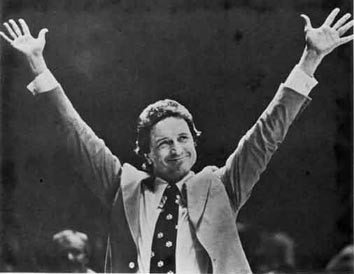
Normally I don’t conduct interviews at urinals. First of all, at least in my case, it’s difficult to take notes. But urinal etiquette usually calls for a couple of guys to brag about the number of Buds passing through or complain that the Cubs haven’t been the same since Ernie Banks last played two.
It’s generally a guy thing as well. And in most cases, I prefer it that way.
“So, Flap, what’s this have to do with going to the bathroom at a local university the other day?” you might ask if you were reading my mind or had been with me.
As “journalist-in-residence” at one of our fine universities in Nashville, I teach young people about writing, ethics, AP style and also advise the student news web site.
And when I’m not talking with these bright young people or drinking Pepsi Maxx, I’ll occasionally – like many of my friends across the U.S., including in Libya and our other recent acquisitions – take a bathroom break.
Other than the every third or fourth decade occurrence, like when I’m chatting with Al McGuire about Magic Johnson and personal hair styles – Al was of the slicked-back persuasion and I am, well something altogether different – I try to pay attention to my own business when in the john.
I’m sure women do the same, but I’ve never been one (although I remain an avid fan), so am not sure what goes on in the women’s restrooms. I have seen couches in there, which does give me pause to wonder just what kind of lurid things are happening in there. But it’s none of my business.
Speaking of minding my business, that’s what I was doing the other day at the university when a when a young man – wearing a T-shirt proclaiming allegiance to God and country – stepped up two urinals away and turned on the speaker function on his iPhone, so he could have a loud conversation with his girlfriend while he was going to the bathroom.
Between the “I’m sorrys” and “I love yous” and “I can’t wait to see yous” and “what did your parents say when they found out” conversation bouncing off the tile walls, well I have to tell you I felt violated. The girl’s voice was so loud that it was as if she was in there too.
And I personally couldn’t believe this young man – a smart and rich young college lad I’m sure – would continue his elimination process while love-cooing his girlfriend. I mean, I’m all for multi-tasking….
Few call me a prude … with good reason and reputation, I’m afraid … but this whole thing turned me against iPhones. If I’d been at Greer Stadium, where they have those big troughs, I’d probably have knocked the phone in there. The girl’s voice would have faded into the sea of recycled Buds.
Which brings me back to Al McGruire in the restroom at the Murphy Center in Murfreesboro back in 1979.
It was my favorite time to be a sportswriter, as generally the first round of the NCAA tournament would be played within a couple hour’s drive. It would be in Murfreesboro, Tenn., or Bowling Green, Ky., and once we even went over to Lexington to watch the first weekend’s games and then the following week’s Regionals.
What was special about these tournaments was that, to a young sportswriter/editor, I got to spend time with the best young athletes and broadcasters, watch remarkable basketball and, if necessary, eat for free in the media lounge.
On that particular weekend in 1979 I was in Mufreesboro primarily because I wanted to see Earvin “Magic” Johnson and his pal, Greg Kelser (the only Spartan to ever score 2,000 points and 1,000 rebounds ) tear into Lamar (Not ALEXANDER … the University … although I’d have gladly watched them tear into the governor as well.)
I’d also been a huge fan of Al McGuire, especially liking it when he reamed out Billy Packer. Hey, Al’s dead. Don’t be silly: Whatever happened to Billy?
Al didn’t hold himself as better than anyone. He and I had just ended up in the same bathroom because back then, the NCAA tournament was not owned by General Electric, Disney World, Gannett, CBS, the oil cartels and the law enforcement Taliban. Even small-time newspaper sports editors and their pals were afforded press credentials without fingerprinting, genital fondling, DNA analysis and blowing into a blood-alcohol machine (a fortunate thing in many cases).
It was in the era of “jump balls.” Remember them? If so, I’m sorry for you. You are pretty damned old.
Anyway, I wanted to talk to Al for one of my slices of life columns I was providing from this tournament. I was covering the games, but I also was writing color stories.
Which would be the only reason I’d ever go into a press conference held by Bobby Knight and ask what he’d tell me was a stupid question. You know, all I did was ask him why he was such a turd. The answer was obvious to us all, and I don’t think he took particular objection. But every question was stupid then for Bobby, long before they tarred and feathered him and ran him out of Bloomington, Ind., in a straitjacket with a bottle rocket up his butt.
But then there was Al McGuire, who coached his Marquette team – a gang of very skilled pseudo-Catholic outlaws – to an NCAA championship in 1977 and retired to the broadcast booth.
He was a likable coach, who proved even more likable behind the microphone. And since I’d won $136 on the Marquette victory (office pools were illegal back then .. .much as they are today), I really liked the guy. After all, he and “Bo” Ellis and the gang had defeated Dean Smith’s Tarballs for the championship.
Anyway, let’s get right to the point, as my pal, Tom Petty, likes to say, I found myself standing at the urinal next to Al McGuire in between games.
Since this was one time when I was alone with one of the great characters in basketball history, I decided to conduct an interview. I mean, I already at that point in my life had spent days with Muhammad Ali (clothed and unclothed – him not me), John Wooden (generally well-clothed), Henry Aaron (in a nice suit), Joe Montana (wearing a dozen Super Bowl rings) and O.J. Simpson (who kept sharpening his knife on his shoe soles while we spoke).
So, with Al, well, I just started chatting. We had bladders filled and so there was time to talk about basketball, about Magic and about his championship season. It was obvious to me that we’d both had our share of “Tab” back in the media lounge. Remember “Tab”? Tasted like Diet Coke.
After we zipped up that conversation, we converged on the single sink. I always wash my hands. Not just after I use the facilities, but always. In fact there are times when my hands turn raw from the repeated washing. Yes, I am the lunatic you’re looking for.
There was just the one sink, so Al and I washed our hands together. Soap brothers. Then he smiled and looked at my shock of hair. My hair, although somewhat shorter back then and almost black, always has exceeded societal-norm standards.
“I guess you don‘t use one of these, do you?” he said, as he pulled a comb from behind the hanky in his breast pocket. “See, you go like this….”
At which point one of the great basketball coaches in NCAA history gave me lessons on combing hair while I finally retrieved my notebook from my back pocket and began scribbling down notes.
“Well, Tim, I gotta get back to work. See what happens in the next game,” he said, as we shook clean hands and walked back toward press row.
Probably nowadays, sports announcers have security clear the rest rooms so long-haired smalltown journalists won’t bother them in their hour of darkness. For all I know Billy Packer left broadcasting not just because he insulted Duke students and alienated almost everyone but because he was afraid I’d catch up to him one day in the john.
I loved Al McGuire and Marquette, and his street-guy-gentlemanly ease with a young reporter proved his image was just him being him. And the urinal interview would have been the capper on a great weekend.
But then, as Al walked away, I looked up, and there was Magic Johnson, standing in front of me, in the hallway.
He’d already done his dog-and-pony press conference, his NCAA duties, smiling and capturing hearts, just as he did the remainder of his ball-playing years.
He had no reason to stop when I asked him if he had time. Course he was standing in front of me, but much lesser athletes and musicians and politicians have ignored me and wandered off, haven’t you Senator Sasser, Mickey Mantle (course you were drunk), Toby Keith and Al Gore.
I looked up at the guy blocking the hallway, who was, to my way of thinking, the best, most-complete basketball player on the planet. And he was there with Kelser, his support man.
This was long before Magic became famous for contracting HIV. Long before he took over the helm of the Los Angeles Lakers after Jabbar went down and guided them – from the center spot – to a world championship.
He was just a big kid, a sophomore in college, and that day he and Kelser had put on a Globe Trotter-worthy exhibition, crushing Lamar, 95-64, in the second-round of the Mideast Regionals.
During my life, I’ve covered a lot of basketball games and met a lot of ballplayers. But, other than James “Fly” Williams, who was a gunslinger for then-outlaw school Austin Peay State University, none of them had a bigger smile than Magic.
And, to be fair, Fly’s smile was enhanced by the fact he was snaggle-toothed. His Peay pals apparently didn’t take care of his dental work. He became a friend of mine and sometime I’ll go up to see if he’s still alive in New York City.
That’s another long story and I may get to it today or it may be next time. Or later on to be sure.
Because this one really is about Magic. Well, about Al McGuire and Magic.
I’ve been thinking a lot about both men as this NCAA tournament – as Al called it “The Big Effin’ Dance” -- progresses.
I love basketball, but there never has been another player who could not only dominate a game but capture hearts like Magic Johnson.
I saw Michael Jordan in the rafters up in the Charlotte Mausoleum the other day and it made me think two things.
No. 1, Michael Jordan was a great basketball player and I loved to watch him play. But I don’t think I’d like to know him, as I’m a Fruit of the Looms guy.
No. 2, Magic Johnson was better. And I am glad I got to know him a little bit back during his playing days.
For me that 1979 season, which ended up with the storied Bird-Magic showdown – won by Magic – may have been college basketball at its best. I later met Bird, and he too seemed like a nice guy, even when I laughed at him for growing up in French Lick.
Anyway, after our conversation, Magic told me he wanted to watch some basketball. So I let him go.
A few minutes later I walked back into the arena, and was looking for a place to sit in the stands. Magic and Greg Kelser waved me up to sit with them.
So I did. Just a scruffy-haired sports editor, wearing Acme cowboy boots, sitting up in the stands watching basketball games with Magic Johnson.
And, a few rows below, Al McGuire was sipping on a Tab.
Besides that, we both were raised in the North, loved basketball and had just relished watching a young and lean Earvin “Magic” Johnson offer proof that he was the best basketball player in the universe.
I was looking for some happy banter, anyway, as I had just been talking to Bobby Knight and was feeling the need to escape that egotistical throw-a-chair-across-the-court hangover funk that resulted.
And Al, well, he was such a contrast to the perhaps brilliant, but erratic, Knight, who these 32 years later has said “Jimmy Tressel represents all that’s good about college athletics” or some such. That’s another story, of course. If that’s true, then Bruce Pearl also is a similarly stellar representation. Wonder if Pearl took that orange sport coat with him when escorted to the door at UT? Great for grilling out.
Normally I don’t conduct interviews at urinals. First of all, at least in my case, it’s difficult to take notes. But urinal etiquette usually calls for a couple of guys to brag about the number of Buds passing through or complain that the Cubs haven’t been the same since Ernie Banks last played two.
It’s generally a guy thing as well. And in most cases, I prefer it that way.
“So, Flap, what’s this have to do with going to the bathroom at a local university the other day?” you might ask if you were reading my mind or had been with me.
As “journalist-in-residence” at one of our fine universities in Nashville, I teach young people about writing, ethics, AP style and also advise the student news web site.
And when I’m not talking with these bright young people or drinking Pepsi Maxx, I’ll occasionally – like many of my friends across the U.S., including in Libya and our other recent acquisitions – take a bathroom break.
Other than the every third or fourth decade occurrence, like when I’m chatting with Al McGuire about Magic Johnson and personal hair styles – Al was of the slicked-back persuasion and I am, well something altogether different – I try to pay attention to my own business when in the john.
I’m sure women do the same, but I’ve never been one (although I remain an avid fan), so am not sure what goes on in the women’s restrooms. I have seen couches in there, which does give me pause to wonder just what kind of lurid things are happening in there. But it’s none of my business.
Speaking of minding my business, that’s what I was doing the other day at the university when a when a young man – wearing a T-shirt proclaiming allegiance to God and country – stepped up two urinals away and turned on the speaker function on his iPhone, so he could have a loud conversation with his girlfriend while he was going to the bathroom.
Between the “I’m sorrys” and “I love yous” and “I can’t wait to see yous” and “what did your parents say when they found out” conversation bouncing off the tile walls, well I have to tell you I felt violated. The girl’s voice was so loud that it was as if she was in there too.
And I personally couldn’t believe this young man – a smart and rich young college lad I’m sure – would continue his elimination process while love-cooing his girlfriend. I mean, I’m all for multi-tasking….
Few call me a prude … with good reason and reputation, I’m afraid … but this whole thing turned me against iPhones. If I’d been at Greer Stadium, where they have those big troughs, I’d probably have knocked the phone in there. The girl’s voice would have faded into the sea of recycled Buds.
Which brings me back to Al McGruire in the restroom at the Murphy Center in Murfreesboro back in 1979.
It was my favorite time to be a sportswriter, as generally the first round of the NCAA tournament would be played within a couple hour’s drive. It would be in Murfreesboro, Tenn., or Bowling Green, Ky., and once we even went over to Lexington to watch the first weekend’s games and then the following week’s Regionals.
What was special about these tournaments was that, to a young sportswriter/editor, I got to spend time with the best young athletes and broadcasters, watch remarkable basketball and, if necessary, eat for free in the media lounge.
On that particular weekend in 1979 I was in Mufreesboro primarily because I wanted to see Earvin “Magic” Johnson and his pal, Greg Kelser (the only Spartan to ever score 2,000 points and 1,000 rebounds ) tear into Lamar (Not ALEXANDER … the University … although I’d have gladly watched them tear into the governor as well.)
I’d also been a huge fan of Al McGuire, especially liking it when he reamed out Billy Packer. Hey, Al’s dead. Don’t be silly: Whatever happened to Billy?
Al didn’t hold himself as better than anyone. He and I had just ended up in the same bathroom because back then, the NCAA tournament was not owned by General Electric, Disney World, Gannett, CBS, the oil cartels and the law enforcement Taliban. Even small-time newspaper sports editors and their pals were afforded press credentials without fingerprinting, genital fondling, DNA analysis and blowing into a blood-alcohol machine (a fortunate thing in many cases).
It was in the era of “jump balls.” Remember them? If so, I’m sorry for you. You are pretty damned old.
Anyway, I wanted to talk to Al for one of my slices of life columns I was providing from this tournament. I was covering the games, but I also was writing color stories.
Which would be the only reason I’d ever go into a press conference held by Bobby Knight and ask what he’d tell me was a stupid question. You know, all I did was ask him why he was such a turd. The answer was obvious to us all, and I don’t think he took particular objection. But every question was stupid then for Bobby, long before they tarred and feathered him and ran him out of Bloomington, Ind., in a straitjacket with a bottle rocket up his butt.
But then there was Al McGuire, who coached his Marquette team – a gang of very skilled pseudo-Catholic outlaws – to an NCAA championship in 1977 and retired to the broadcast booth.
He was a likable coach, who proved even more likable behind the microphone. And since I’d won $136 on the Marquette victory (office pools were illegal back then .. .much as they are today), I really liked the guy. After all, he and “Bo” Ellis and the gang had defeated Dean Smith’s Tarballs for the championship.
Anyway, let’s get right to the point, as my pal, Tom Petty, likes to say, I found myself standing at the urinal next to Al McGuire in between games.
Since this was one time when I was alone with one of the great characters in basketball history, I decided to conduct an interview. I mean, I already at that point in my life had spent days with Muhammad Ali (clothed and unclothed – him not me), John Wooden (generally well-clothed), Henry Aaron (in a nice suit), Joe Montana (wearing a dozen Super Bowl rings) and O.J. Simpson (who kept sharpening his knife on his shoe soles while we spoke).
So, with Al, well, I just started chatting. We had bladders filled and so there was time to talk about basketball, about Magic and about his championship season. It was obvious to me that we’d both had our share of “Tab” back in the media lounge. Remember “Tab”? Tasted like Diet Coke.
After we zipped up that conversation, we converged on the single sink. I always wash my hands. Not just after I use the facilities, but always. In fact there are times when my hands turn raw from the repeated washing. Yes, I am the lunatic you’re looking for.
There was just the one sink, so Al and I washed our hands together. Soap brothers. Then he smiled and looked at my shock of hair. My hair, although somewhat shorter back then and almost black, always has exceeded societal-norm standards.
“I guess you don‘t use one of these, do you?” he said, as he pulled a comb from behind the hanky in his breast pocket. “See, you go like this….”
At which point one of the great basketball coaches in NCAA history gave me lessons on combing hair while I finally retrieved my notebook from my back pocket and began scribbling down notes.
“Well, Tim, I gotta get back to work. See what happens in the next game,” he said, as we shook clean hands and walked back toward press row.
Probably nowadays, sports announcers have security clear the rest rooms so long-haired smalltown journalists won’t bother them in their hour of darkness. For all I know Billy Packer left broadcasting not just because he insulted Duke students and alienated almost everyone but because he was afraid I’d catch up to him one day in the john.
I loved Al McGuire and Marquette, and his street-guy-gentlemanly ease with a young reporter proved his image was just him being him. And the urinal interview would have been the capper on a great weekend.
But then, as Al walked away, I looked up, and there was Magic Johnson, standing in front of me, in the hallway.
He’d already done his dog-and-pony press conference, his NCAA duties, smiling and capturing hearts, just as he did the remainder of his ball-playing years.
He had no reason to stop when I asked him if he had time. Course he was standing in front of me, but much lesser athletes and musicians and politicians have ignored me and wandered off, haven’t you Senator Sasser, Mickey Mantle (course you were drunk), Toby Keith and Al Gore.
I looked up at the guy blocking the hallway, who was, to my way of thinking, the best, most-complete basketball player on the planet. And he was there with Kelser, his support man.
This was long before Magic became famous for contracting HIV. Long before he took over the helm of the Los Angeles Lakers after Jabbar went down and guided them – from the center spot – to a world championship.
He was just a big kid, a sophomore in college, and that day he and Kelser had put on a Globe Trotter-worthy exhibition, crushing Lamar, 95-64, in the second-round of the Mideast Regionals.
During my life, I’ve covered a lot of basketball games and met a lot of ballplayers. But, other than James “Fly” Williams, who was a gunslinger for then-outlaw school Austin Peay State University, none of them had a bigger smile than Magic.
And, to be fair, Fly’s smile was enhanced by the fact he was snaggle-toothed. His Peay pals apparently didn’t take care of his dental work. He became a friend of mine and sometime I’ll go up to see if he’s still alive in New York City.
That’s another long story and I may get to it today or it may be next time. Or later on to be sure.
Because this one really is about Magic. Well, about Al McGuire and Magic.
I’ve been thinking a lot about both men as this NCAA tournament – as Al called it “The Big Effin’ Dance” -- progresses.
I love basketball, but there never has been another player who could not only dominate a game but capture hearts like Magic Johnson.
I saw Michael Jordan in the rafters up in the Charlotte Mausoleum the other day and it made me think two things.
No. 1, Michael Jordan was a great basketball player and I loved to watch him play. But I don’t think I’d like to know him, as I’m a Fruit of the Looms guy.
No. 2, Magic Johnson was better. And I am glad I got to know him a little bit back during his playing days.
For me that 1979 season, which ended up with the storied Bird-Magic showdown – won by Magic – may have been college basketball at its best. I later met Bird, and he too seemed like a nice guy, even when I laughed at him for growing up in French Lick.
Anyway, after our conversation, Magic told me he wanted to watch some basketball. So I let him go.
A few minutes later I walked back into the arena, and was looking for a place to sit in the stands. Magic and Greg Kelser waved me up to sit with them.
So I did. Just a scruffy-haired sports editor, wearing Acme cowboy boots, sitting up in the stands watching basketball games with Magic Johnson.
And, a few rows below, Al McGuire was sipping on a Tab.
Subscribe to:
Posts (Atom)


